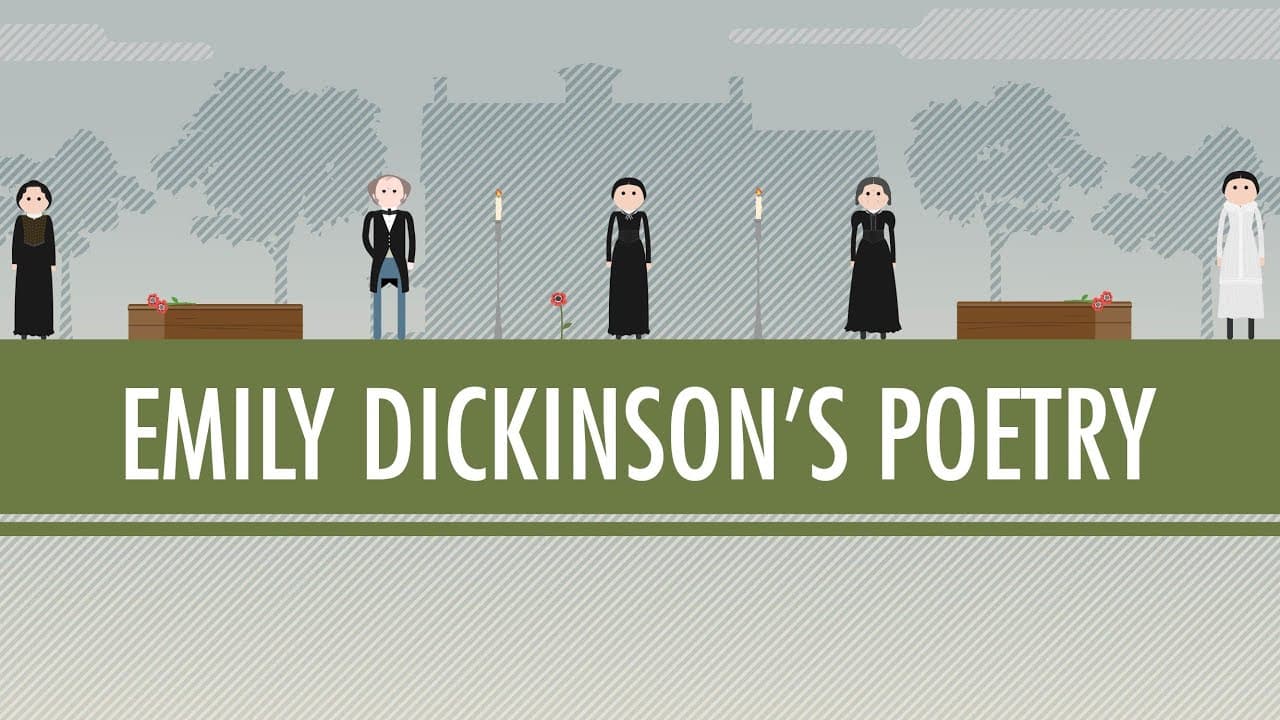
Before I Got My Eye Put Out - The Poetry of Emily Dickinson: Crash Course English Literature #8
TL;DR
John Green analyzes Emily Dickinson's paradoxical poetry and life.
Transcript
Hi I'm John Green, this is Crash Course Literature, and today we're gonna talk about this lady, Emily Dickinson. By the way we don't have a book today cause she's on my Nook. Emily Dickinson was a great 19th Century American poet who- Mr. Green! Mr. Green! I already know everything about her: she was a recluse and you can sing all of her poems to t... Read More
Key Insights
- Emily Dickinson's poetry often explores themes of life, death, faith, and doubt, reflecting a complex worldview.
- Her poems can be sung to tunes like 'I'd Like to Buy the World a Coke,' but their meter is more intricate.
- Dickinson's use of paradox in her poetry can be challenging, as she often contradicts herself within a single poem.
- The poet's use of sight as a metaphor extends beyond literal vision to encompass understanding and ownership.
- Dickinson's reclusiveness and eccentricity, such as her preference for wearing white, contribute to her enigmatic image.
- Her poetry often employs slant rhymes and unconventional punctuation, like dashes, to convey deeper meanings.
- The poem 'I Heard a Fly Buzz When I Died' highlights Dickinson's preoccupation with death and the unexpected nature of its arrival.
- Despite her reclusive life, Dickinson's poetry resonates with universal themes, making her work enduringly relevant.
Install to Summarize YouTube Videos and Get Transcripts
Explore YouTube Video Summarizer or Get YouTube Transcript Extractor
Questions & Answers
Q: What are some themes explored in Emily Dickinson's poetry?
Emily Dickinson's poetry explores themes such as life and death, faith and doubt, and the power of observation and understanding. Her work often reflects a complex and paradoxical worldview, challenging readers to consider the interplay between individual agency and divine influence.
Q: How does Dickinson use sight as a metaphor in her poetry?
In Dickinson's poetry, sight is not just a literal sense but a metaphor for understanding and ownership. She associates the ability to see with power and self-expression, as seen in her poem 'Before I Got My Eye Put Out,' where sight symbolizes control over the natural world and personal insight.
Q: What is unique about Dickinson's use of punctuation in her poems?
Dickinson's use of punctuation, particularly her distinctive dashes, is often seen as a reflection of her poetic style and thought process. These dashes can symbolize pauses or interruptions in thought, adding a layer of complexity to her work. Some critics view them as a way to convey the workings of the mind.
Q: How does Dickinson's poem 'I Heard a Fly Buzz When I Died' depict death?
In 'I Heard a Fly Buzz When I Died,' Dickinson depicts death as an unexpected and mundane event, symbolized by the intrusion of a fly. The poem contrasts the anticipated arrival of a divine presence with the reality of a trivial interruption, highlighting the unpredictability of death.
Q: What role does paradox play in Dickinson's poetry?
Paradox is a central element in Dickinson's poetry, as she often presents conflicting ideas within a single poem. This use of paradox challenges readers to engage with the complexity of her themes, such as faith versus science and life versus death, without offering straightforward conclusions.
Q: Why is Emily Dickinson considered an enigmatic figure?
Emily Dickinson is considered enigmatic due to her reclusive lifestyle and eccentricities, such as her preference for wearing white and her limited interactions with the outside world. These aspects of her life, combined with the depth and complexity of her poetry, contribute to her mysterious persona.
Q: How does Dickinson's poetry remain relevant today?
Dickinson's poetry remains relevant today because it addresses universal themes and emotions, such as the nature of existence, the search for meaning, and the tension between individuality and collective beliefs. Her innovative use of language and form continues to resonate with modern readers.
Q: What is the significance of slant rhyme in Dickinson's work?
Slant rhyme in Dickinson's work creates a sense of unease and tension, reflecting the unresolved nature of the themes she explores. This technique allows her to challenge traditional poetic forms and engage readers in a deeper contemplation of her subject matter, enhancing the emotional impact of her poems.
Summary & Key Takeaways
-
John Green delves into Emily Dickinson's poetry, highlighting her exploration of themes like death, faith, and individuality. He discusses her use of paradox and unconventional punctuation, which adds depth to her work. Dickinson's reclusive lifestyle and preference for wearing white have contributed to her mysterious image.
-
Dickinson's poetry, characterized by slant rhymes and intricate meter, often reflects on the power of sight, both literal and metaphorical. Her work challenges readers with its paradoxical nature, as she frequently juxtaposes faith and science, life and death, creating a rich tapestry of meaning.
-
In 'I Heard a Fly Buzz When I Died,' Dickinson portrays death as an unexpected interruption, symbolized by a fly. The poem exemplifies her formal style, with a precise meter and rhyme scheme, offering a glimpse into her fascination with mortality and the human experience.
Read in Other Languages (beta)
Share This Summary 📚
Summarize YouTube Videos and Get Video Transcripts with 1-Click
Try YouTube Summary with ChatGPT & Claude or YouTube Transcript Generator
Explore More Summaries from CrashCourse 📚





Summarize YouTube Videos and Get Video Transcripts with 1-Click
Try YouTube Summary with ChatGPT & Claude or YouTube Transcript Generator