Partial quotient method of division | Multiplication and division | Arithmetic | Khan Academy
TL;DR
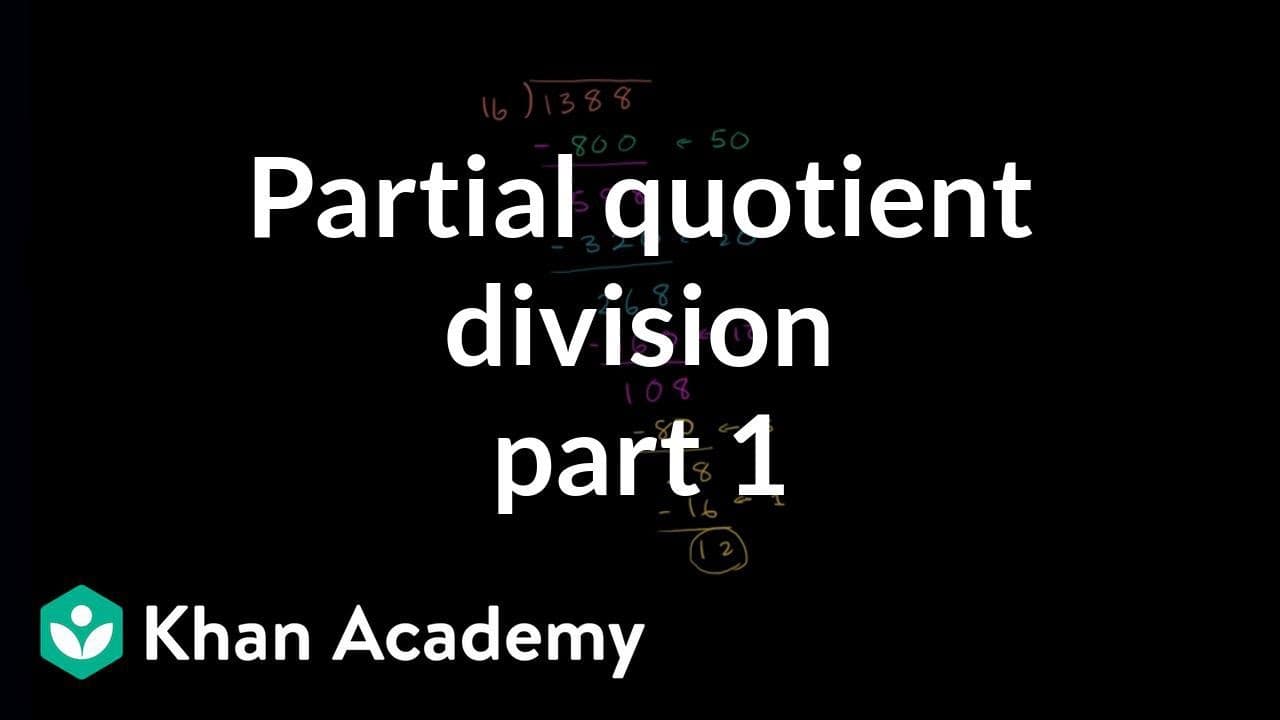
Learn two different methods for solving long division problems involving 16, with one method allowing for more approximation.
Transcript
Let's say we need to figure out how many times 16 goes into 1,388. And what I want to do is first think about how we traditionally solve a problem like this and then introduce another method that allows for a little bit more approximation. So traditionally you would say, well, 16 does not go into 1 any times. So then you move over one spot. Well, h... Read More
Key Insights
- ➗ Long division is a common method for dividing numbers, especially when dealing with whole numbers and remainders.
- 🥡 The traditional method requires precise calculation at each step, taking into account each digit of the dividend.
- 👻 The approximation method provides a more flexible and simplified approach, allowing for estimation and educated guessing.
- 🐎 Using multiples of the divisor to approximate chunks of the dividend can speed up the calculation process.
- ✋ The approximation method may introduce higher levels of approximation error compared to the traditional method.
- ➗ Both methods ultimately arrive at the correct quotient and remainder for the division problem.
- 💦 The approximation method is particularly useful when an exact quotient is not essential or when working with large numbers.
Install to Summarize YouTube Videos and Get Transcripts
Explore YouTube Video Summarizer or Get YouTube Transcript Extractor
Questions & Answers
Q: What is the traditional method of performing long division?
The traditional method involves dividing each digit of the dividend by the divisor, starting from the leftmost digit and working to the right. Trial and error is often necessary to find the correct quotient digit.
Q: How does the approximation method differ from the traditional method?
The approximation method allows for more estimation and educated guessing. Instead of focusing on individual digits, chunks of the dividend are divided, using multiples of the divisor to simplify calculations.
Q: Why might the approximation method be useful?
The approximation method can be useful when working with larger numbers or when an exact quotient is not required. It allows for faster calculations and provides a reasonable approximation of the actual quotient.
Q: Do both methods guarantee the same result?
While the methods may yield different quotients at each step, they ultimately arrive at the same final result. The approximation method allows for more flexibility in the calculations but may introduce some approximation errors.
Summary & Key Takeaways
-
The traditional method of long division involves dividing each digit of the dividend by the divisor, starting from the leftmost digit and working to the right.
-
An alternative approximation method involves making educated guesses for how many times the divisor goes into chunks of the dividend, using multiples of the divisor to simplify calculations.
Read in Other Languages (beta)
Share This Summary 📚
Summarize YouTube Videos and Get Video Transcripts with 1-Click
Try YouTube Summary with ChatGPT & Claude or YouTube Transcript Generator
Explore More Summaries from Khan Academy 📚



Summarize YouTube Videos and Get Video Transcripts with 1-Click
Try YouTube Summary with ChatGPT & Claude or YouTube Transcript Generator