Sine of time
TL;DR
This video introduces the concept of sinusoids and frequency in electrical signals, highlighting their importance in understanding and analyzing various phenomena in nature and electronic systems.
Transcript
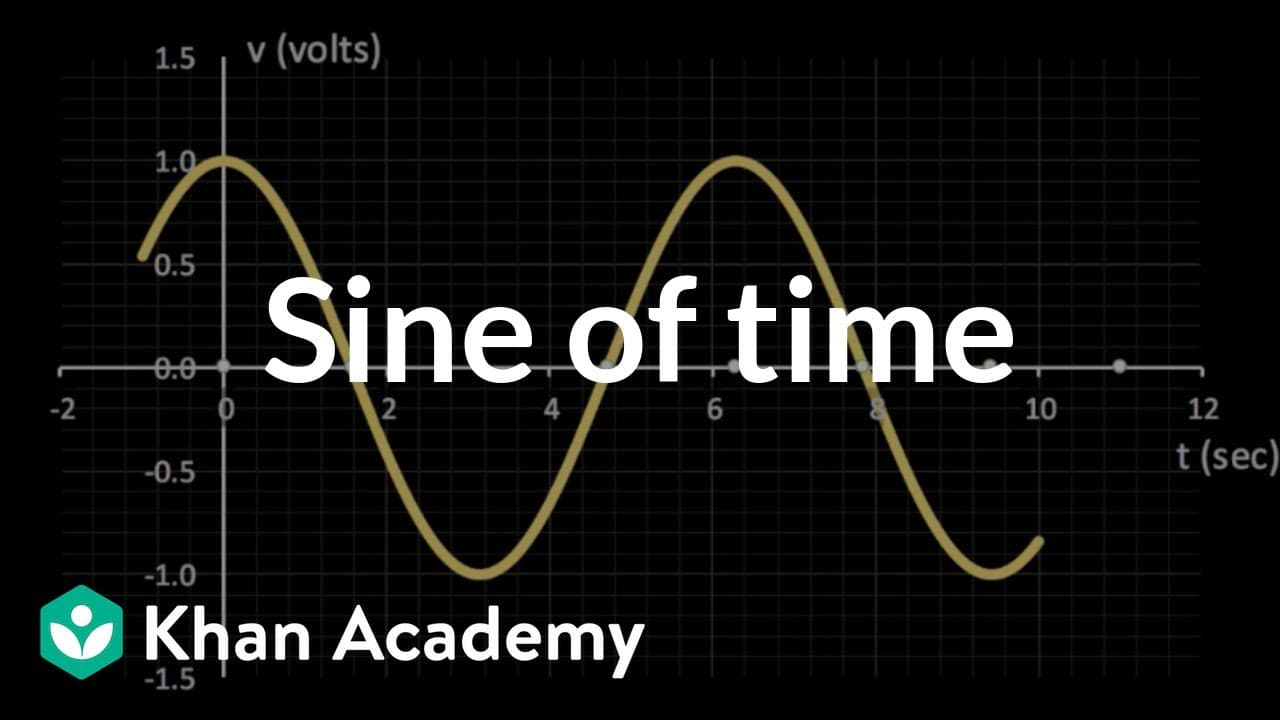
- [Voiceover] Now I wanna introduce a new idea, and that is the idea of voltage or current, some electrical signal being a function of time, cosine of omega t. So here what we're doing is we're introducing time as the argument to a cosine. And time is that stuff that always goes up, this is a number that increases forever. And we have another varia... Read More
Key Insights
- 🖐️ Sinusoids, represented by the cosine of an argument that is a function of time, are widely used to model natural phenomena and play a crucial role in electronic systems.
- ⌛ The argument of the cosine function, omega, is a dimensionless constant and represents 1/time.
- 🏍️ The period of a sinusoid is the recurring interval of the waveform, while the frequency indicates the number of cycles per second.
- 📐 Frequency is measured in Hertz (Hz), a unit named after Heinrich Hertz, and can be converted to angular frequency (radians per second) using the equation omega = 2πf.
Install to Summarize YouTube Videos and Get Transcripts
Explore YouTube Video Summarizer or Get YouTube Transcript Extractor
Questions & Answers
Q: Why are sine waves and cosine waves commonly used in electronic systems?
Sine and cosine waves are often encountered in electronic systems because they accurately model many natural phenomena, including pure tones or notes produced by musical instruments, bells, whistles, and even human singing. These waves provide a convenient mathematical representation for analyzing and manipulating various signals.
Q: How can the period of a sinusoid be determined graphically?
The period of a sinusoid can be determined by identifying the repeating interval of the waveform. This can be done by observing the points where the waveform crosses the horizontal axis. The distance between any two consecutive zero-crossings corresponds to one period of the sinusoid.
Q: What is the significance of frequency and how is it measured?
Frequency refers to the number of cycles a sinusoid completes in one second. It is measured in Hertz (Hz), which is equivalent to cycles per second. A higher frequency indicates a more rapid oscillation or repetition rate of the sinusoid.
Q: How does the conversion factor between frequency (f) and angular frequency (omega) help in understanding sinusoids?
The conversion factor, omega = 2πf, allows for easy interchange between frequency (measured in cycles per second) and angular frequency (measured in radians per second). This relationship is useful for expressing sinusoids in different forms and for performing calculations between the two measures.
Summary & Key Takeaways
-
The video explains that a sinusoid is a continuously changing waveform represented by the cosine of an argument that is a function of time. It is commonly used to model natural phenomena and is encountered in electronic systems.
-
The argument of the cosine function, called omega, has the units of 1/time and is a dimensionless constant that allows for the unit-less output of the cosine wave.
-
The period of a sinusoid is the repeating interval of the waveform, represented by the symbol T, and it is the time it takes to complete one cycle. The frequency, measured in Hertz (Hz), is the number of cycles per second.
-
The relationship between frequency (f) and angular frequency (omega) is omega = 2πf, allowing for conversion between cycles per second and radians per second.
Read in Other Languages (beta)
Share This Summary 📚
Summarize YouTube Videos and Get Video Transcripts with 1-Click
Try YouTube Summary with ChatGPT & Claude or YouTube Transcript Generator
Explore More Summaries from Khan Academy 📚



Summarize YouTube Videos and Get Video Transcripts with 1-Click
Try YouTube Summary with ChatGPT & Claude or YouTube Transcript Generator