The Third Amendment | The National Constitution Center | US government and civics | Khan Academy
TL;DR
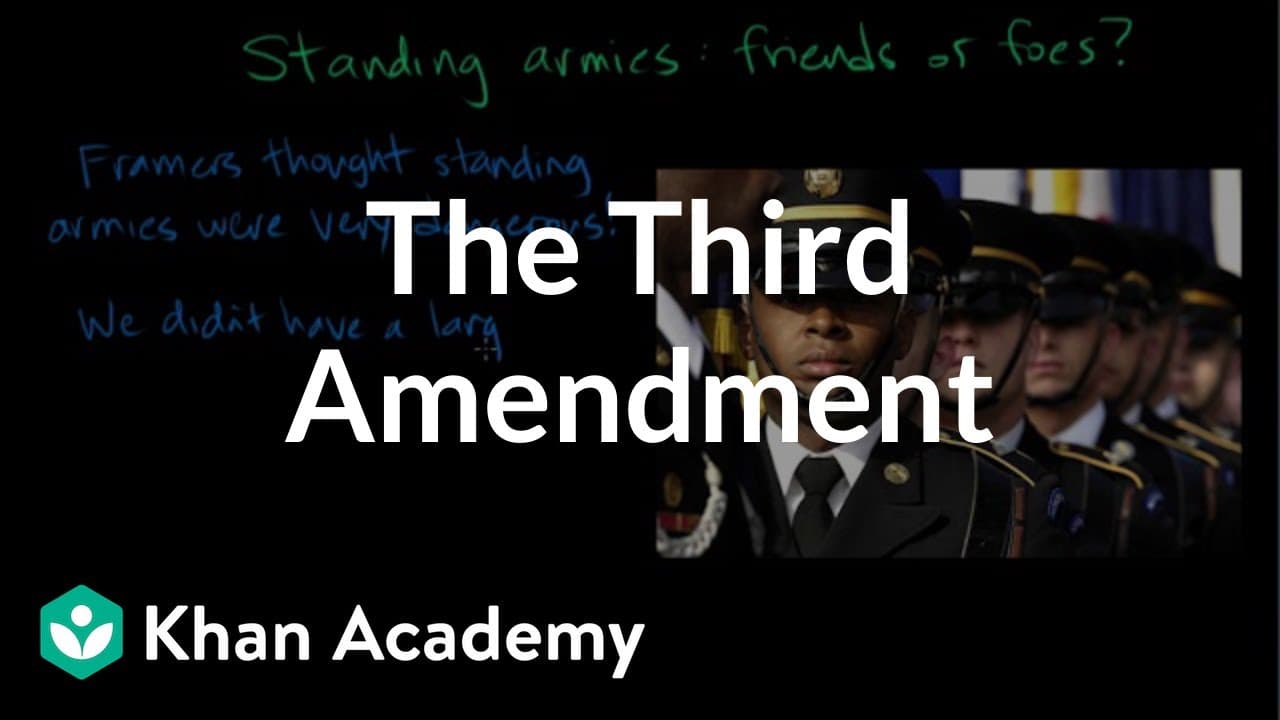
The Third Amendment prevents soldiers from being quartered in American homes and has historical significance, but its relevance today is limited.
Transcript
- [Kim] Hi, this is Kim from Khan Academy and today, I'm learning more about the Third Amendment to the U.S. Constitution, which states that no soldier shall, in time of peace, be quartered in any house without the consent of the owner, nor in time of war, but in a manner to be prescribed by law. This amendment clearly draws its inspiration from th... Read More
Key Insights
- 🌓 The Third Amendment was a response to abuses of quartering soldiers by the British monarchy during the colonial period.
- 😨 It reflected the fear of standing armies and the importance of protection against intrusion into private homes.
Install to Summarize YouTube Videos and Get Transcripts
Explore YouTube Video Summarizer or Get YouTube Transcript Extractor
Questions & Answers
Q: Why did the framers of the Constitution consider the issue of quartering soldiers important enough to include it in the Bill of Rights?
The English civil wars of the 17th century, where troops were quartered as a form of punishment, influenced the framers' views. They wanted to prevent the government from using soldiers to invade the privacy of citizens' homes and establish its authority.
Q: What were the negative consequences of having soldiers quartered in homes during that time?
Soldiers during that era were often unruly and had a criminal background. They would take liberties, cause nuisances, and disrupt the daily lives of homeowners. Having the government's troops in their living rooms and bedrooms was offensive and problematic.
Q: Was the Quartering Act of 1774 a significant factor in triggering the American Revolution?
The Quartering Act of 1774 was not the sole cause of the Revolution, but it added to the growing discontent among colonists. It exemplified the colonists' perception of being treated as second-class citizens without the same rights as those in England.
Q: Has the Third Amendment had any impact in modern times?
The Third Amendment has rarely been directly invoked or enforced by the courts. However, it is occasionally cited in cases involving privacy rights, such as the Supreme Court's ruling in Griswold v. Connecticut.
Summary & Key Takeaways
-
The Third Amendment to the U.S. Constitution prohibits the government from quartering soldiers in private homes without the owner's consent, which was a significant issue during the American Revolution.
-
The framers included this amendment in the Bill of Rights due to the abuse of quartering troops by the British monarchy.
-
The possibility of soldiers being quartered in homes was a concern even after the Revolution, and there is evidence that it occurred during the Civil War.
Read in Other Languages (beta)
Share This Summary 📚
Summarize YouTube Videos and Get Video Transcripts with 1-Click
Try YouTube Summary with ChatGPT & Claude or YouTube Transcript Generator
Explore More Summaries from Khan Academy 📚



Summarize YouTube Videos and Get Video Transcripts with 1-Click
Try YouTube Summary with ChatGPT & Claude or YouTube Transcript Generator