2011 Calculus AB free response #5c. | AP Calculus AB | Khan Academy
TL;DR
Learn how to solve a differential equation by separating the independent and dependent variables and integrating both sides.
Transcript
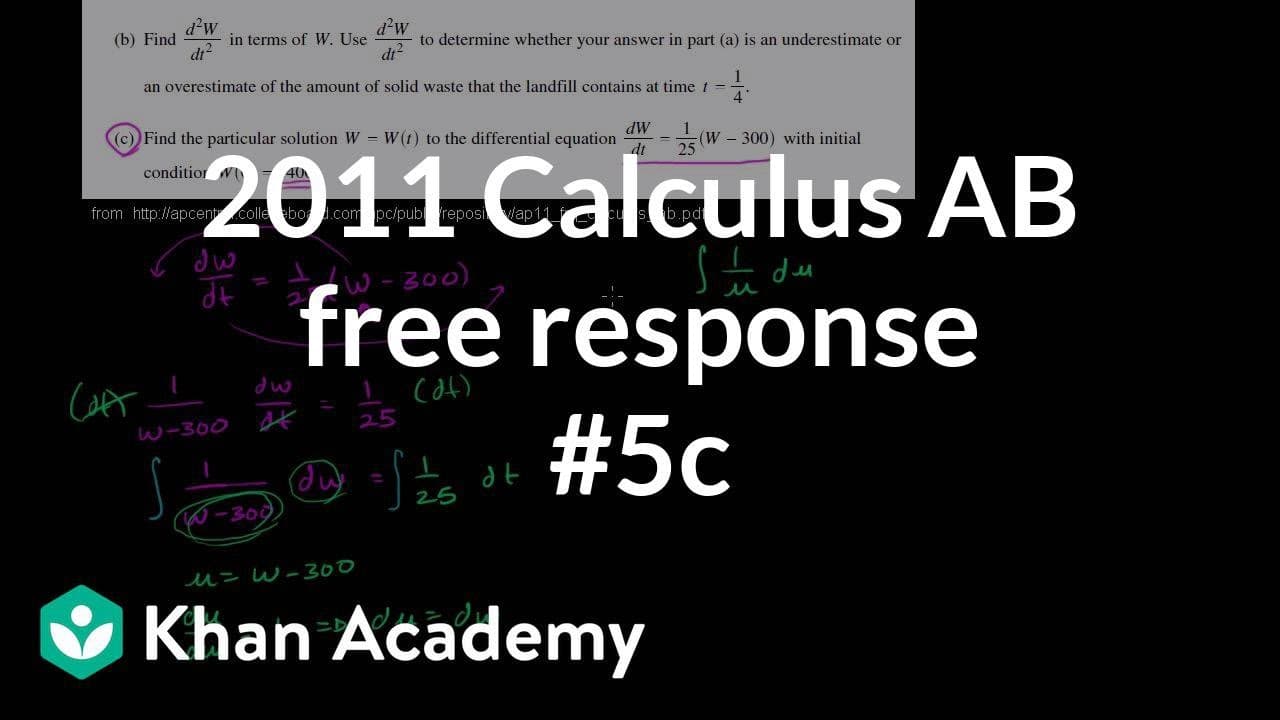
Part C, find the particular solution-- W as a function of t-- to the differential equations, derivative of W with respect to t is equal to 1 over 25 times w minus 300, with initial condition, at time 0, W is equal to 1,400. And the units in this problem, it was 1,400 tons they told us. So it might seem strange to see a differential equations proble... Read More
Key Insights
- ❓ Differential equations on AP exams usually involve separable differential equations.
- 🙃 Separating variables involves isolating the dependent and independent variables on opposite sides of the equation.
- 🙃 Integrating both sides allows us to find the general solution of the differential equation.
- ❓ Initial conditions are used to determine any constants and find the particular solution.
- ❓ The natural logarithm is often involved in solving separable differential equations.
- 😑 The final solution can be expressed explicitly as a function of the independent variable.
- 😃 The solution to the specific example problem is w = 1100e^(t/25) + 300.
Install to Summarize YouTube Videos and Get Transcripts
Explore YouTube Video Summarizer or Get YouTube Transcript Extractor
Questions & Answers
Q: How can differential equations be solved using basic integration techniques?
Differential equations can be solved by rearranging the equation to separate the dependent and independent variables and integrating both sides. This allows us to find the general solution and use initial conditions to determine the particular solution.
Q: Why is it important to separate the variables in a differential equation?
Separating the variables allows us to treat the dependent and independent variables as separate entities, making it easier to integrate and solve the equation. It simplifies the process and allows us to find an explicit solution.
Q: How do initial conditions affect the solution to a differential equation?
Initial conditions serve as constraints that help find the particular solution to a differential equation. By plugging in the given initial values, we can determine the specific values for any constants in the general solution, resulting in a unique solution that satisfies the given conditions.
Q: What is the significance of the natural logarithm in solving this differential equation?
The natural logarithm arises from integrating the left-hand side of the differential equation. It allows us to express the relationship between w and t more explicitly and find the particular solution by applying exponential functions.
Summary & Key Takeaways
-
This video teaches how to solve a differential equation by separating the dependent and independent variables and integrating both sides.
-
The example problem involves finding the particular solution to the differential equation dw/dt = (1/25)(w - 300), with the initial condition that when t=0, w=1400.
-
By rearranging the equation and integrating both sides, the solution is found to be w = 1100e^(t/25) + 300.
Read in Other Languages (beta)
Share This Summary 📚
Summarize YouTube Videos and Get Video Transcripts with 1-Click
Try YouTube Summary with ChatGPT & Claude or YouTube Transcript Generator
Explore More Summaries from Khan Academy 📚



Summarize YouTube Videos and Get Video Transcripts with 1-Click
Try YouTube Summary with ChatGPT & Claude or YouTube Transcript Generator