Introduction to Trusses & its stability criteria
TL;DR
This content provides an introduction to trusses, including their types, stability criteria, and examples of truss structures.
Transcript
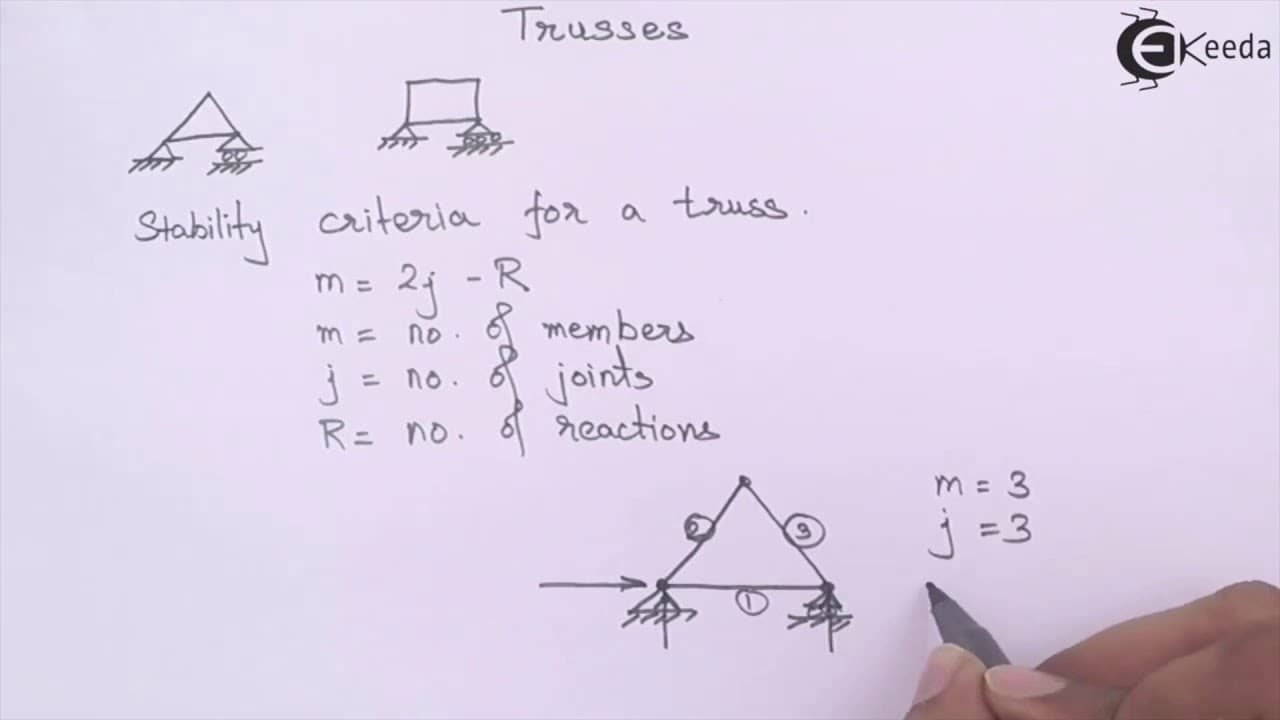
today i am going to talk about introduction of trusses different types of trusses the stability criteria required in the trusses what are trusses what are the different examples of trusses we will first discuss about that and then we will see how to solve a truss question this is the simplest form of a truss a triangular truss this is a rigid non-d... Read More
Key Insights
- 🫥 Trusses are common building structures, found in bridge designs and electrical transmission lines.
- #️⃣ The stability of a truss is determined by the number of members, joints, and reactions.
- 😆 If the stability criteria equation is satisfied, the truss is considered stable.
- ❓ A truss with fewer members than required is deficient and may not be stable.
- 🪜 Additional members can be added to a deficient truss to potentially increase stability.
- 🇩🇴 The equation M = 2J - R is used to calculate the stability criteria for a truss.
- 📐 Triangular trusses, square trusses, and redundant trusses are examples discussed in the content.
Install to Summarize YouTube Videos and Get Transcripts
Explore YouTube Video Summarizer or Get YouTube Transcript Extractor
Questions & Answers
Q: What is a truss and where are they commonly used?
Trusses are building structures that are rigid and non-deformable. They are frequently used in bridge designs and electrical transmission lines.
Q: How is the stability of a truss determined?
The stability of a truss can be determined using the stability criteria equation M = 2J - R, where M is the number of members, J is the number of joints, and R is the number of reactions.
Q: Can you provide an example of a stable truss?
Yes, a triangular truss with three members, three joints, and three reactions satisfies the stability criteria, making it stable.
Q: What happens if the number of members in a truss is less than required by the stability criteria?
If the number of members in a truss is less than the required value, the truss is considered deficient and may not be stable. However, adding an additional member can potentially make it stable.
Summary & Key Takeaways
-
Trusses are rigid, non-deformable structures commonly seen in bridge designs and electrical transmission lines.
-
The stability criteria for a truss is given by the equation M = 2J - R, where M represents the number of members, J represents the number of joints, and R represents the number of reactions.
-
A truss is stable if the number of members is equal to 2 times the number of joints minus the number of reactions.
Read in Other Languages (beta)
Share This Summary 📚
Summarize YouTube Videos and Get Video Transcripts with 1-Click
Try YouTube Summary with ChatGPT & Claude or YouTube Transcript Generator
Explore More Summaries from Ekeeda 📚




Summarize YouTube Videos and Get Video Transcripts with 1-Click
Try YouTube Summary with ChatGPT & Claude or YouTube Transcript Generator