Intro to 30-60-90 triangles | Right triangles and trigonometry | Geometry | Khan Academy
TL;DR
This video explains the properties and relationships of 45-45-90 and 30-60-90 triangles, including how to calculate the length of their sides using the Pythagorean theorem.
Transcript
Sorry for starting the presentation with a cough. I think I still have a little bit of a bug going around. But now I want to continue with the 45-45-90 triangles. So in the last presentation we learned that either side of a 45-45-90 triangle that isn't the hypotenuse is equal to the square route of 2 over 2 times the hypotenuse. Let's do a couple o... Read More
Key Insights
- 🦿 45-45-90 triangles have two equal legs and one right angle. The length of each leg is equal to the square root of 2 divided by 2 times the length of the hypotenuse.
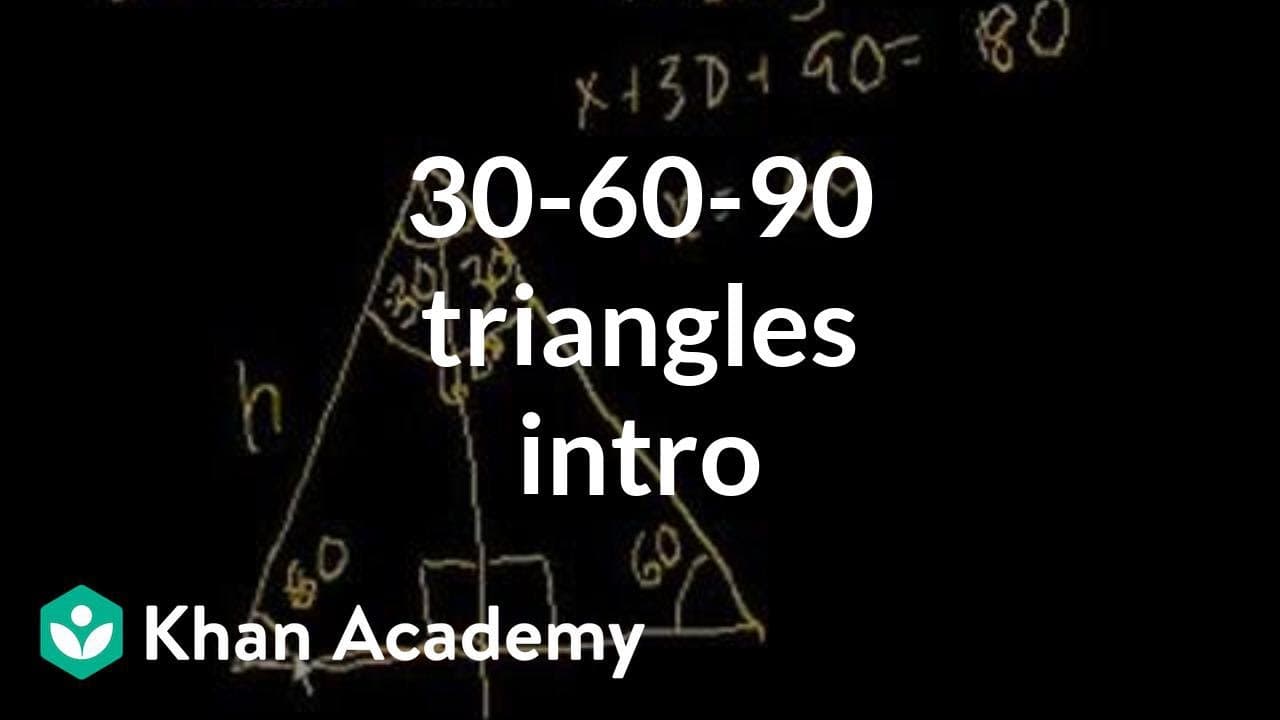
- 🔺 30-60-90 triangles have angles measuring 30, 60, and 90 degrees. The side opposite the 30-degree angle is half the length of the hypotenuse, and the side opposite the 60-degree angle is the square root of 3 divided by 2 times the length of the hypotenuse.
- 🔺 Flipping a 30-60-90 triangle creates an equilateral triangle, where all angles and sides have the same length.
- 🆘 Memorizing the relationships and formulas for 45-45-90 and 30-60-90 triangles can help solve problems quickly and accurately.
- 🔺 The Pythagorean theorem is a useful tool for finding the lengths of sides in right triangles, including 45-45-90 and 30-60-90 triangles.
- 🔺 Understanding the properties of these triangles is valuable in geometry and can be applied to various problem-solving situations.
- 🫵 The presenter encourages viewers to practice and memorize these concepts for standardized tests, where quick problem-solving is essential.
Install to Summarize YouTube Videos and Get Transcripts
Explore YouTube Video Summarizer or Get YouTube Transcript Extractor
Questions & Answers
Q: How do you calculate the length of the sides in a 45-45-90 triangle?
To calculate the length of the sides in a 45-45-90 triangle, the formula is x = (sqrt(2)/2) * h, where x is the length of either leg and h is the length of the hypotenuse.
Q: Why is the sum of the angles in a triangle always 180 degrees?
The sum of the angles in a triangle is always 180 degrees because the three angles form a straight line or a straight angle.
Q: How are the sides of a 30-60-90 triangle related?
In a 30-60-90 triangle, the side opposite the 30-degree angle is (1/2) times the length of the hypotenuse, and the side opposite the 60-degree angle is (sqrt(3)/2) times the length of the hypotenuse.
Q: How can the Pythagorean theorem be used to find the lengths of the sides in a 30-60-90 triangle?
The Pythagorean theorem can be used to find the lengths of the sides in a 30-60-90 triangle by setting up an equation where the squared length of one side plus the squared length of another side equals the squared length of the hypotenuse.
Summary & Key Takeaways
-
The video begins with an explanation of the properties of a 45-45-90 triangle and how to calculate the length of its sides.
-
The presenter then introduces a 30-60-90 triangle and explains how its angles and sides are related, using the Pythagorean theorem to find their lengths.
-
The video concludes by highlighting the importance of memorizing these relationships for quick problem-solving in standardized tests.
Read in Other Languages (beta)
Share This Summary 📚
Summarize YouTube Videos and Get Video Transcripts with 1-Click
Try YouTube Summary with ChatGPT & Claude or YouTube Transcript Generator
Explore More Summaries from Khan Academy 📚



Summarize YouTube Videos and Get Video Transcripts with 1-Click
Try YouTube Summary with ChatGPT & Claude or YouTube Transcript Generator