How to Differentiate Using Chain and Product Rules
TL;DR
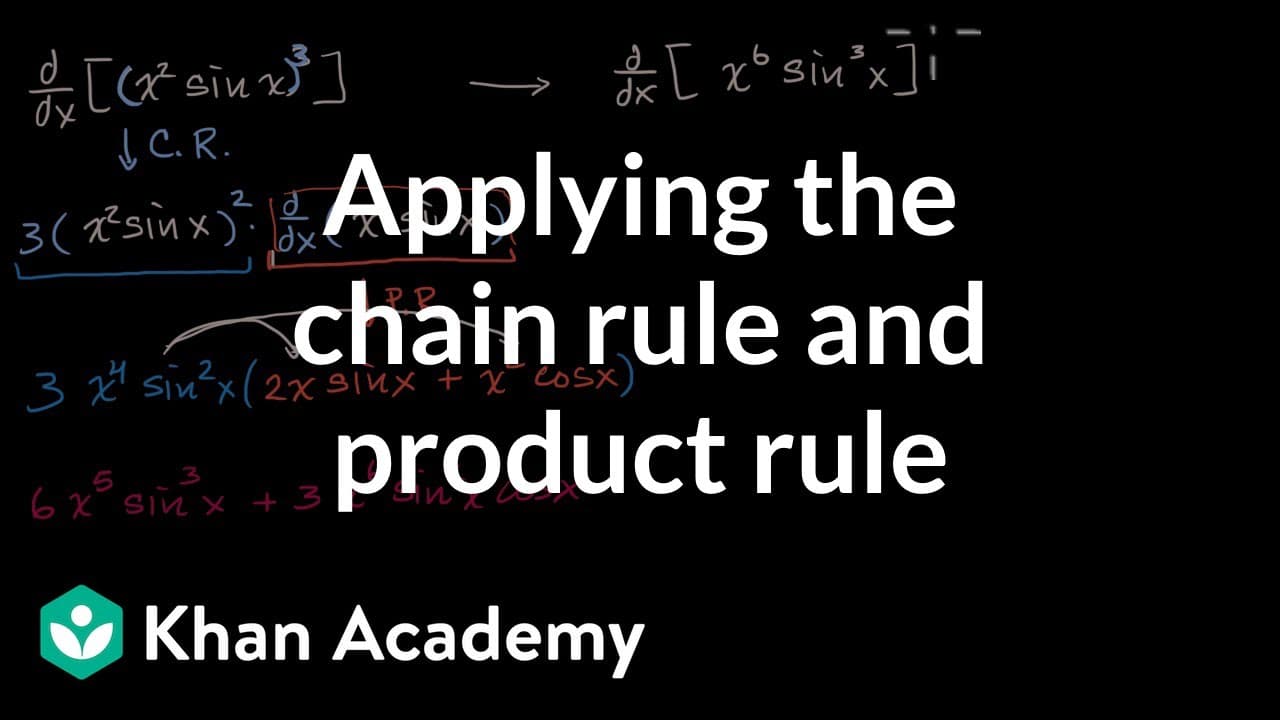
To find the derivative of X^2 * sin(X)^3, apply either the chain rule followed by the product rule or simplify using exponent properties first. Both methods yield the same result, demonstrating the versatility of calculus in solving derivative problems.
Transcript
- [Instructor] What we're going to do in this video is try to find the derivative with respect to X of X squared sin of X. All of that to the third power. And what's going to be interesting is that there's multiple ways to tackle it. And I encourage you to pause the video and see if you could work through it on your own. So there's actually multipl... Read More
Key Insights
- 📏 There are multiple strategies for finding derivatives, such as using the chain rule, product rule, or simplifying the expression using exponent properties.
- 😑 The chain rule is particularly useful when differentiating functions with nested expressions or composite functions.
- 😑 The product rule is helpful when differentiating the product of two or more expressions.
- 🥺 Sometimes, different strategies can lead to the same result, as long as they are logically consistent and properly executed.
- 🧑🏭 The choice of approach should be based on factors like simplicity, efficiency, and personal preference.
Install to Summarize YouTube Videos and Get Transcripts
Explore YouTube Video Summarizer or Get YouTube Transcript Extractor
Questions & Answers
Q: What is the purpose of using the chain rule in finding the derivative of X^2 * sin(X)^3?
The chain rule allows us to find the derivative of the function inside the parentheses. It helps us account for the changes in both the exponent and the trigonometric function.
Q: How does the product rule contribute to finding the derivative in this case?
The product rule helps us differentiate the two expressions being multiplied: X^2 and sin(X)^3. It involves finding the derivative of each expression and then combining them using specific rules.
Q: What is the advantage of simplifying the expression using exponent properties first?
Simplifying the expression using exponent properties reduces the complexity of the problem. It allows for a more straightforward application of the product rule and chain rule, resulting in a simpler final derivative.
Q: Are there any benefits to using a specific approach (chain rule or product rule) over the other?
The choice of approach depends on the specific problem and individual preference. In some cases, one method may be more efficient or lead to a simpler solution, while in other cases, the difference may be minimal.
Summary & Key Takeaways
-
The video demonstrates two different approaches to finding the derivative of X^2 * sin(X)^3, by first using the chain rule and then the product rule.
-
The chain rule is applied to find the derivative of the expression inside the parentheses, followed by the product rule to differentiate the two expressions in the product.
-
Another approach is shown, where the exponent properties are used to simplify the expression first, and then the product rule is applied followed by the chain rule.
Read in Other Languages (beta)
Share This Summary 📚
Summarize YouTube Videos and Get Video Transcripts with 1-Click
Try YouTube Summary with ChatGPT & Claude or YouTube Transcript Generator
Explore More Summaries from Khan Academy 📚



Summarize YouTube Videos and Get Video Transcripts with 1-Click
Try YouTube Summary with ChatGPT & Claude or YouTube Transcript Generator