Message Passing System - Process Management - Operating System
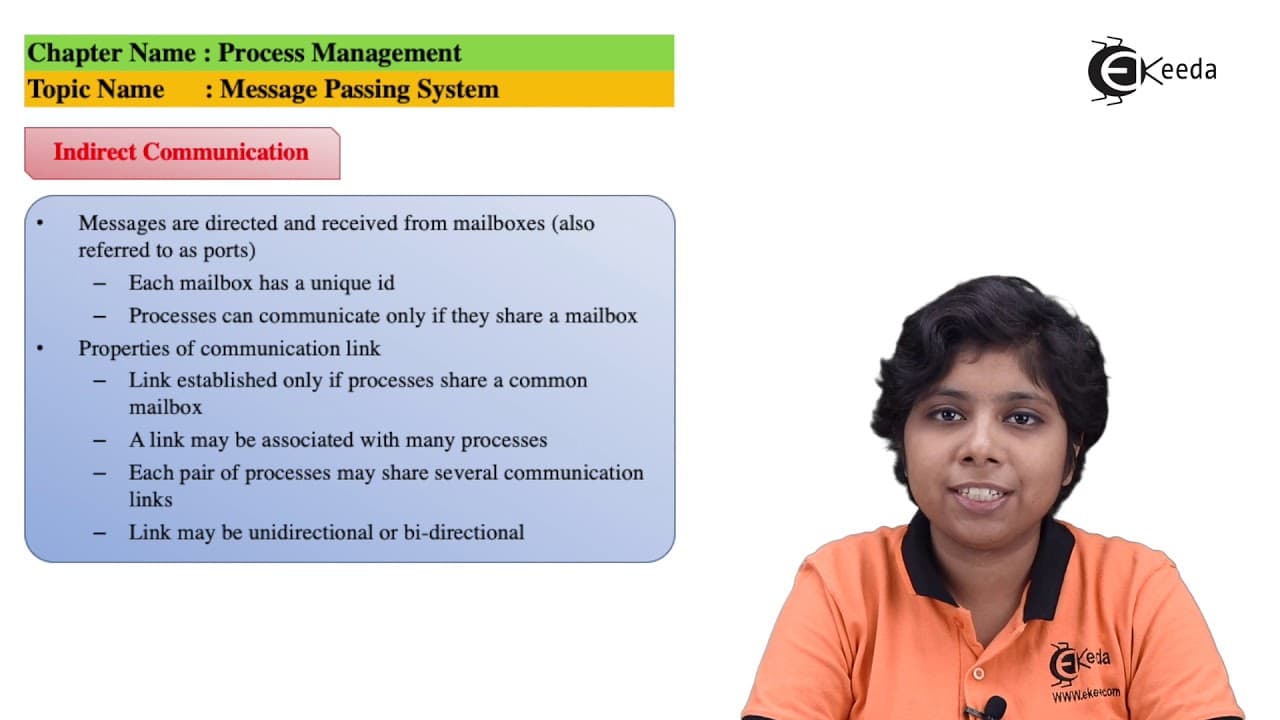
TL;DR
Learn about message passing systems, their methods, advantages, and disadvantages in inter-process communication.
Transcript
click the bell icon to get latest videos from akira hello friends today we are going to discuss about the message passing system in inter-process communication what are the methods to achieve them what are that when this is a disadvantages of using a message passing system and what are the issues that we fault like they're using of message passing ... Read More
Key Insights
- 👨🎨 Message passing enables communication and synchronization between processes without shared data in inter-process communication.
- 🅰️ Two types of messages, fixed size and variable size, have different advantages and complexities.
- 🙃 Direct communication requires processes to know each other's Process IDs (PID).
- 👾 Symmetrical and asymmetrical address spaces provide different levels of flexibility and reliability.
Install to Summarize YouTube Videos and Get Transcripts
Explore YouTube Video Summarizer or Get YouTube Transcript Extractor
Questions & Answers
Q: What is message passing and why is it important?
Message passing is a mechanism in inter-process communication where processes can communicate and synchronize without shared data. It is important in distributed environments to facilitate communication between processes running on different computers.
Q: What are the two types of messages in message passing systems?
The two types of messages are fixed size and variable size. Fixed size messages have a simpler system layout but can be complex to program. Variable size messages have a more complex system but make programming easier.
Q: How is direct communication established between processes?
In direct communication, a process must know the Process ID (PID) of the receiving process. The sending process uses the "send" function with the PID and message parameters, while the receiving process uses the "receive" function with the PID and message parameters.
Q: What are the advantages and disadvantages of using symmetrical and asymmetrical address spaces?
Symmetrical address spaces allow any process to send a message to any recipient, providing flexibility. However, changing process references can be complex. Asymmetrical address spaces allow more reliability as the receiving end does not need to know the sending processes, but it restricts modularity.
Summary & Key Takeaways
-
Message passing is a mechanism for processes to communicate and synchronize without using shared data or address space.
-
It is useful in distributed environments where processes from different computers are connected via a network.
-
Two types of messages can be sent: fixed size and variable size, each with its own advantages and complexities.
Read in Other Languages (beta)
Share This Summary 📚
Summarize YouTube Videos and Get Video Transcripts with 1-Click
Try YouTube Summary with ChatGPT & Claude or YouTube Transcript Generator
Explore More Summaries from Ekeeda 📚






Summarize YouTube Videos and Get Video Transcripts with 1-Click
Try YouTube Summary with ChatGPT & Claude or YouTube Transcript Generator