Heat capacity | Thermodynamics | AP Chemistry | Khan Academy
TL;DR
Heat capacity measures the amount of heat required to increase the temperature of an object, while specific heat measures the heat capacity of one gram of a substance. Water has a specific heat of 4.18 J/g°C, and its molar heat capacity is 75.2 J/mol°C.
Transcript
- [Instructor] The heat capacity of an object is the amount of heat necessary to raise the temperature of the object by one degree Celsius or one Kelvin. The specific heat capacity, which is often just called specific heat is the heat capacity of one gram of a substance while the molar heat capacity is the heat capacity for one mole of a substance.... Read More
Key Insights
- 🥵 Heat capacity measures the amount of heat needed to increase an object's temperature, while specific heat measures the heat capacity of one gram of a substance.
- 🥵 Water has a specific heat of 4.18 J/g°C, meaning it requires a relatively large amount of energy to increase its temperature.
- 🥵 Molar heat capacity is the heat capacity for one mole of a substance. For water, the molar heat capacity is 75.2 J/mol°C.
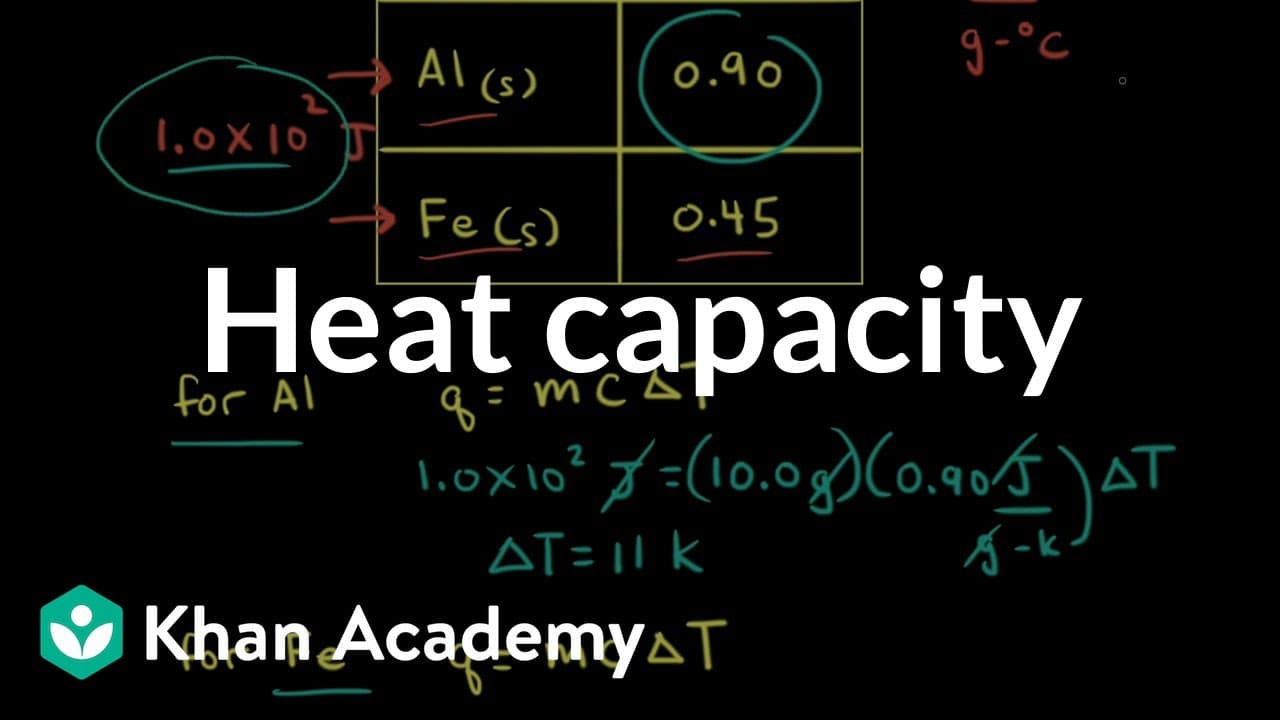
- 🥵 The equation Q = mCΔT can be used to calculate the heat transferred for a substance with a specific heat.
- 🥵 Specific heat values can vary slightly with temperature, so temperature is often specified when referring to specific heat tables.
- 🥵 Comparing substances with different specific heats shows that substances with higher specific heats require more heat to increase their temperature.
- 🥵 Iron has a lower specific heat than aluminum, making it easier to change the temperature of iron.
Install to Summarize YouTube Videos and Get Transcripts
Explore YouTube Video Summarizer or Get YouTube Transcript Extractor
Questions & Answers
Q: What is heat capacity and how is it related to temperature increase?
Heat capacity is the amount of heat required to raise the temperature of an object by one degree Celsius or one Kelvin. It measures how much energy is needed to increase the object's temperature. The higher the heat capacity, the more energy is required for temperature increase.
Q: What is specific heat and how is it calculated?
Specific heat is the heat capacity of one gram of a substance. It is calculated by dividing the amount of heat needed to increase the temperature of the substance by the mass of the substance. For example, if it takes 4.18 J of energy to increase the temperature of one gram of water by one degree Celsius, the specific heat of water is 4.18 J/g°C.
Q: What is molar heat capacity?
Molar heat capacity is the heat capacity for one mole of a substance. It is calculated by multiplying the specific heat of the substance by its molar mass. For example, if the specific heat of water is 4.18 J/g°C and the molar mass of water is 18.0 g/mol, then the molar heat capacity of water is 75.2 J/mol°C.
Q: How can the heat transferred be calculated using specific heat?
The heat transferred can be calculated using the equation Q = mCΔT, where Q is the heat transferred, m is the mass of the substance, C is the specific heat, and ΔT is the change in temperature. This equation allows us to find the amount of heat needed to increase the temperature of a substance.
Summary & Key Takeaways
-
Heat capacity is the amount of heat needed to raise the temperature of an object by one degree Celsius or one Kelvin. Specific heat is the heat capacity of one gram of a substance, while molar heat capacity is the heat capacity for one mole of a substance.
-
The specific heat of water is 4.18 J/g°C, meaning it takes 4.18 joules of energy to increase the temperature of one gram of water by one degree Celsius.
-
The molar heat capacity of water is 75.2 J/mol°C, which means it takes 75.2 joules of energy to increase the temperature of one mole of water by one degree Celsius.
Read in Other Languages (beta)
Share This Summary 📚
Summarize YouTube Videos and Get Video Transcripts with 1-Click
Try YouTube Summary with ChatGPT & Claude or YouTube Transcript Generator
Explore More Summaries from Khan Academy 📚



Summarize YouTube Videos and Get Video Transcripts with 1-Click
Try YouTube Summary with ChatGPT & Claude or YouTube Transcript Generator