What Is Torque and How Is It Calculated?
TL;DR
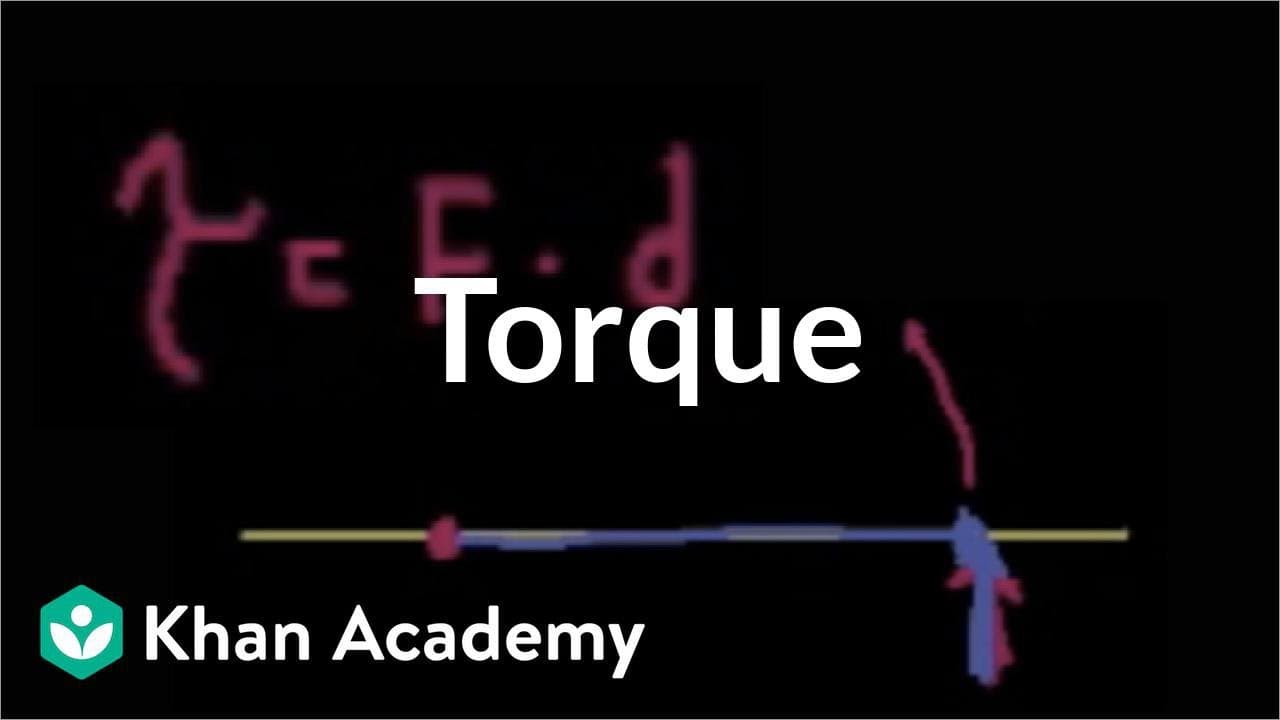
Torque is the rotational effect produced when a force is applied at a distance from a pivot point, calculated as the product of the force and the perpendicular distance from the pivot. Torque is distinct from work, and its direction can be positive for counterclockwise rotation and negative for clockwise rotation. If an object is not rotating, the net torque acting on it is zero.
Transcript
Welcome to the presentation on torque. So, if you watched the presentation on the center of mass, which you should have, you might have gotten a little bit of a glancing view of what torque is. And now we'll do some more in detail. So in general, from the center of mass video, we learned, if this is a ruler and this is the ruler's center of mass. A... Read More
Key Insights
- 😥 Torque is the rotation of an object around a fixed point, caused by the application of force at a distance from the pivot point.
- 💦 Torque is different from work, as it involves force and distance vectors perpendicular to each other.
- 🔄 The direction of torque determines the direction of rotation, with clockwise rotation being negative and counterclockwise rotation being positive.
- ☠️ The net torque on an object is zero if the object is not rotating or its rate of rotation is not changing.
- 😥 Torque can be influenced by both the magnitude of force applied and the distance from the pivot point.
- 🦾 Mechanical advantage can be observed in torque situations, where a smaller force at a longer distance can balance out a larger force at a shorter distance.
Install to Summarize YouTube Videos and Get Transcripts
Explore YouTube Video Summarizer or Get YouTube Transcript Extractor
Questions & Answers
Q: What is torque and how is it different from work?
Torque is the rotation of an object around a fixed point, while work is the translation of an object. Torque is calculated by multiplying force by distance, with force being perpendicular to the distance vector. Work, on the other hand, involves force and distance vectors in the same direction.
Q: How is torque affected by the force and distance applied?
Torque increases with an increase in force or an increase in the distance from the pivot point. For example, applying double the force at half the distance will result in double the torque.
Q: What is the significance of the direction of torque?
The direction of torque indicates the direction of rotation. Clockwise rotation is considered negative torque, while counterclockwise rotation is positive torque.
Q: How can we determine the net torque on an object?
If an object is not rotating or its rate of rotation is not changing, the net torque on the object must be zero. This can be determined by summing up all the torques applied to the object.
Summary & Key Takeaways
-
Torque is the rotation of an object around a fixed point, which occurs when a force is applied at a distance away from the pivot point.
-
Torque is calculated by multiplying the force applied to an object by the perpendicular distance from the pivot point.
-
The direction of torque can be positive or negative depending on the direction of rotation, with clockwise rotation being negative and counterclockwise rotation being positive.
Read in Other Languages (beta)
Share This Summary 📚
Summarize YouTube Videos and Get Video Transcripts with 1-Click
Try YouTube Summary with ChatGPT & Claude or YouTube Transcript Generator
Explore More Summaries from Khan Academy 📚



Summarize YouTube Videos and Get Video Transcripts with 1-Click
Try YouTube Summary with ChatGPT & Claude or YouTube Transcript Generator