Example free response question from AP macroeconomics | AP Macroeconomics | Khan Academy
TL;DR
This video discusses the concepts of Phillips curves, short-run and long-run aggregate supply, fiscal policy actions, and their impact on unemployment rates and currency exchange rates.
Transcript
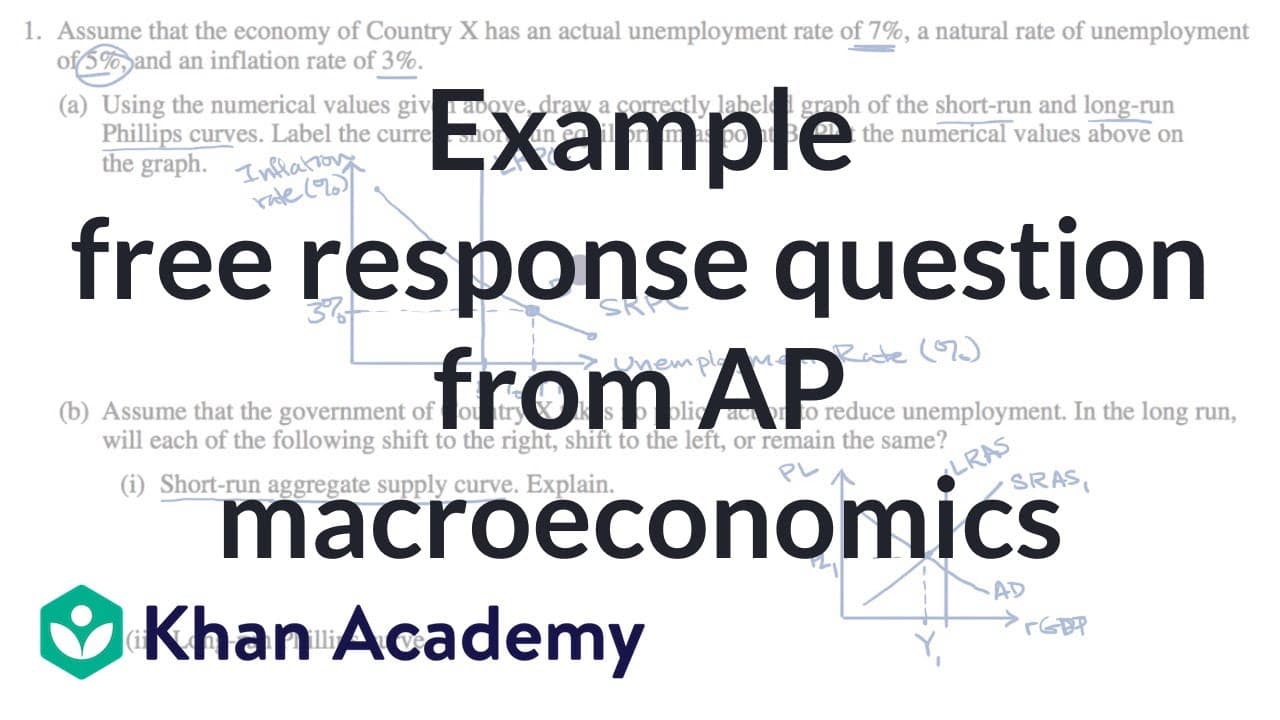
- [Instructor] In this video, I want to tackle an entire AP macroeconomics free response exercise with you. Assume that the economy of Country X has an actual unemployment rate of 7%, a natural rate of unemployment of 5%, and an inflation rate of 3%. Using the numerical values given above, draw a correctly labeled graph of the short-run and long-ru... Read More
Key Insights
- ☠️ Phillips curves illustrate the relationship between unemployment and inflation rates.
- ☠️ Short-run aggregate supply curve shifts in response to changes in actual unemployment rates.
- 🏃 Long-run aggregate supply curve remains unchanged unless there are fundamental changes in the economy.
- 💇 Fiscal policy actions, such as tax cuts, can be used to stimulate the economy in the short run.
- 💱 Increase in national income leads to an increase in the supply of a country's currency in foreign exchange markets.
Install to Summarize YouTube Videos and Get Transcripts
Explore YouTube Video Summarizer or Get YouTube Transcript Extractor
Questions & Answers
Q: What is the purpose of graphing the short-run and long-run Phillips curves?
The Phillips curves show the relationship between unemployment and inflation rates. Graphing them helps visualize how changes in unemployment impact inflation in the short and long run.
Q: How does the short-run aggregate supply curve shift in response to high unemployment rates?
High unemployment rates can lead to wage pressure, causing wages to decrease. This shift in wages would shift the short-run aggregate supply curve to the right, allowing for more output at a given price level.
Q: What is the difference between a fiscal policy action and a monetary policy action?
A fiscal policy action involves changes in taxation or government spending to stimulate or stabilize the economy. In contrast, a monetary policy action involves adjustments to interest rates or the money supply by the central bank.
Q: In the context of the video, why would an increase in national income lead to an increase in the supply of Country X's currency?
An increase in national income means that people have more purchasing power, leading to an increase in the demand for imports. To buy imports, there needs to be an increase in the supply of Country X's currency in foreign exchange markets.
Summary & Key Takeaways
-
The video explains how to graph the short-run and long-run Phillips curves, which illustrate the relationship between unemployment and inflation rates.
-
It discusses how the short-run aggregate supply curve shifts in response to changes in actual unemployment rates, and how the long-run aggregate supply curve remains unchanged unless there are fundamental changes in the economy.
-
It also explores a fiscal policy action, such as a tax cut, that can be used to reduce unemployment in the short run, and how it affects the equilibrium price level and real GDP.
-
Lastly, it analyzes the impact of an increase in the supply of Country X's currency on the foreign exchange market and the resulting currency depreciation.
Read in Other Languages (beta)
Share This Summary 📚
Summarize YouTube Videos and Get Video Transcripts with 1-Click
Try YouTube Summary with ChatGPT & Claude or YouTube Transcript Generator
Explore More Summaries from Khan Academy 📚



Summarize YouTube Videos and Get Video Transcripts with 1-Click
Try YouTube Summary with ChatGPT & Claude or YouTube Transcript Generator