Justification using second derivative: inflection point | AP Calculus AB | Khan Academy
TL;DR
The article discusses the calculus-based justification for the presence of an inflection point based on the behavior of the second derivative.
Transcript
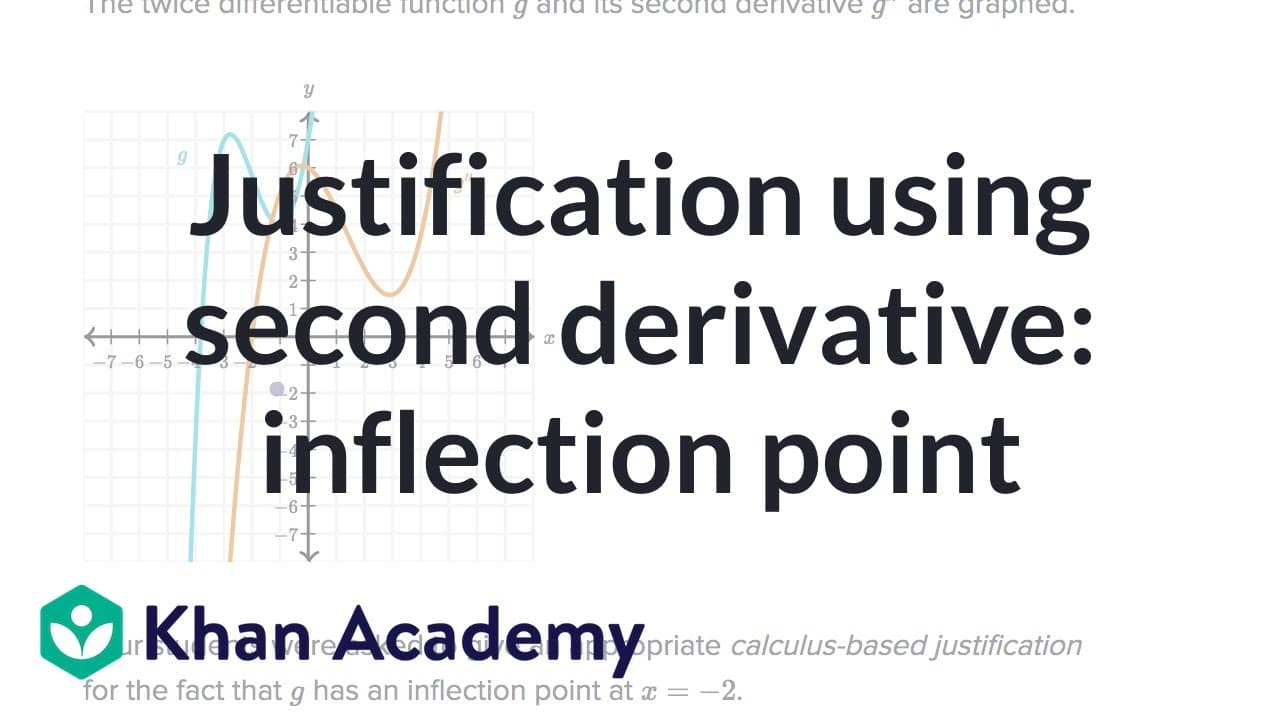
- [Instructor] The twice differentiable function G and its second derivative G prime prime are graphed. And you can see it right over here. I'm actually working off of the article on Khan Academy called Justifying Using Second Derivatives. So we see our function G. And we see not its first derivative but its second derivative here in this brown col... Read More
Key Insights
- 😥 An inflection point signifies a change in the concavity of a function or the slope of the function.
- 😥 The second derivative is used to determine if the function has an inflection point.
- 👈 For a point to be considered an inflection point, the second derivative must cross the x-axis.
Install to Summarize YouTube Videos and Get Transcripts
Explore YouTube Video Summarizer or Get YouTube Transcript Extractor
Questions & Answers
Q: What is an inflection point?
An inflection point is a point on a graph where the concavity changes, indicating a transition from concave upwards to concave downwards, or vice versa. It can also signify a change in the slope from decreasing to increasing, or from increasing to decreasing.
Q: How can the second derivative help identify inflection points?
By examining the second derivative of a function, we can identify where it crosses the x-axis. If the second derivative is negative, it indicates concavity downwards, while a positive second derivative suggests concavity upwards. The point where the second derivative crosses the x-axis is a potential inflection point.
Q: What is the significance of the second derivative crossing the x-axis?
For an inflection point to exist, the second derivative must not only touch or be zero at a certain point but also cross the x-axis. This crossing signifies the change in concavity, making it a valid justification for an inflection point.
Q: Why is the third student response not considered a calculus-based justification?
The student states that the graph of the function changes concavity at X equals negative two, which is true but not a calculus-based justification. To provide a calculus-based justification, it is necessary to refer to the behavior of the second derivative.
Summary & Key Takeaways
-
The article explores the concept of inflection points, where the concavity of a function changes.
-
The second derivative of the function is analyzed to determine if it crosses the x-axis.
-
Four student responses are evaluated, with some justifications being correct and others not providing sufficient reasoning.
Read in Other Languages (beta)
Share This Summary 📚
Summarize YouTube Videos and Get Video Transcripts with 1-Click
Try YouTube Summary with ChatGPT & Claude or YouTube Transcript Generator
Explore More Summaries from Khan Academy 📚



Summarize YouTube Videos and Get Video Transcripts with 1-Click
Try YouTube Summary with ChatGPT & Claude or YouTube Transcript Generator