What Is Archimedes' Principle and How Does Buoyancy Work?
TL;DR
Archimedes' Principle states that the buoyant force on an object submerged in a fluid equals the weight of the fluid displaced by that object. This principle explains why objects feel lighter in water than in air, as water's higher density provides a greater upward buoyant force, making it easier to lift submerged objects.
Transcript
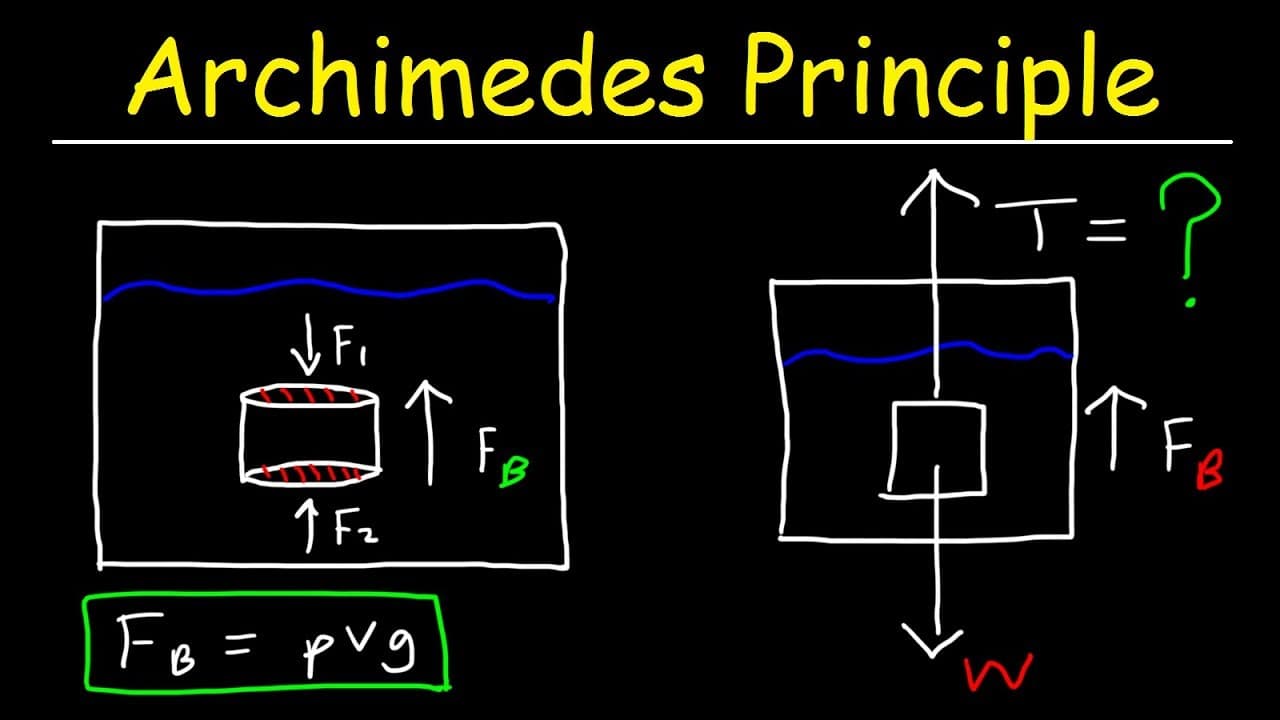
in this video we're going to talk about archimedes principle and buoyant force the basic idea behind archimedes principle is that the buoyant force acted on an object that's immersed in the fluid is equal to the weight of the fluid displaced by that object now this problem is going to illustrate the concept of arguments principle and you'll see it ... Read More
Key Insights
- 🏋️ Archimedes Principle states that buoyant force is equal to the weight of the fluid displaced by an object.
- 💦 Objects appear lighter in water than in air due to the upward buoyant force exerted by water.
- 🥹 The tension force in a rope holding a block depends on whether it is in a vacuum, in air, or in water.
- 🔇 The buoyant force can be calculated using the density of the fluid, volume of the submerged object, and gravitational acceleration.
- 🏋️ As the density of the fluid increases, it becomes easier to lift a block submerged in that fluid.
- 💦 Air and water are both considered fluids, and both exert buoyant forces on objects.
- 💆 The volume of an object can be calculated using its mass and density.
Install to Summarize YouTube Videos and Get Transcripts
Explore YouTube Video Summarizer or Get YouTube Transcript Extractor
Questions & Answers
Q: What is Archimedes Principle?
Archimedes Principle states that the buoyant force on an object immersed in a fluid is equal to the weight of the fluid displaced by the object. It explains why objects appear lighter in water than in air.
Q: Why is it easier to lift a block in water than in air?
Water has a higher density than air, so it exerts an upward buoyant force on the block. This buoyant force reduces the tension force required to lift the block, making it easier to lift in water.
Q: What is the tension force in a rope if the block is in a vacuum?
In a vacuum, there is no upward buoyant force, so the tension force in the rope represents the true weight of the block. It can be calculated by multiplying the mass of the block by the gravitational acceleration.
Q: How is the buoyant force calculated?
The buoyant force can be calculated using the equation: Buoyant force = density of the fluid * volume of the submerged object * gravitational acceleration. It is equal to the weight of the fluid displaced by the object.
Summary & Key Takeaways
-
Archimedes Principle states that the buoyant force on an object in a fluid is equal to the weight of the fluid displaced by the object.
-
It is easier to lift a block in water than in air because water has a higher density and exerts an upward buoyant force on the block.
-
The tension force in a rope holding a block depends on whether it is in a vacuum, in air, or in water.
Read in Other Languages (beta)
Share This Summary 📚
Summarize YouTube Videos and Get Video Transcripts with 1-Click
Try YouTube Summary with ChatGPT & Claude or YouTube Transcript Generator
Explore More Summaries from The Organic Chemistry Tutor 📚




Summarize YouTube Videos and Get Video Transcripts with 1-Click
Try YouTube Summary with ChatGPT & Claude or YouTube Transcript Generator