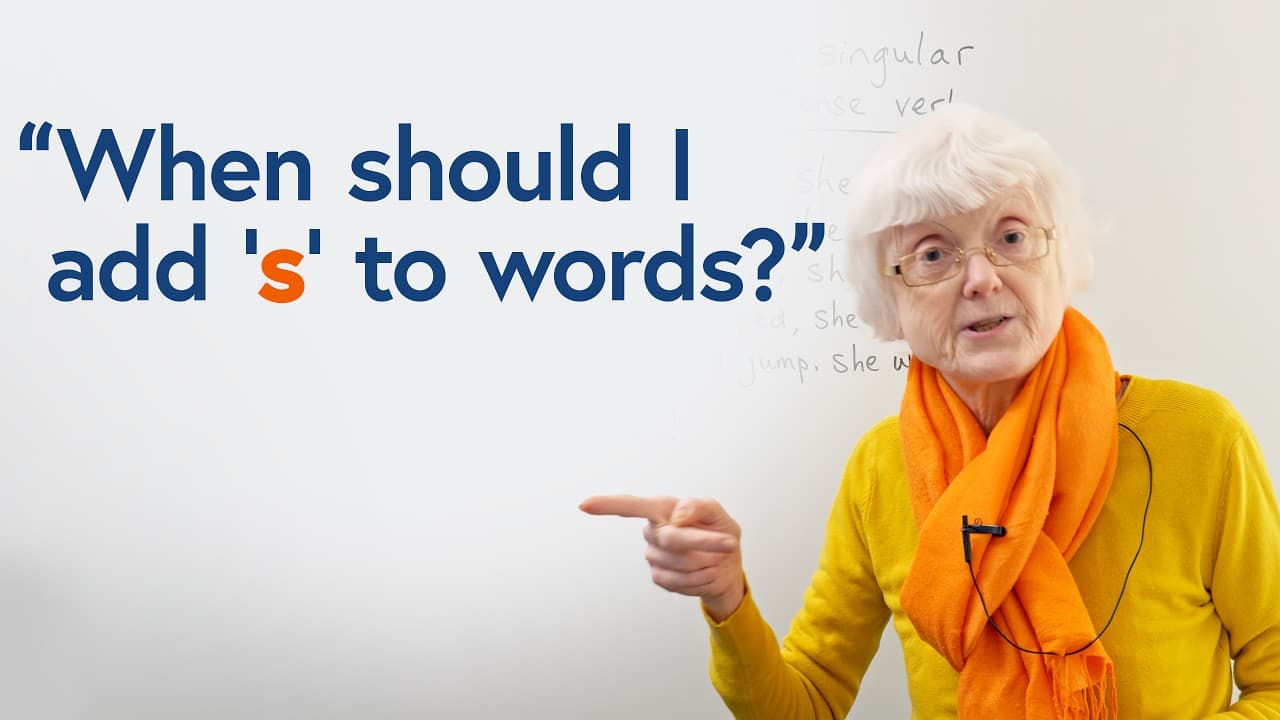
Basic English Grammar: When & how to add ‘s’
TL;DR
Learn how to correctly use plurals, third-person singular verbs, and apostrophes with words ending in "s".
Transcript
Hello. This is Gill at engVid, and today we have a lesson on words that end with an "s" or words where you sometimes add an "s" for a particular reason and for different reasons, because I found that sometimes people get a little bit confused about whether it's a noun or a verb, whether it's a plural because it has an "s" on the end, that sort of t... Read More
Key Insights
- 💁 Plural nouns in English typically add an "s" for the plural form, but some irregular nouns have different plural forms.
- 🧑 Third-person singular present tense verbs require an added "s" for subjects like "he", "she", or "it" to indicate singular action.
- 😯 Correct pronunciation of the final "s" is crucial for clarity and proper understanding in English speech.
- 💌 Apostrophes are used in contractions to indicate missing letters and in possessives to show ownership, but not with plurals or verbs.
Install to Summarize YouTube Videos and Get Transcripts
Explore YouTube Video Summarizer or Get YouTube Transcript Extractor
Questions & Answers
Q: When do you add an extra syllable to words ending in "s"?
An extra syllable is added when the original word already ends with an "s" sound, like in "horses" or "loses", to ensure clear pronunciation and distinction.
Q: Why is it important to pronounce the final "s" in English plurals?
Pronouncing the final "s" in English plurals is crucial to convey the correct meaning and avoid confusion, especially for non-native speakers.
Q: How does the use of apostrophes differ for contractions and possessives?
Apostrophes are used in contractions to show missing letters (e.g., "the dog's asleep") and in possessives to indicate ownership (e.g., "Mary's house"), but not with plurals or verbs.
Q: Why do some non-native speakers struggle with pronouncing the final "s" in English words?
Non-native speakers may struggle with pronouncing the final "s" due to differences in plural formations in their native language, requiring extra practice for clarity.
Summary & Key Takeaways
-
Plural nouns in English usually have an added "s" at the end, like "girls" or "boxes".
-
Third-person singular present tense verbs require an added "s" for clarity, as in "she jumps".
-
Apostrophes are only used in contractions, possessives, not with plurals or verbs.
Read in Other Languages (beta)
Share This Summary 📚
Summarize YouTube Videos and Get Video Transcripts with 1-Click
Try YouTube Summary with ChatGPT & Claude or YouTube Transcript Generator
Explore More Summaries from Learn English with Gill · engVid 📚





Summarize YouTube Videos and Get Video Transcripts with 1-Click
Try YouTube Summary with ChatGPT & Claude or YouTube Transcript Generator