Analyzing mistakes when finding extrema example 2 | AP Calculus AB | Khan Academy
TL;DR
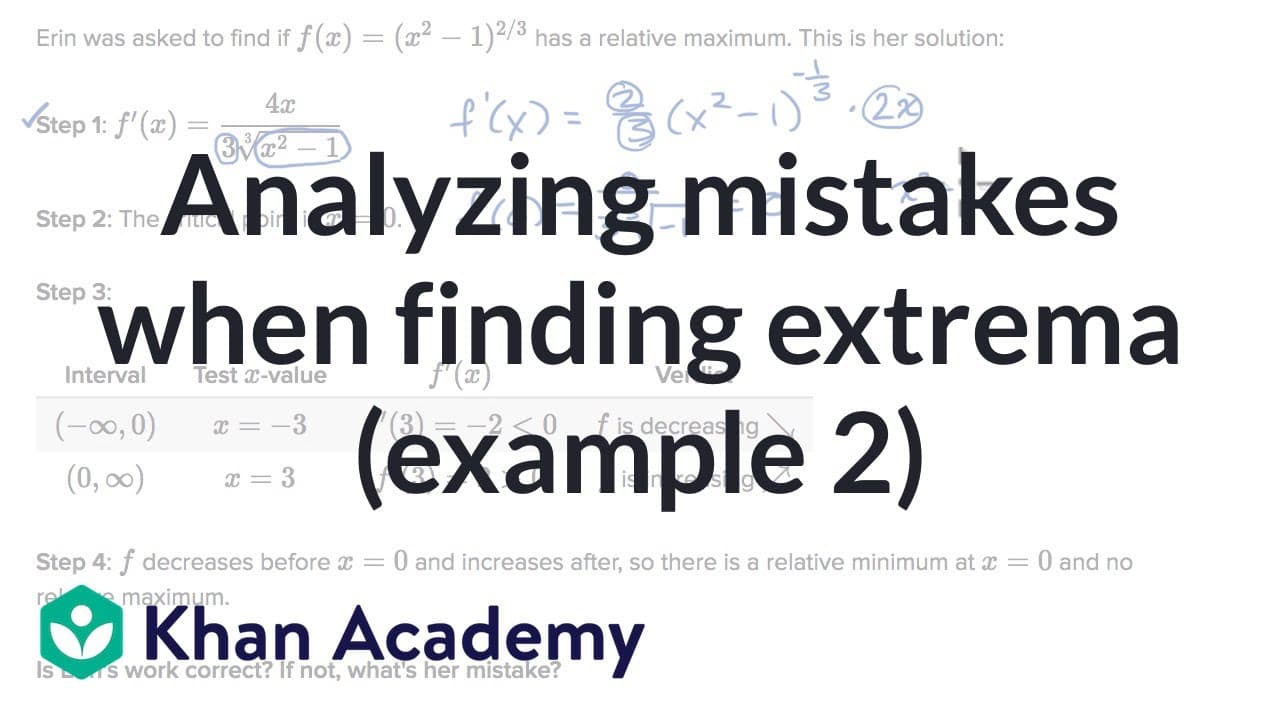
Erin's solution for finding a relative maximum is incorrect because she only identifies one critical point instead of all the critical points.
Transcript
- [Instructor] Erin was asked to find if f of x is equal to x squared minus one to the 2/3 power has a relative maximum. This is her solution. And then they give us her steps, and at the end they say, is Erin's work correct? If not, what's her mistake? So pause this video and see if you can figure it out yourself. Is Erin correct, or did you she ma... Read More
Key Insights
- 😥 Erin's solution for finding a relative maximum is flawed because she only identifies one critical point instead of all the critical points.
- 😥 Critical points are locations where the derivative is either zero or undefined.
- 😥 When using the first derivative test, it is crucial to sample values on either side of the critical point, ensuring that no other critical points are crossed.
- 🥺 Erin's mistake in failing to identify all the critical points could lead to incorrect conclusions about the existence of a relative maximum.
Install to Summarize YouTube Videos and Get Transcripts
Explore YouTube Video Summarizer or Get YouTube Transcript Extractor
Questions & Answers
Q: What was Erin's mistake in her solution for finding the relative maximum?
Erin mistakenly only considers one critical point (x = 0), while failing to identify additional critical points at x = ±1. This oversight prevents her from accurately determining the existence of a relative maximum.
Q: Is it important to identify all the critical points when determining if a function has a relative maximum?
Yes, it is crucial to identify all the critical points because they are the potential locations of extrema. Ignoring critical points can lead to incorrect conclusions about the existence of a relative maximum.
Q: How can the first derivative test be used to determine if a critical point is a relative maximum or minimum?
The first derivative test requires sampling values on either side of the critical point and checking for a change in the sign of the derivative. However, it is essential to ensure that the tested values do not go beyond other critical points, as critical points can change the direction of the function.
Q: What values should Erin have tested to determine the presence of a relative maximum?
Erin should have tested values such as x = -2, -1, -0.5, 0, 0.5, 1, and 2. These values lie in the intervals between the critical points and can help determine if the function has a relative maximum.
Summary & Key Takeaways
-
Erin's solution involves finding the derivative of the function and identifying the critical point.
-
She correctly calculates the derivative using the chain rule.
-
However, she only identifies one critical point (x = 0) and fails to recognize that there are additional critical points at x = ±1.
Read in Other Languages (beta)
Share This Summary 📚
Summarize YouTube Videos and Get Video Transcripts with 1-Click
Try YouTube Summary with ChatGPT & Claude or YouTube Transcript Generator
Explore More Summaries from Khan Academy 📚



Summarize YouTube Videos and Get Video Transcripts with 1-Click
Try YouTube Summary with ChatGPT & Claude or YouTube Transcript Generator