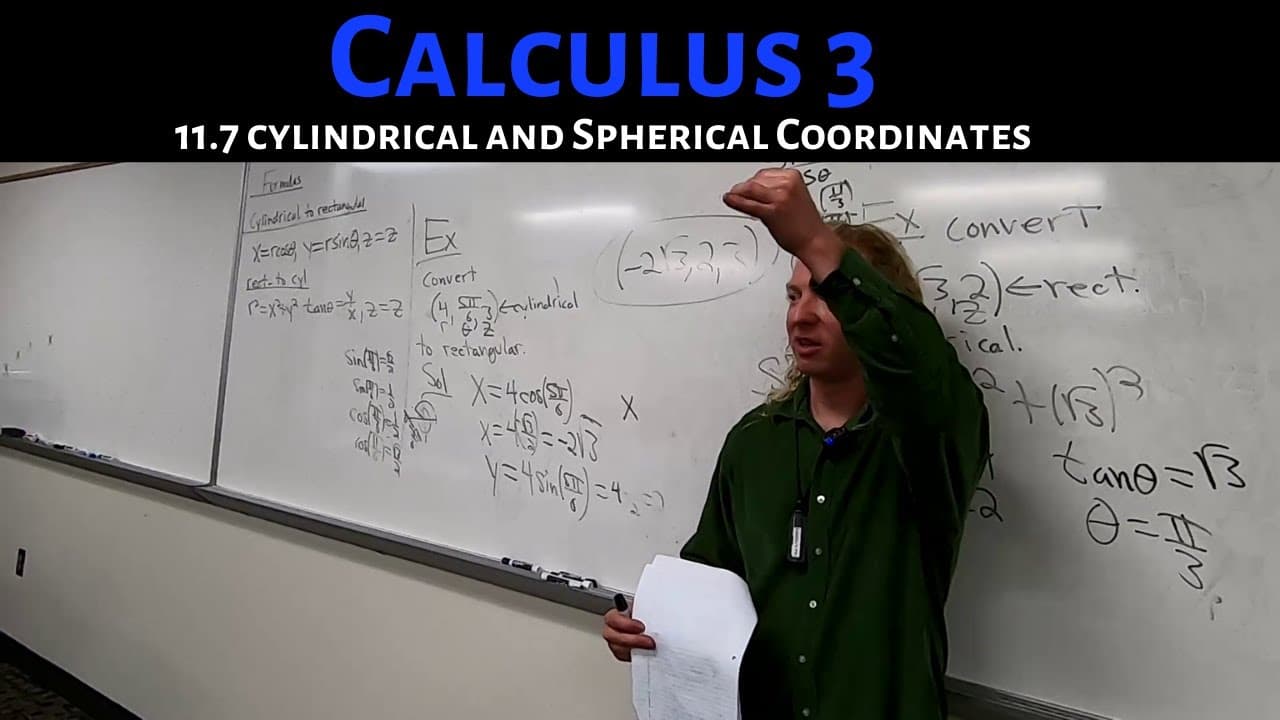
Calculus 3: Lecture 11.7 Cylindrical and Spherical Coordinates
TL;DR
- Understanding the conversion from rectangular to spherical coordinates with key formulas.
Transcript
this is an extension of polar coordinates so this is an extension of polar more polar was our theta right R was your angle theta was your angle and our was your directed distance right in polar so it was R theta this is an extension of polar we just have an extra coordinate we have a Z we have a z coordinate so P equals XYZ I'll write it like this ... Read More
Key Insights
- 🚥 Spherical coordinates involve Rho, Theta, and Phi for distance, horizontal angle, and vertical angle from the positive z-axis.
- 🤩 Conversion from rectangular to spherical coordinates requires applying key formulas for Rho, Theta, and Phi.
- 😥 Understanding the practical implications of spherical coordinates in 3D space aids in accurate representation of points or objects.
- 😥 Spherical coordinates offer a unique way to describe points in three-dimensional space efficiently and effectively.
- 🈸 Mastery of spherical coordinates is essential for advanced mathematical applications and problem-solving scenarios.
- 😥 Utilizing spherical coordinates can simplify complex geometric problems involving positioning points in 3D space.
- ❓ The conversion process from rectangular to spherical coordinates involves applying specific mathematical formulas for each component.
Install to Summarize YouTube Videos and Get Transcripts
Explore YouTube Video Summarizer or Get YouTube Transcript Extractor
Questions & Answers
Q: What are the key components of spherical coordinates?
Spherical coordinates consist of Rho as the distance to the origin, Theta as the angle in the xy-plane, and Phi as the angle from the positive z-axis, forming a unique triple.
Q: How do you convert from rectangular to spherical coordinates?
Conversion involves using specific formulas for Rho, Theta, and Phi, where Rho is the square root of the sum of squares of x, y, and z coordinates, Theta is the arctan of y/x, and Phi is the arc cosine of z/Rho.
Q: Why is it crucial to understand spherical coordinates?
Spherical coordinates enable representing points in 3D space efficiently, providing a clear description of position using distance, horizontal angle, and vertical angle from the positive z-axis.
Q: What are the practical applications of spherical coordinates?
Spherical coordinates find applications in physics, engineering, and astronomy, where the three-dimensional nature of positioning points or objects is vital for accurate measurements and calculations.
Summary & Key Takeaways
-
Spherical coordinates involve Rho, Theta, and Phi where Rho is the distance to the origin, Theta is the angle in the xy-plane, and Phi is the angle from the positive z-axis.
-
Conversion from rectangular to spherical involves using key formulas for Rho, Theta, and Phi to determine the spherical coordinates.
-
Understanding the practical applications of spherical coordinates in representing points in 3D space.
Read in Other Languages (beta)
Share This Summary 📚
Summarize YouTube Videos and Get Video Transcripts with 1-Click
Try YouTube Summary with ChatGPT & Claude or YouTube Transcript Generator
Explore More Summaries from The Math Sorcerer 📚



Summarize YouTube Videos and Get Video Transcripts with 1-Click
Try YouTube Summary with ChatGPT & Claude or YouTube Transcript Generator