Problem No. 6 on Bending Stress Formula - Stresses in Beams - Strength of Materials
TL;DR
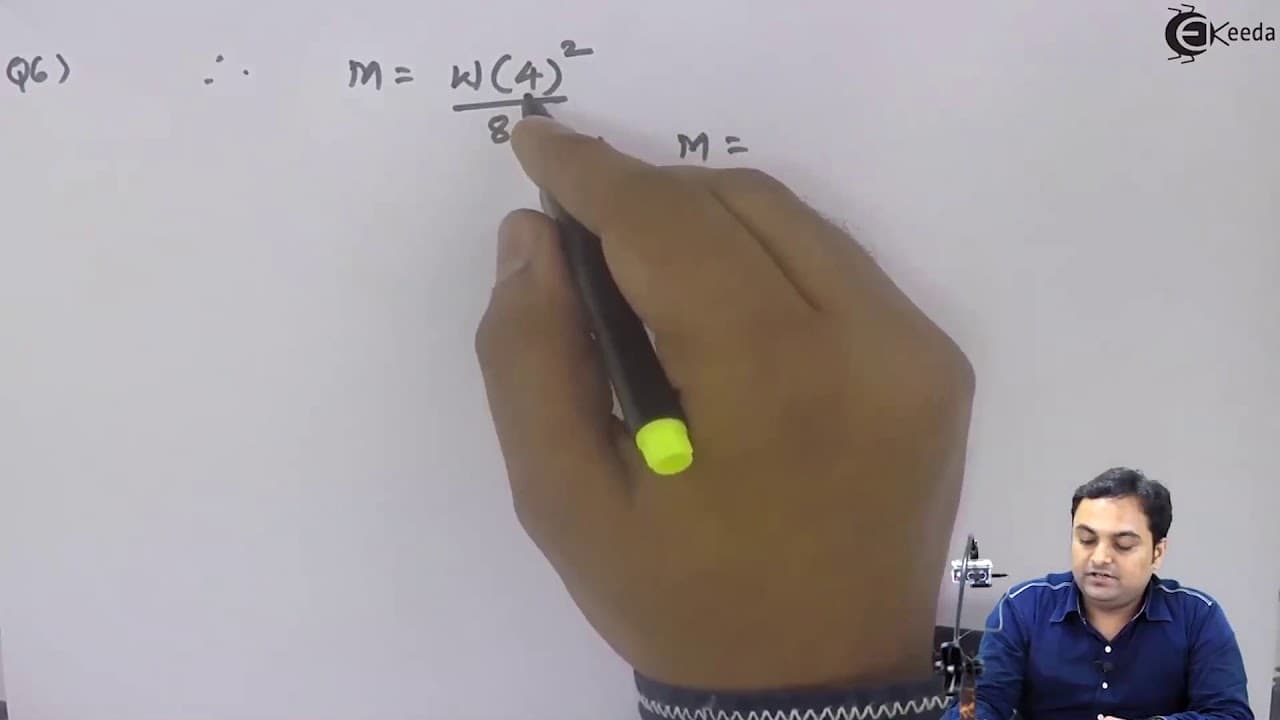
The video demonstrates the step-by-step calculation of the UDL a rectangular beam can carry, based on its dimensions and bending stress.
Transcript
let me solve the next question which is question number six okay i'm looking a question so i'm getting it now what is given a rectangular beam 120 mm wide and 300 mm deep is simply supported over a span of 4 meter full stop what udl the beam may carry if the bending stress is not to exceed 120 megapascal question mark the width of the beam is 120 m... Read More
Key Insights
- 😁 The problem involves determining the UDL a rectangular beam can support without exceeding a given bending stress.
- 😐 Calculations involve finding the moment of inertia, neutral axis, and using the flexural equation to solve for the UDL.
- 😁 The width and depth of the beam are important parameters in the calculations.
- 🎮 The video demonstrates the step-by-step process of solving the problem, providing a clear explanation of the calculations involved.
- 😁 By keeping the bending stress below the specified limit, the structural integrity of the beam can be maintained.
- 😁 Simply supported beams rely on support at both ends, allowing for free rotation and vertical movement.
- 😁 Understanding and calculating the moment of inertia is crucial in determining the strength and load-carrying capacity of a beam.
Install to Summarize YouTube Videos and Get Transcripts
Explore YouTube Video Summarizer or Get YouTube Transcript Extractor
Questions & Answers
Q: What are the dimensions of the rectangular beam discussed in the video?
The beam has a width of 120mm and a depth of 300mm.
Q: How is the moment of inertia of the beam calculated?
The moment of inertia is calculated using the formula: I = (b * d^3) / 12, where b is the width and d is the depth of the beam.
Q: What is the flexural equation used in the video?
The flexural equation used is: M / I = σb / (y - (d/2)), where M is the bending moment, I is the moment of inertia, σb is the bending stress, y is the distance to the neutral axis, and d is the depth of the beam.
Q: What is the UDL that the beam can carry without exceeding the bending stress?
The UDL is calculated to be 108 kilonewton per meter.
Summary & Key Takeaways
-
The video discusses the problem of determining the UDL a rectangular beam can carry without exceeding a given bending stress.
-
The rectangular beam in question has dimensions of 120mm width and 300mm depth, and it is simply supported over a 4-meter span.
-
The video explains the process of calculating the moment of inertia, neutral axis, and using the flexural equation to determine the UDL the beam can bear.
Read in Other Languages (beta)
Share This Summary 📚
Summarize YouTube Videos and Get Video Transcripts with 1-Click
Try YouTube Summary with ChatGPT & Claude or YouTube Transcript Generator
Explore More Summaries from Ekeeda 📚






Summarize YouTube Videos and Get Video Transcripts with 1-Click
Try YouTube Summary with ChatGPT & Claude or YouTube Transcript Generator