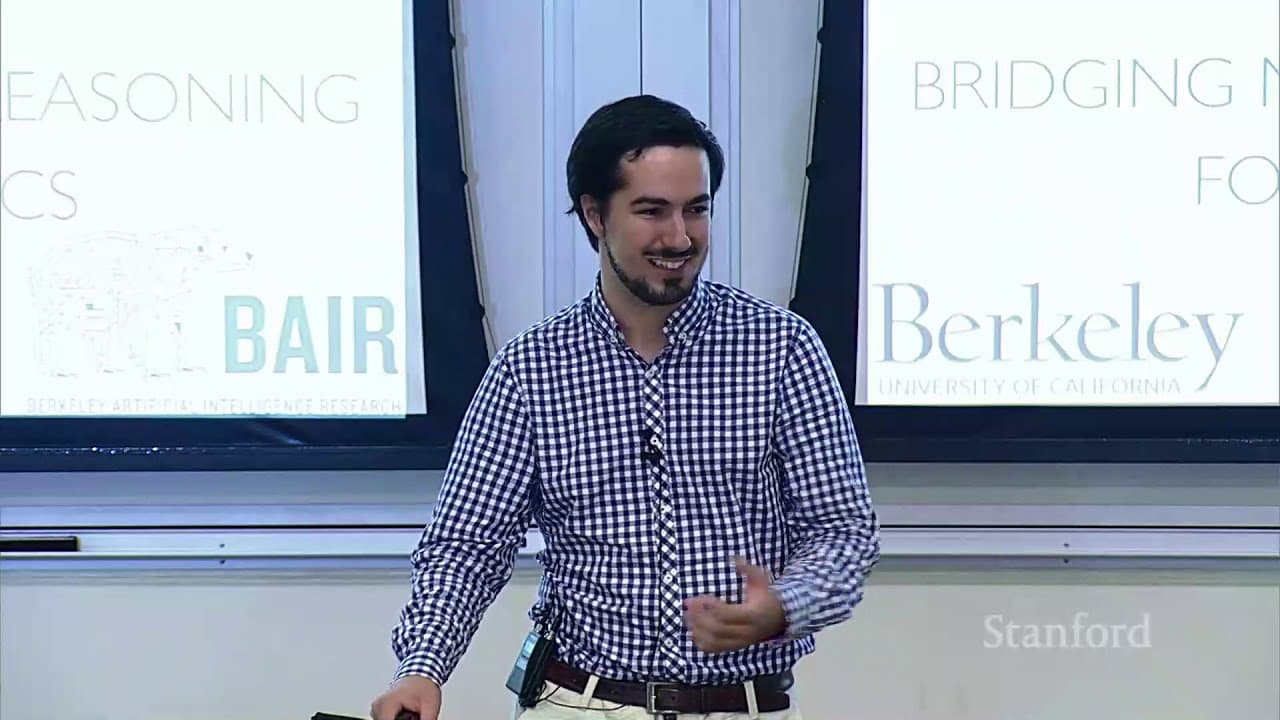
Stanford Seminar - Bridging model-based and data-driven reasoning for safe human-centered robotics
TL;DR
Safety in autonomous systems, such as drones and self-driving cars, is a complex issue due to uncertainties and interactions with humans. Safety guarantees based solely on theoretical models are insufficient and need to be complemented with real-time monitoring and adaptive strategies.
Transcript
thank you so much for the very kind introduction one of the main drives during my PhD which has been the question of how do we keep autonomous systems in particular robotic systems including drones so driving cars home robots and even more generally AI and automation systems safe how do we keep these systems safe and especially how do we keep them ... Read More
Key Insights
- 🦺 Safety in autonomous systems remains a major challenge, especially in complex and uncertain environments.
- 👋 Theoretical safety guarantees based on models have limitations and are only as good as the model assumptions.
- 🖤 Learning-based methods can improve performance but often lack worst-case guarantees.
- 🤖 By accounting for uncertainties in human-robot interactions and strategic behavior, safety can be enhanced.
- 😚 Reasoning about closed-loop interactions between automation systems and humans is crucial for understanding the impact and consequences of these interactions.
Install to Summarize YouTube Videos and Get Transcripts
Explore YouTube Video Summarizer or Get YouTube Transcript Extractor
Questions & Answers
Q: What challenges arise when ensuring the safety of autonomous systems?
Ensuring safety in autonomous systems becomes challenging due to increasing complexity, uncertainties, and interactions with humans. Traditional safety measures are often ineffective, and model errors can compromise safety guarantees.
Q: How do theoretical safety guarantees work in autonomous systems?
Theoretical safety guarantees involve analyzing the system's dynamics through safety analysis and reachability analysis. These methods help identify and avoid forbidden failure states. However, they are limited by discrepancies between the model and the real system.
Q: How can learning-based methods be applied to improve safety in robotics?
Learning-based methods, such as reinforcement learning, can improve system performance, but they often lack guarantees and can have poor worst-case performance. Combining safety analysis with learning algorithms can provide real-time monitoring and adaptive strategies for safer autonomous systems.
Q: How can human-robot interactions be accounted for in safety analysis?
Human-robot interactions can introduce uncertainties and deviations from expected behaviors. By incorporating probabilistic models of human actions and reasoning about the confidence in these models, the robot can adapt its behavior and be more conservative when predictions are uncertain.
Summary & Key Takeaways
-
Autonomous systems are gaining widespread applications, but ensuring their safety remains a major challenge.
-
Traditional safety measures, such as physical barriers, are no longer effective for open environments with complex interactions.
-
The use of theoretical safety guarantees and provably safe algorithms is limited by the discrepancy between the model and the real world.
-
Model error is inevitable, especially in human-robot interactions, and can lead to failures in safety guarantees.
Read in Other Languages (beta)
Share This Summary 📚
Summarize YouTube Videos and Get Video Transcripts with 1-Click
Try YouTube Summary with ChatGPT & Claude or YouTube Transcript Generator
Explore More Summaries from Stanford Online 📚




Summarize YouTube Videos and Get Video Transcripts with 1-Click
Try YouTube Summary with ChatGPT & Claude or YouTube Transcript Generator