The Swahili Language
TL;DR
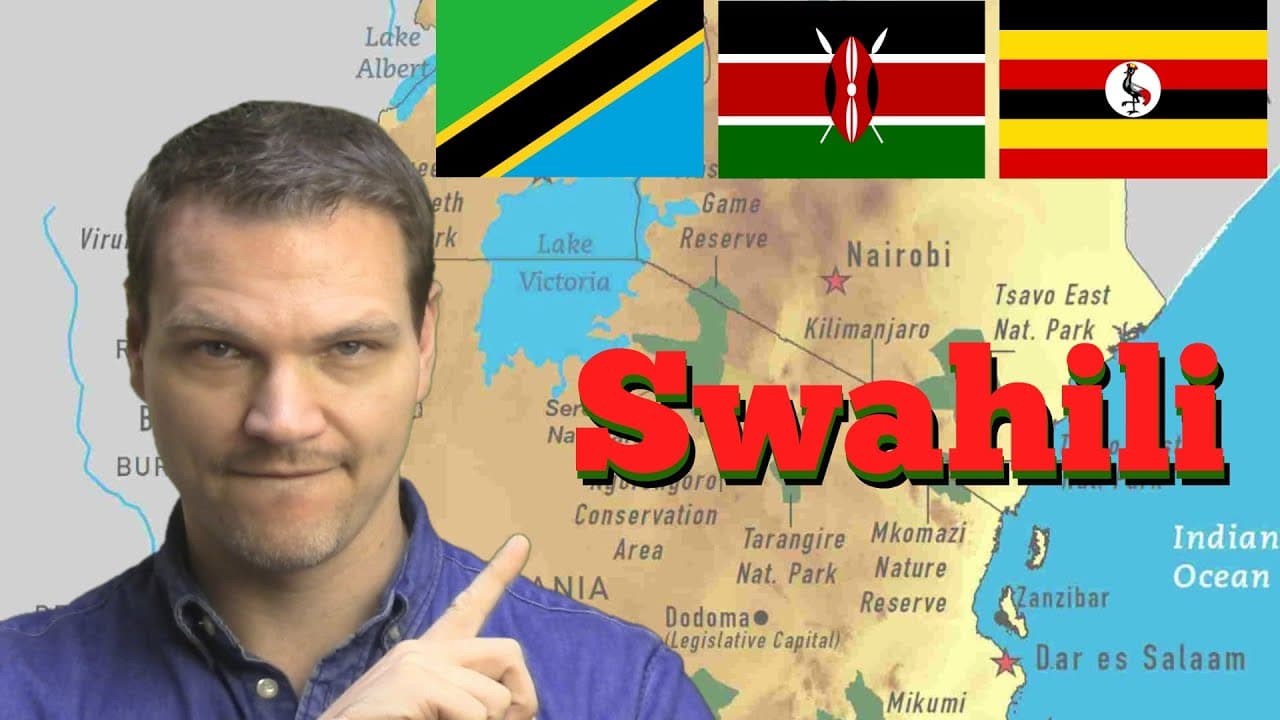
Swahili is a widely spoken lingua franca in East Africa.
Transcript
Learning a language? Have a look at our partner website, Italki, where you can meet language exchange partners for free, or learn on Skype with personal, customi(s/z)ed lessons. Buy your first lesson, and get your second lesson free. Check out the link in the description below. Hello, everyone! Welcome to the Langfocus channel, and my name is Pau... Read More
Key Insights
- Swahili is one of the most widely spoken languages in Africa, primarily used as a lingua franca across East Africa despite having relatively few native speakers.
- Swahili has a significant number of loanwords from Arabic, due to historical interactions with Middle Eastern traders, and also contains influences from Persian, Malay, and Portuguese.
- The language is an official language in several African countries, including Kenya, Tanzania, Uganda, and the Democratic Republic of the Congo, and is widely used in Rwanda and Burundi.
- Swahili belongs to the Bantu branch of the Niger-Congo language family and has a complex system of noun classes, which is a major challenge for learners.
- The language was historically written in Arabic script but is now written in Latin script due to European colonial influence, with a phonetic writing system.
- Swahili's grammar includes a unique verbal system with subject prefixes, tense markers, and object infixes, which can be challenging for new learners.
- Swahili vocabulary includes many words familiar to English speakers through popular culture, such as 'Simba' from The Lion King, which means 'lion'.
- Despite being an official language in Uganda, Swahili is not widely taught or learned there, highlighting regional differences in language adoption.
Install to Summarize YouTube Videos and Get Transcripts
Explore YouTube Video Summarizer or Get YouTube Transcript Extractor
Questions & Answers
Q: What is the historical origin of the Swahili language?
Swahili originated as a language of the coastal areas of Kenya and Tanzania, developed through interactions between local Bantu-speaking people and foreign traders, particularly from the Middle East. Over time, it spread to nearby islands and further inland through trade and was influenced by various cultures, including Persian, Arabic, and European colonial powers.
Q: How has Swahili been influenced by other languages?
Swahili has been significantly influenced by Arabic due to historical trade interactions with Middle Eastern traders. It also contains loanwords from Persian, Malay, and Portuguese, reflecting its diverse cultural exchanges. The language's vocabulary includes many Arabic-derived words, and its writing system transitioned from Arabic to Latin script under European colonial influence.
Q: What makes Swahili's noun class system challenging for learners?
Swahili's noun class system is challenging because it categorizes nouns into different classes, each with specific prefixes for singular and plural forms. This system is unlike English, which uses suffixes for plurals. Learners must also apply these prefixes to adjectives and verbs, making it a complex aspect of Swahili grammar to master.
Q: Why is Swahili considered a lingua franca in East Africa?
Swahili is considered a lingua franca in East Africa because it serves as a common language that unites speakers of diverse native languages across the region. It is widely used in countries like Kenya, Tanzania, and the Democratic Republic of the Congo for communication in trade, education, and government, facilitating interaction among people with different linguistic backgrounds.
Q: How did European colonial powers influence the Swahili language?
European colonial powers, particularly the British and Germans, influenced Swahili by promoting its use as a national language to unify diverse populations. Germany made Swahili the official language in Tanganyika (now Tanzania), while the British used it for local administration and primary education in Kenya. This colonial influence led to the standardization of Swahili and its adoption of the Latin script.
Q: What are some examples of Swahili words familiar to English speakers?
English speakers may recognize Swahili words like 'Simba' (lion), 'Nala' (gift), 'Rafiki' (friend), 'Pumba' (stupid), and 'Hakuna Matata' (no worries) from popular culture, particularly the Disney movie The Lion King. These words highlight Swahili's influence and presence in global media and entertainment.
Q: How is Swahili taught and used in Uganda?
In Uganda, Swahili is an official language and compulsory in schools. However, it is not widely taught or learned due to a lack of interest and implementation in educational institutions. This reflects regional differences in the adoption and use of Swahili, contrasting with countries like Kenya and Tanzania where it is more widely spoken and integrated into daily life.
Q: What is the current status of Swahili as a native language?
Swahili is increasingly being spoken as a native language, especially among younger generations in urban areas of Tanzania and Kenya. While traditionally used as a second or third language, its status as an official language and its role in education and media are contributing to its growth as a native language in certain regions.
Summary & Key Takeaways
-
Swahili, or Kiswahili, is a Bantu language widely spoken across East Africa as a lingua franca. It has a small number of native speakers but is used by millions as a second or third language. Swahili is an official language in several countries and has absorbed many loanwords from Arabic due to historical trade interactions.
-
The language has a complex noun class system, which is one of its most challenging aspects for learners. Swahili was once written in Arabic script but now uses the Latin alphabet. Its verbal system includes subject prefixes, tense markers, and object infixes, requiring adjustment for new learners.
-
Swahili's vocabulary includes many words from Arabic, Persian, Malay, and Portuguese, reflecting its diverse historical influences. The language is promoted in education systems in countries like Kenya and Tanzania, but its adoption varies regionally, with less emphasis in countries like Uganda.
Read in Other Languages (beta)
Share This Summary 📚
Summarize YouTube Videos and Get Video Transcripts with 1-Click
Try YouTube Summary with ChatGPT & Claude or YouTube Transcript Generator
Explore More Summaries from Langfocus 📚


Summarize YouTube Videos and Get Video Transcripts with 1-Click
Try YouTube Summary with ChatGPT & Claude or YouTube Transcript Generator