What Is Hess's Law in Thermodynamics?
TL;DR
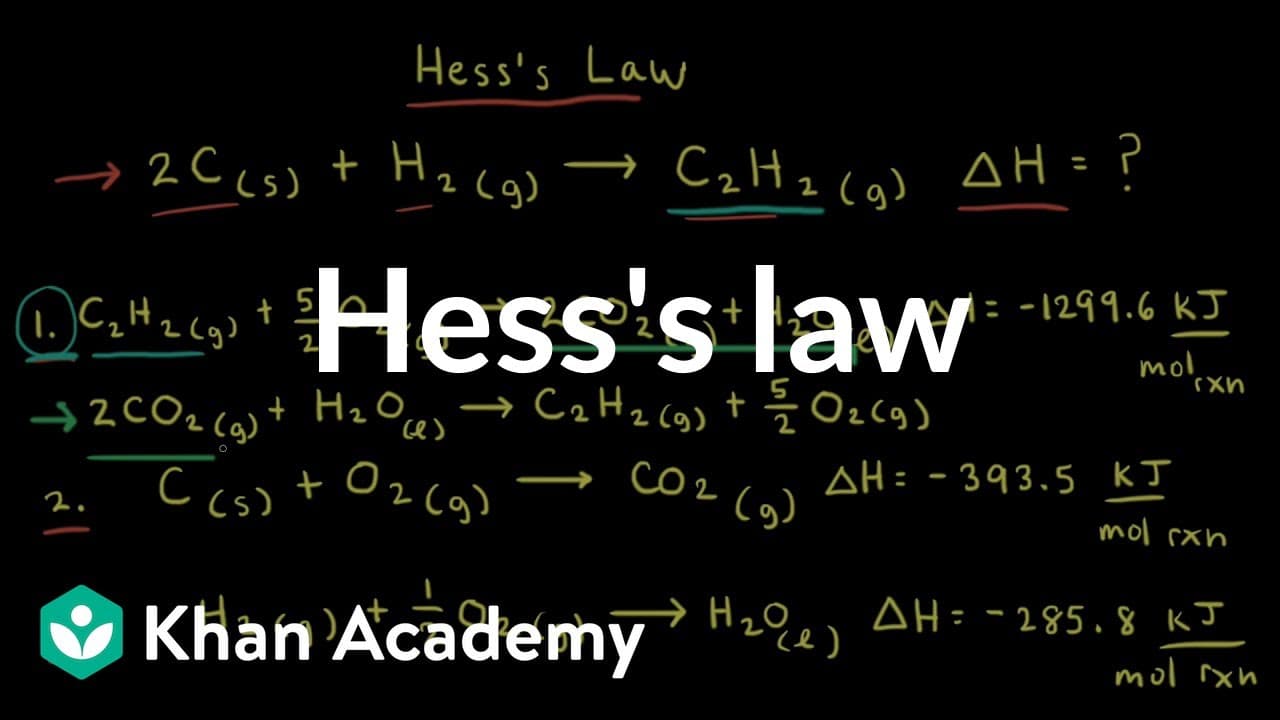
Hess's Law states that the total change in enthalpy for a chemical reaction is equal to the sum of the enthalpy changes from each step, regardless of the reaction path taken. This principle allows for the calculation of enthalpy changes by combining reactions and making necessary adjustments to their equations.
Transcript
- [Instructor] Hess's law states that the overall change in enthalpy for a chemical reaction is equal to the sum of the enthalpy changes for each step. And this is independent of the path taken. So it doesn't matter what set of reactions you use. If you add up those reactions and they equal the reaction that you're trying to find, you can also sum ... Read More
Key Insights
- 💱 Hess's Law allows us to calculate the change in enthalpy for a reaction by combining enthalpy changes from different reactions.
- 🧑🏭 Adjusting the equations involves comparing them to the original reaction and making necessary changes such as reversing or multiplying them by a factor.
- 🪡 When adjusting equations in Hess's Law calculations, the enthalpy changes also need to be reversed to maintain consistency.
- 💱 The overall change in enthalpy can be determined by adding up the enthalpy changes of the individual steps.
Install to Summarize YouTube Videos and Get Transcripts
Explore YouTube Video Summarizer or Get YouTube Transcript Extractor
Questions & Answers
Q: What does Hess's Law state and why is it useful in chemistry?
Hess's Law states that the overall change in enthalpy for a chemical reaction is equal to the sum of the enthalpy changes for each step, regardless of the reaction path. It is useful because it allows us to calculate the enthalpy change for a reaction by combining known enthalpy changes from different reactions.
Q: How do we adjust the equations in Hess's Law calculations?
To adjust the equations, we compare them to the original reaction and make changes as necessary. We may need to reverse the equations, multiply them by a factor, or keep them as they are. These adjustments ensure that the reactants and products match the original reaction.
Q: Which enthalpy changes need to be reversed when adjusting the equations?
When reversing an equation, we also need to reverse the sign of the enthalpy change (ΔH). This ensures that the calculations follow the correct direction of the reaction.
Q: How can we calculate the overall change in enthalpy using Hess's Law?
To calculate the overall change in enthalpy, we add up the enthalpy changes from each step. By adjusting and summing the enthalpy changes of the individual reactions, we can determine the enthalpy change for the overall reaction.
Summary & Key Takeaways
-
Hess's Law states that the change in enthalpy for a chemical reaction is independent of the reaction path and is equal to the sum of the enthalpy changes for each step.
-
To calculate the change in enthalpy for a reaction, we can use a series of known reactions and compare them to the original reaction to make adjustments and sum up the enthalpy changes.
-
In this example, three reactions are used to find the change in enthalpy for the formation of acetylene from carbon and hydrogen.
Read in Other Languages (beta)
Share This Summary 📚
Summarize YouTube Videos and Get Video Transcripts with 1-Click
Try YouTube Summary with ChatGPT & Claude or YouTube Transcript Generator
Explore More Summaries from Khan Academy 📚



Summarize YouTube Videos and Get Video Transcripts with 1-Click
Try YouTube Summary with ChatGPT & Claude or YouTube Transcript Generator