Measurement Uncertainty - Squares, Cubes, and Square Roots
TL;DR
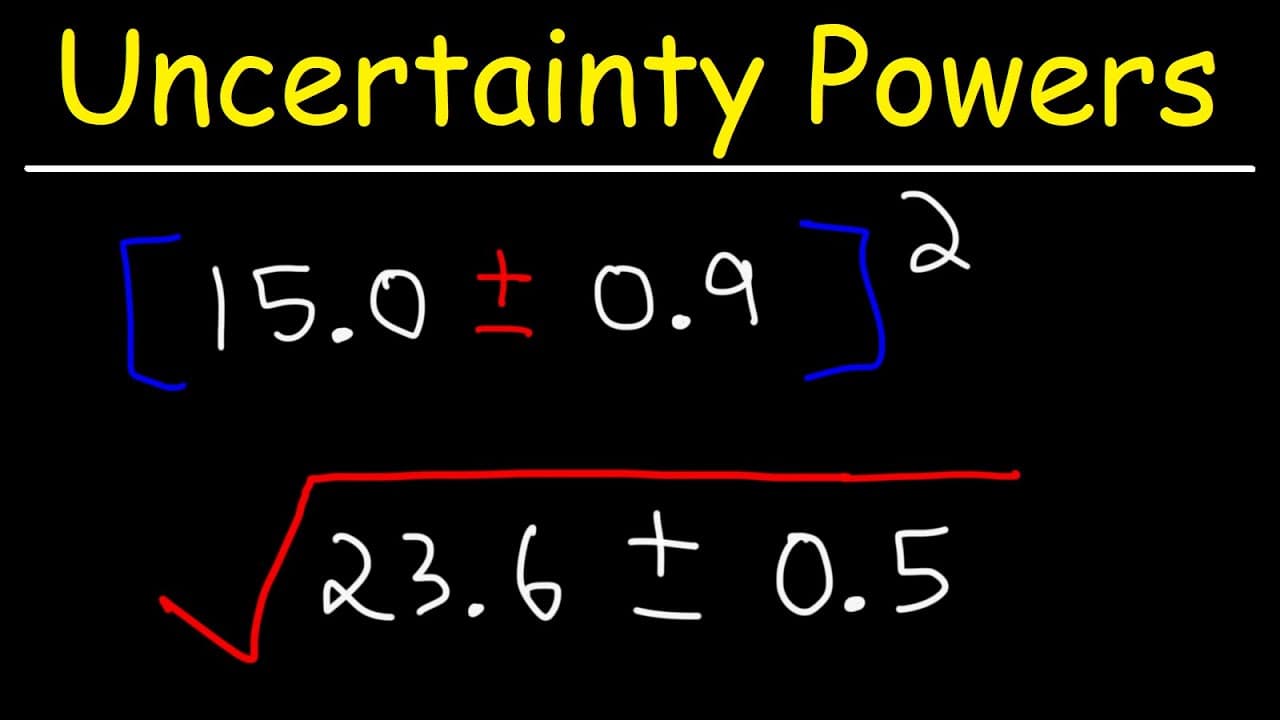
Learn how to calculate uncertainty for values raised to powers and roots, and convert them to percent uncertainty.
Transcript
now in this video we're going to focus on uncertainty calculations but with powers and roots particularly squares cubes and square roots so let's begin with this example let's say we have 15.0 plus or minus 0.9 so this is the measured value and this is the uncertainty but what we're going to do is we're going to square this result if we square it w... Read More
Key Insights
- ✊ When dealing with uncertainty in values raised to powers, the value is squared or cubed, while the percent uncertainty is multiplied by the power.
- 🗂️ Converting uncertainty to percent uncertainty involves dividing the uncertainty by the measured value and multiplying by 100%.
- 🧡 Rounding the measured value and uncertainty to the appropriate number of significant figures helps ensure the final answer falls within the range.
- ✊ When taking the square root, the value is raised to the power of one-half, and the percent uncertainty is multiplied by half (or the exponent).
Install to Summarize YouTube Videos and Get Transcripts
Explore YouTube Video Summarizer or Get YouTube Transcript Extractor
Questions & Answers
Q: What is the first step in calculating uncertainty for values raised to powers and roots?
The first step is to convert the uncertainty into percent uncertainty by dividing it by the measured value and multiplying by 100%.
Q: Should the percent uncertainty be squared or multiplied when raising a value to a power?
The percent uncertainty should be multiplied by the power, not squared. The value itself is squared or cubed, while the percent uncertainty is multiplied by the power.
Q: How can rounding help ensure the final answer falls within the range of the measured value and uncertainty?
Rounding the measured value and uncertainty to the appropriate number of significant figures ensures that the final answer falls within the range. For example, rounding up the uncertainty value can extend the range and include the final answer.
Q: What should be done with the percent uncertainty when taking the square root of a value?
The percent uncertainty should be multiplied by half (or the exponent) when taking the square root of a value. This is because the square root is equivalent to raising the value to the power of one-half.
Summary & Key Takeaways
-
The video teaches how to calculate uncertainty for values raised to powers and roots.
-
It explains the process of converting uncertainty to percent uncertainty.
-
The video provides examples and demonstrates how to round the final answer to ensure it falls within the range of the measured value and uncertainty.
Read in Other Languages (beta)
Share This Summary 📚
Summarize YouTube Videos and Get Video Transcripts with 1-Click
Try YouTube Summary with ChatGPT & Claude or YouTube Transcript Generator
Explore More Summaries from The Organic Chemistry Tutor 📚

Summarize YouTube Videos and Get Video Transcripts with 1-Click
Try YouTube Summary with ChatGPT & Claude or YouTube Transcript Generator