What Are Rate Law Expressions for SN2, SN1, E1, and E2 Reactions?
TL;DR
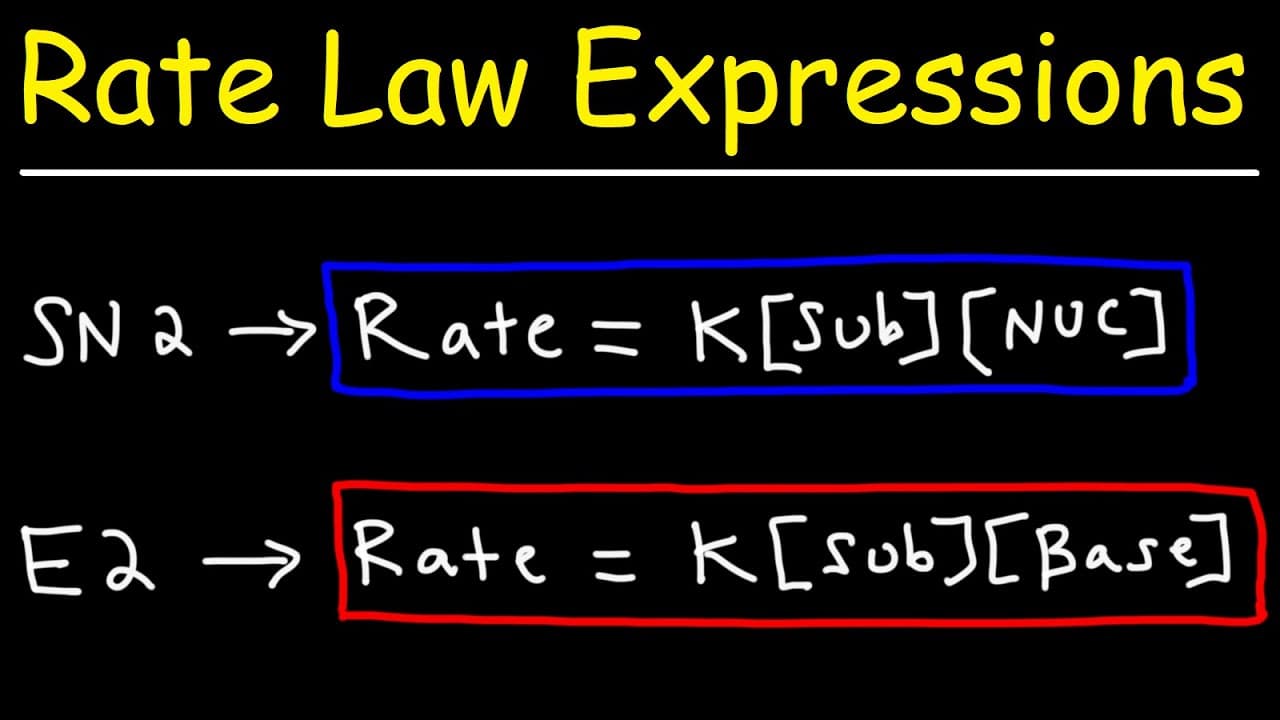
Rate law expressions vary across SN1, SN2, E1, and E2 reactions: SN2 is second-order and depends on substrate and nucleophile concentrations, while SN1 and E1 depend solely on substrate concentration. In contrast, E2 reactions depend on both substrate and base concentrations, making them second-order as well.
Transcript
in this video we're going to talk about the rate law expressions for s from 1s into E1 E2 reactions so let's begin with the sn2 reaction here we have two bromo butane and I'm going to react it with let's say potassium iodide I'm just going to draw the anion so the iodide ion it's a very good nucleophile and what it's going to do it's going to behav... Read More
Key Insights
- 😑 S<sub>N</sub>2 reactions involve nucleophilic substitution and have a rate law expression that depends on both substrate and nucleophile concentrations.
- 😑 S<sub>N</sub>1 reactions involve carbocation formation and have a rate law expression that only depends on the substrate concentration.
- 😑 E1 reactions also involve carbocation formation, but the rate law expression is the same as for S<sub>N</sub>1 reactions.
- 😑 E2 reactions involve elimination and have a rate law expression that depends on both substrate and base concentrations.
Install to Summarize YouTube Videos and Get Transcripts
Explore YouTube Video Summarizer or Get YouTube Transcript Extractor
Questions & Answers
Q: What is the rate law expression for an S<sub>N</sub>2 reaction?
The rate law expression for an S<sub>N</sub>2 reaction is second-order, depending on the concentration of both the substrate and the nucleophile. It can be written as rate = k [substrate] [nucleophile].
Q: How does the rate law expression differ for an S<sub>N</sub>1 reaction?
The rate law expression for an S<sub>N</sub>1 reaction only depends on the concentration of the substrate. It can be written as rate = k [substrate].
Q: What are the key steps in an E1 reaction?
In an E1 reaction, the first step is ionization, where the leaving group leaves and a carbocation is formed. Then, a base abstracts a proton from the carbocation, resulting in the formation of an alkene.
Q: How does the rate law expression for an E2 reaction differ from the other reactions?
The rate law expression for an E2 reaction depends on both the concentration of the substrate and the base. It can be written as rate = k [substrate] [base].
Summary & Key Takeaways
-
S<sub>N</sub>2 reactions involve a nucleophile attacking a substrate, resulting in inversion of configuration. The rate law expression for S<sub>N</sub>2 reactions is second-order, depending on the concentration of both the substrate and the nucleophile.
-
S<sub>N</sub>1 reactions occur when a leaving group leaves a substrate, forming a carbocation, followed by the nucleophile attacking the carbocation. The rate law expression for S<sub>N</sub>1 reactions only depends on the concentration of the substrate.
-
E1 reactions involve ionization of the leaving group, followed by a base abstracting a proton to form an alkene. The rate law expression for E1 reactions is the same as for S<sub>N</sub>1 reactions, depending only on the concentration of the substrate.
-
E2 reactions occur when a strong base abstracts a proton and a leaving group is expelled, leading to the formation of an alkene. The rate law expression for E2 reactions depends on the concentrations of both the substrate and the base.
Read in Other Languages (beta)
Share This Summary 📚
Summarize YouTube Videos and Get Video Transcripts with 1-Click
Try YouTube Summary with ChatGPT & Claude or YouTube Transcript Generator
Explore More Summaries from The Organic Chemistry Tutor 📚



Summarize YouTube Videos and Get Video Transcripts with 1-Click
Try YouTube Summary with ChatGPT & Claude or YouTube Transcript Generator