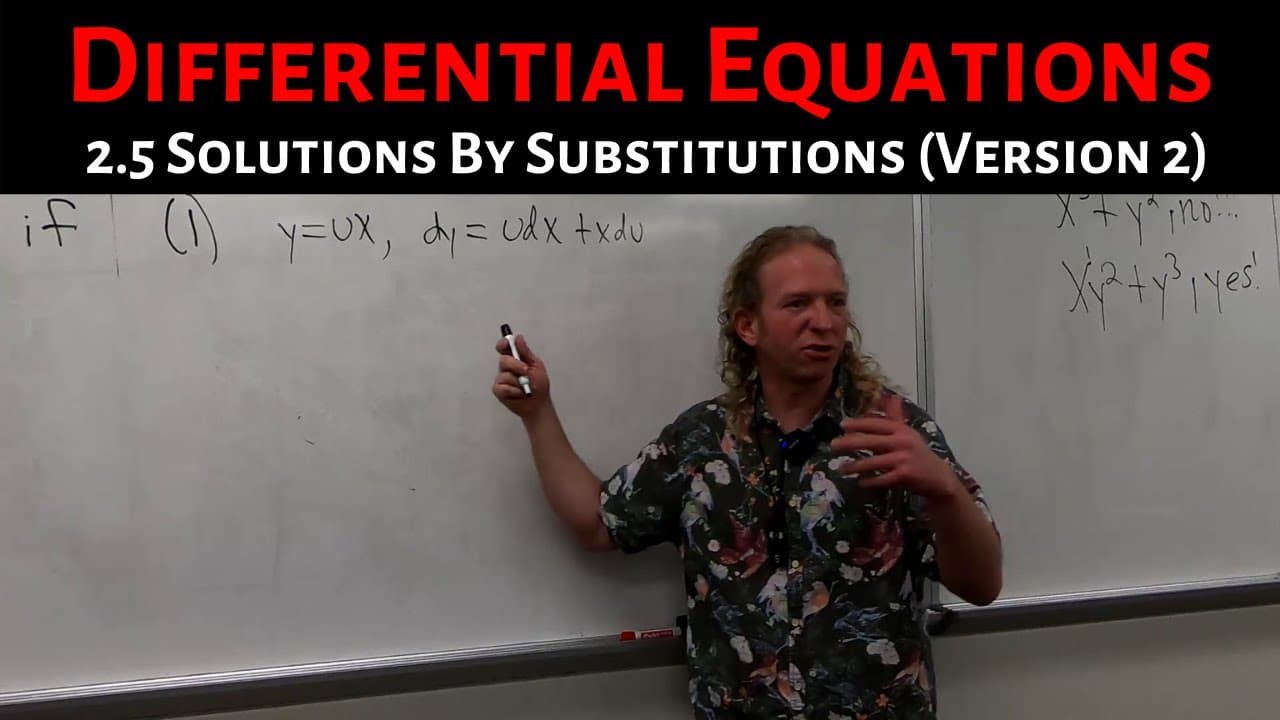
Differential Equations: Lecture 2.5 Solutions by Substitions (Version 2)
TL;DR
Analyzing and solving differential equations in homogeneous form using degree calculations and substitution for ease in integration.
Transcript
so we need to introduce the notion of what's called a homogeneous function so a function this is a really interesting concept so a function f of X Y so a function of two variables right so like count three style so function f of XY is called or said to be I just said call to save a few seconds is called homogenious so hold genius of degree this is ... Read More
Key Insights
- 👻 Homogeneous functions simplify calculations by allowing for the factoring out of a constant factor.
- ✊ Degree in homogeneity is crucial for determining the power at which the variable can be factored out in functions.
- 🦻 Incorporating substitution strategies in differential equations aids in transforming nonlinear functions into linear forms for easier resolution.
Install to Summarize YouTube Videos and Get Transcripts
Explore YouTube Video Summarizer or Get YouTube Transcript Extractor
Questions & Answers
Q: What is a homogeneous function in the context of differential equations?
A homogeneous function in differential equations is one where increasing all variables by a constant factor will also increase the function output by a constant factor, allowing for simplification in calculations.
Q: How does degree play a role in determining homogeneity in functions?
The degree of a homogeneous function, represented by a new variable alpha, dictates the power to which the constant factor can be factored out of the function, hence determining homogeneity.
Q: Why is integration factor crucial in transforming Bernoulli's equations to linear forms?
The integration factor eases the process of solving nonlinear Bernoulli's equations, simplifying the calculations and enabling the transformation to linear form for easier resolution.
Q: What role does substitution play in solving homogeneous functions in differential equations?
Substitution, such as representing Y as U to the power of 1-n in Bernoulli's equations, simplifies complex calculations and transforms nonlinear functions into linear forms for more manageable solutions.
Summary & Key Takeaways
-
Introduction to homogeneous functions in differential equations.
-
Explanation of homogeneity degree concept with examples.
-
Demonstration of problem solving through a step-by-step process using Bernoulli's equation.
Read in Other Languages (beta)
Share This Summary 📚
Summarize YouTube Videos and Get Video Transcripts with 1-Click
Try YouTube Summary with ChatGPT & Claude or YouTube Transcript Generator
Explore More Summaries from The Math Sorcerer 📚


Summarize YouTube Videos and Get Video Transcripts with 1-Click
Try YouTube Summary with ChatGPT & Claude or YouTube Transcript Generator