Mapping shapes
TL;DR
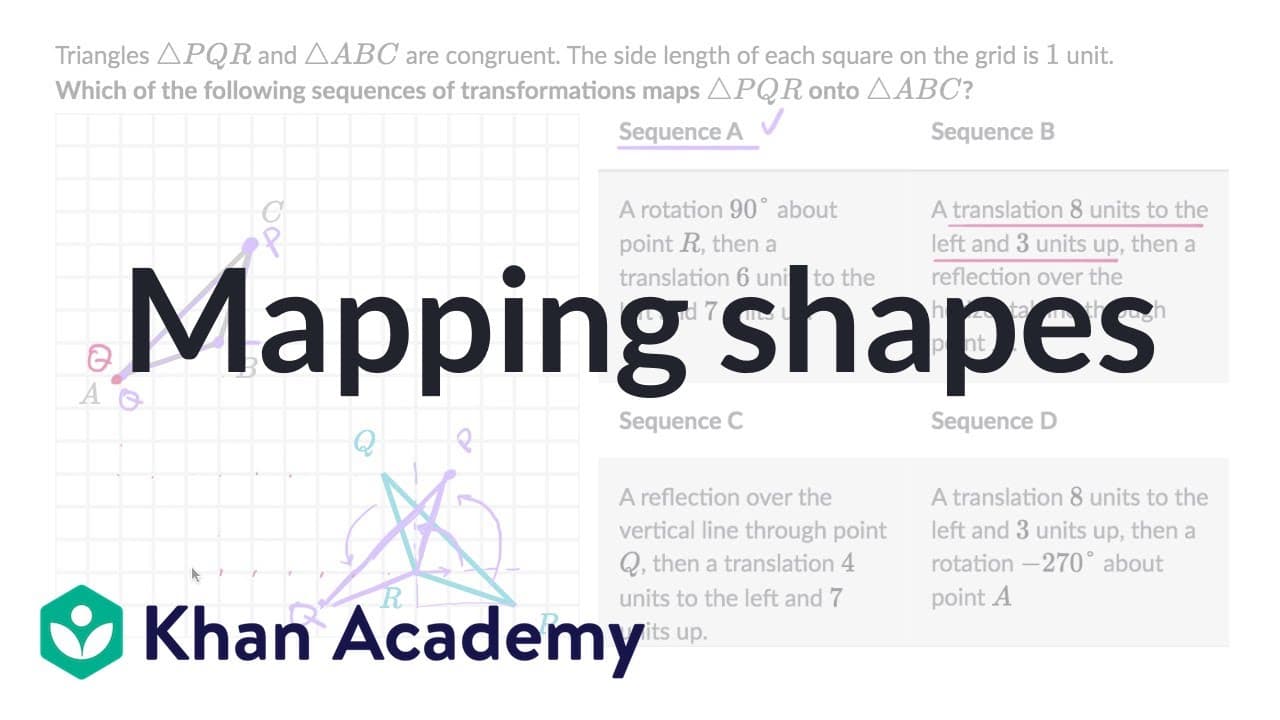
This video explains how to determine which sequence of transformations maps triangle PQR onto triangle ABC.
Transcript
- [Instructor] We're told that triangles, let's see, we have triangle PQR and triangle ABC are congruent. The side length of each square on the grid is one unit. So each of these is one unit. Which of the following sequences of transformations maps triangle PQR onto triangle ABC? So we have four different sequences of transformations, and so why do... Read More
Key Insights
- 🚦 The correct sequence of transformations to map PQR onto ABC is Sequence C, involving a reflection over a vertical line and a subsequent translation.
- 💦 Sequences A and D also work, showing alternative methods to achieve congruence between the triangles.
- 😥 Sequence B fails because the reflection over a horizontal line places point R incorrectly.
- 😥 Understanding the rotational and translational properties of each point is crucial in determining the correct sequence.
- 🏃 This exercise highlights the significance of visualizing transformations and their effects on shapes in geometry.
- 🔺 Isosceles triangles can be particularly useful in mapping since their symmetry simplifies the problem.
- 🫵 The video demonstrates step-by-step solutions, making it easier for viewers to understand and replicate the process.
Install to Summarize YouTube Videos and Get Transcripts
Explore YouTube Video Summarizer or Get YouTube Transcript Extractor
Questions & Answers
Q: What is the first step in Sequence A to map triangle PQR onto triangle ABC?
The first step in Sequence A is a 90-degree rotation about point R, where P moves to the right and up, and Q moves to the right as well.
Q: How does Sequence B differ from Sequence A in mapping the triangles?
In Sequence B, after the translation, a reflection over a horizontal line is performed. However, this sequence fails to map point R correctly and is not valid.
Q: What is the first transformation in Sequence C to map the triangles?
The first transformation in Sequence C is a reflection over a vertical line through point Q. This reflects P to the left and R to the left as well.
Q: How does Sequence D differ from the other sequences in mapping the triangles?
Sequence D starts with a translation to the left and up, followed by a rotation of -270 degrees about point A. This rotation maps the triangles onto each other.
Summary & Key Takeaways
-
The video presents four different sequences of transformations to map triangle PQR onto triangle ABC.
-
Sequence A involves a 90-degree rotation about point R, followed by a translation six units left and seven units up.
-
Sequence B includes a translation eight units left and three units up, followed by a reflection over a horizontal line.
-
Sequence C starts with a reflection over a vertical line through point Q, and then a translation four units left and seven units up.
-
Sequence D begins with a translation eight units left and three units up, followed by a rotation -270 degrees about point A.
Read in Other Languages (beta)
Share This Summary 📚
Summarize YouTube Videos and Get Video Transcripts with 1-Click
Try YouTube Summary with ChatGPT & Claude or YouTube Transcript Generator
Explore More Summaries from Khan Academy 📚



Summarize YouTube Videos and Get Video Transcripts with 1-Click
Try YouTube Summary with ChatGPT & Claude or YouTube Transcript Generator