What are Direction Cosines and Direction Angles? Full Derivation:)
TL;DR
Exploring direction angles and cosines to describe vectors with formulas and unit vectors.
Transcript
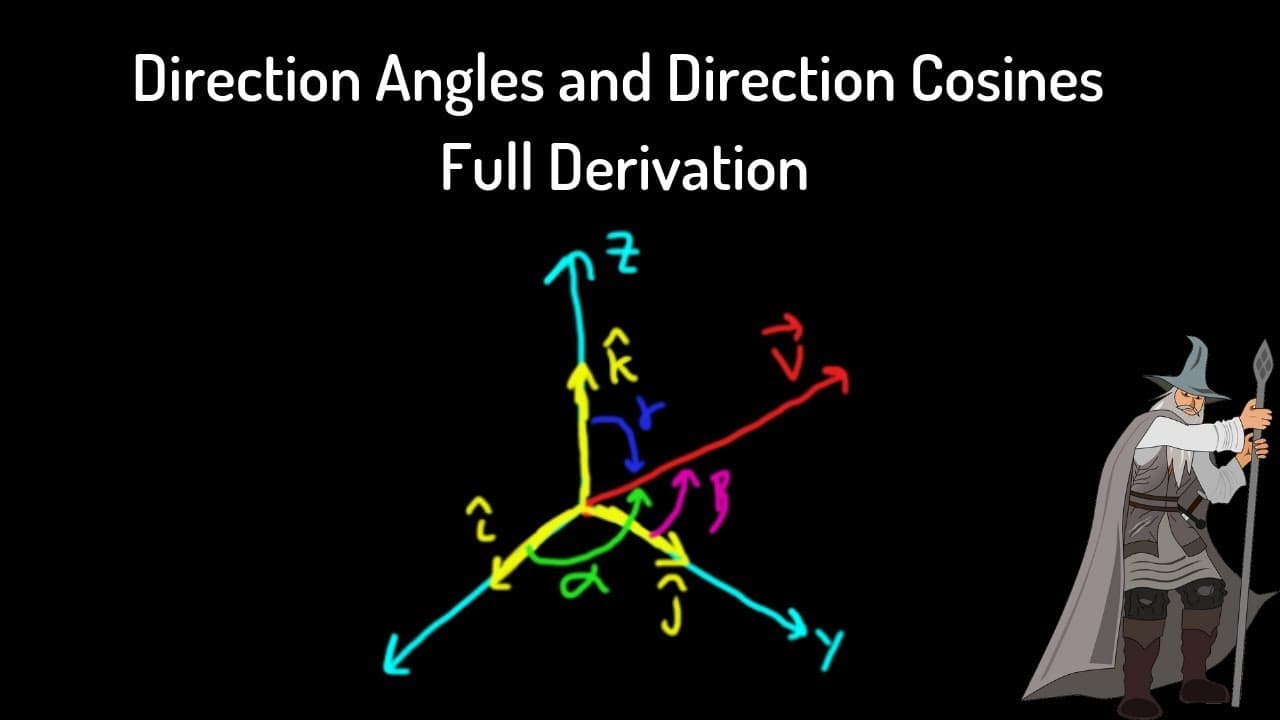
hi everyone in this video I wanted to show you what direction cosines are and how to drive all of the formulas from scratch so Direction cosines so we're going to do this all from nothing so we'll start by drawing a picture of the X Y Z plane so this here will be the z axis and this over here will be the x axis and this here will be the y axis all ... Read More
Key Insights
- 🔺 Direction angles describe the orientation of vectors relative to standard unit vectors.
- 🗂️ Deriving direction cosines involves dividing vector components by the vector's magnitude.
- 😑 Unit vectors can be expressed in terms of direction cosines for a compact representation.
- 🍹 The identity linking the sum of squared direction cosines to one highlights their orthogonality.
- 🖐️ Direction cosines play a vital role in precise vector analysis and computations.
- 👾 Understanding direction cosines enhances the comprehension of vector orientations in 3D space.
- 💁 Direction angles and cosines form the basis for vector mathematics and calculations.
Install to Summarize YouTube Videos and Get Transcripts
Explore YouTube Video Summarizer or Get YouTube Transcript Extractor
Questions & Answers
Q: What are direction angles, and how are they related to vectors?
Direction angles are the angles between vectors and standard unit vectors. They describe the orientation of a vector in space and play a crucial role in determining the direction cosines for the vector.
Q: How can direction cosines be derived for a given vector?
Direction cosines can be calculated by taking the components of a vector and dividing them by the vector's magnitude. The resulting ratios of components to magnitude give the cosine values of the direction angles.
Q: What is the significance of expressing unit vectors in terms of direction cosines?
The expression of unit vectors using direction cosines allows for a concise representation of vectors in terms of direction angles. This representation simplifies vector analysis and computations involving directions.
Q: Why is the identity involving the sum of squared direction cosines essential?
The identity stating that the sum of squared direction cosines equals one is crucial as it confirms the orthogonality of direction cosines. It ensures that the direction angles are orthogonal and adds to the understanding of vector orientations.
Summary & Key Takeaways
-
Introduction to direction cosines and angles.
-
Explanation of how to derive and calculate direction cosines.
-
Demonstrating how unit vectors can be expressed in terms of direction cosines.
Read in Other Languages (beta)
Share This Summary 📚
Summarize YouTube Videos and Get Video Transcripts with 1-Click
Try YouTube Summary with ChatGPT & Claude or YouTube Transcript Generator
Explore More Summaries from The Math Sorcerer 📚


Summarize YouTube Videos and Get Video Transcripts with 1-Click
Try YouTube Summary with ChatGPT & Claude or YouTube Transcript Generator