Screw Thread Terminology - Screw Thread Measurements - Metrology and Quality Engineering
TL;DR
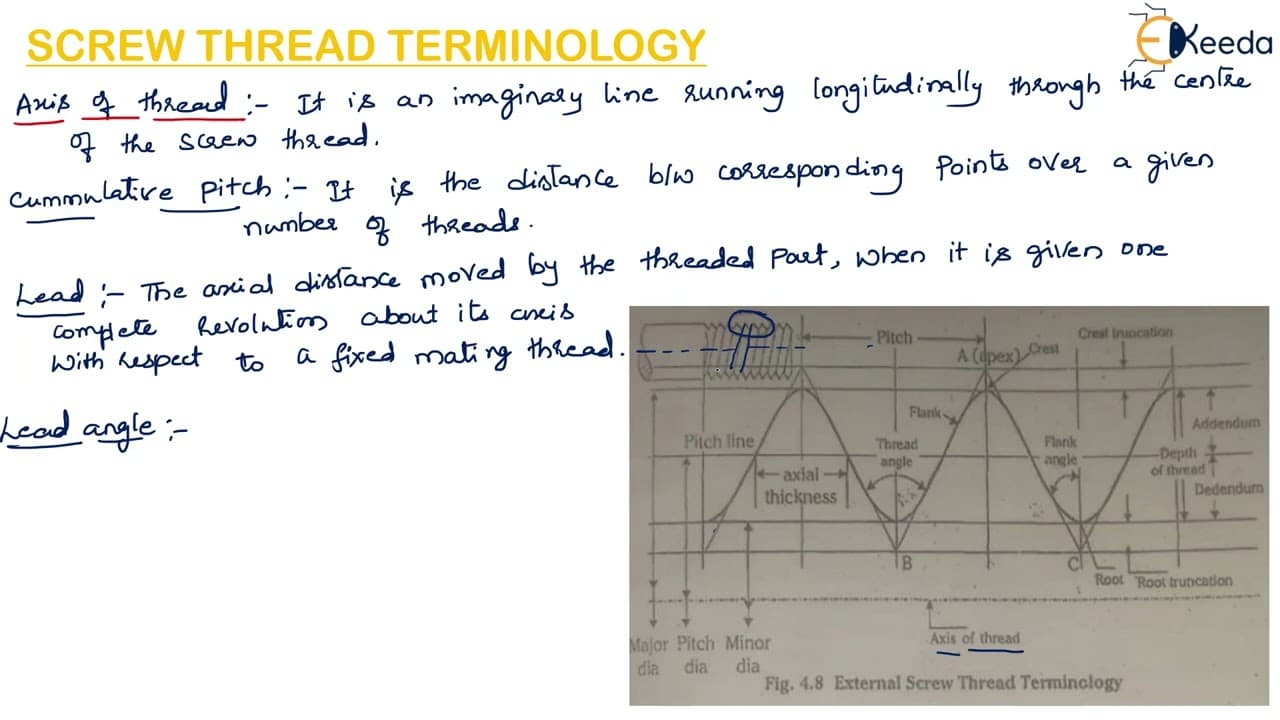
"This content discusses the terminology related to screw threads, including external and internal threads, single start and multi-start threads, crest and root, flank and half angle of thread, pitch, lead, helix angle, depth, axial thickness, fundamental triangle, addendum and dedendum, major and minor diameter."
Transcript
hello students today let us discuss the topic screw thread terminology so when helical grooves are formed on the exterior then the thread is called as an external thread so here we can see external threads which are formed outside or on the exterior surface of a cylindrical shape so these are the external threads when the helical grooves are formed... Read More
Key Insights
- 💁 Screw threads can be categorized as external (formed on the exterior surface) and internal (formed on the interior of a circular hole).
- 🧵 Single start threads have only one helical groove, while multi-start threads have multiple helical ridges.
- 🧵 The root and crest of a thread can be curved or flat depending on the type of thread.
- 🧵 Flank angle and half angle of thread determine the geometry of the thread.
- 😥 Pitch is the distance between corresponding points on adjacent threads, measured parallel to the axis.
- 🥺 Lead is the axial distance moved by the threaded part in one complete revolution.
- 🧵 Helix angle represents the inclination of the thread.
Install to Summarize YouTube Videos and Get Transcripts
Explore YouTube Video Summarizer or Get YouTube Transcript Extractor
Questions & Answers
Q: What is the difference between an external thread and an internal thread?
An external thread is formed on the exterior surface of a cylindrical shape, while an internal thread is formed on the interior of a circular hole.
Q: What is a single start thread?
A single start thread is a thread with only one helical groove.
Q: How is the pitch of a thread measured?
The pitch is the distance measured parallel to the axis of the thread between corresponding points on the adjacent threads, on the same axial plane and on the same side of the axis.
Q: What is the lead of a threaded part?
The lead is the axial distance moved by the threaded part when it is given one complete revolution about its axis with respect to a fixed mating thread.
Q: What is the significance of the helix angle?
The helix angle is the angle made by the helix of the thread at the pitch line with the axis. It determines the inclination of the thread.
Q: How is the depth of a thread measured?
The depth of a thread is the distance between the crest and the root of the thread, measured perpendicular to the longitudinal axis of the thread.
Q: What is the addendum of an external thread?
The addendum of an external thread is the radial distance between the major diameter and the pitch line.
Q: How is the minor diameter defined?
The minor diameter is the diameter of the pitch cylinder that intersects the flanks of the thread in such a way that the width of the threads and the spaces between them are equal.
Summary & Key Takeaways
-
The content explains the definition of external and internal threads, as well as single start and multi-start threads.
-
It discusses the terms related to the structure of threads, such as crest, root, flank, and half angle of thread.
-
Pitch, lead, helix angle, depth, axial thickness, fundamental triangle, addendum, dedendum, major and minor diameter are also covered in the content.
Read in Other Languages (beta)
Share This Summary 📚
Summarize YouTube Videos and Get Video Transcripts with 1-Click
Try YouTube Summary with ChatGPT & Claude or YouTube Transcript Generator
Explore More Summaries from Ekeeda 📚






Summarize YouTube Videos and Get Video Transcripts with 1-Click
Try YouTube Summary with ChatGPT & Claude or YouTube Transcript Generator