Darcy Weisbach Equation Friction Factor - Real Fluid Flows - Fluid Mechanics 1
TL;DR
This content explains the derivation of Darcy's equation for major loss in fluid friction, covering concepts such as Bernoulli's equation, frictional force, and friction factor.
Transcript
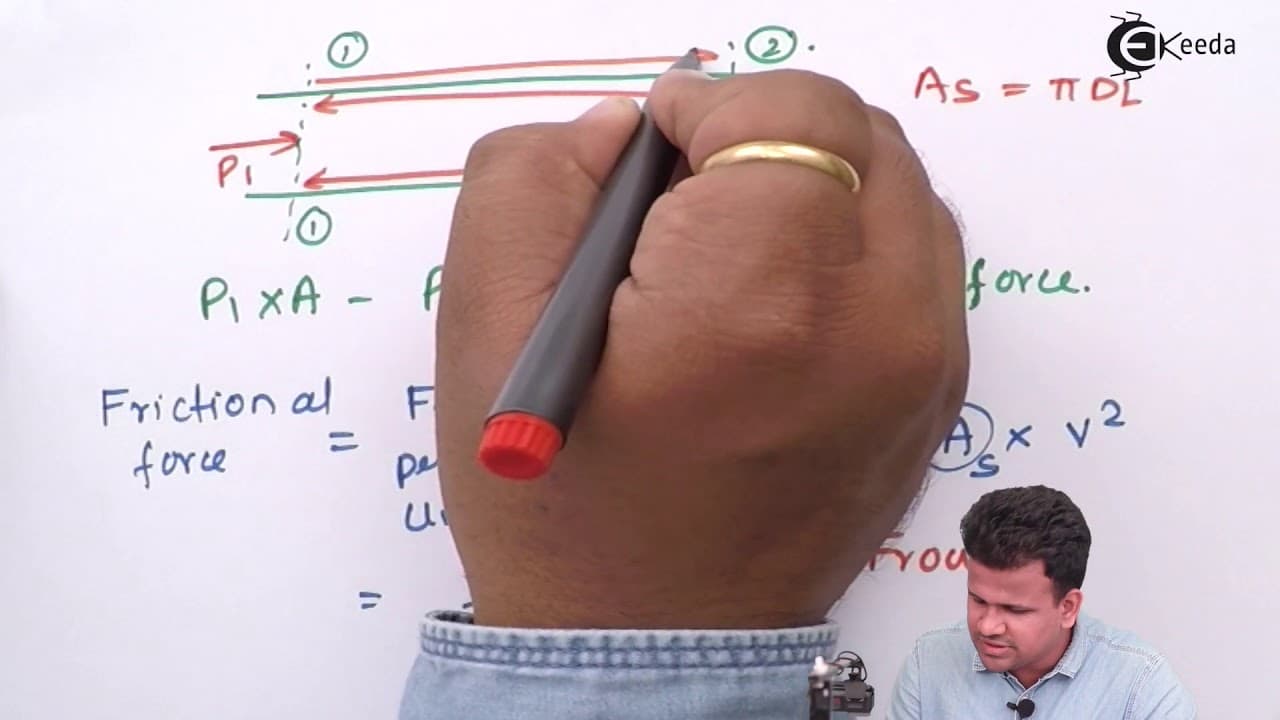
as we have studied the major loss and minor loss let us derive what is darcy's equation for major loss over here for that we need to consider flow through a pipe so let us study what is darcy's equation rather it is also called as big back and darcy's equation for fluid friction now we have already seen what is darcy's and wick back equation for fl... Read More
Key Insights
- 🌸 Darcy's equation for major loss in fluid friction (h_f = flv^2/(2gd)) is derived by considering flow through a pipe and applying Bernoulli's equation.
- 🇦🇪 The frictional force is calculated using the frictional resistance per unit area per unit velocity (f_dash) and the formula introduced by a scientist named Froude.
- 🧑🏭 Friction factor (f) is related to the frictional resistance and the coefficient of friction, with a value of 4 times the coefficient of friction.
- 💐 The head loss due to friction can be expressed in terms of flow rate by substituting the flow rate (q) in the equation h_f = flq^2/(12.1 * d^5).
Install to Summarize YouTube Videos and Get Transcripts
Explore YouTube Video Summarizer or Get YouTube Transcript Extractor
Questions & Answers
Q: What is Darcy's equation for major loss in fluid friction?
Darcy's equation for major loss in fluid friction is h_f = flv^2/(2gd), where h_f represents the head loss due to friction, f is the friction factor, l is the length of the pipe, v is the velocity of the fluid, g is the acceleration due to gravity, and d is the diameter of the pipe.
Q: How is frictional force calculated in the derivation?
The frictional force is calculated using the equation f_dash = (f_double_dash*rho/2) * A_s * v^2, where f_dash is the frictional resistance per unit area per unit velocity, f_double_dash is the coefficient of friction, rho is the density of the fluid, A_s is the surface area of the pipe, and v is the velocity of the fluid.
Q: What are the relationships between frictional resistance, coefficient of friction, and friction factor?
Frictional resistance per unit area per unit velocity (f_dash) is equal to the coefficient of friction (f_double_dash) multiplied by the density of the fluid (rho) divided by 2. The friction factor (f) is four times the coefficient of friction, stated as f = 4 * f_double_dash. These relationships help in expressing the head loss due to friction in various forms.
Q: How is the head loss due to friction derived in terms of flow rate?
The head loss due to friction can be derived in terms of flow rate using the equation h_f = flq^2/(12.1 * d^5), where q is the flow rate and d is the diameter of the pipe. This equation allows for solving problems related to fluid flow using flow rate as a variable.
Summary & Key Takeaways
-
The content discusses the derivation of Darcy's equation for major loss in fluid friction, focusing on flow through a pipe and the application of Bernoulli's equation.
-
It explains the calculation of head loss due to friction, providing the equation as h_f = flv^2/(2gd), where f is the friction factor.
-
The derivation is presented in terms of different components such as frictional resistance, coefficient of friction, and frictional factor.
-
The content also explains the relationship between friction factor and Reynolds number for laminar and turbulent flows.
Read in Other Languages (beta)
Share This Summary 📚
Summarize YouTube Videos and Get Video Transcripts with 1-Click
Try YouTube Summary with ChatGPT & Claude or YouTube Transcript Generator
Explore More Summaries from Ekeeda 📚






Summarize YouTube Videos and Get Video Transcripts with 1-Click
Try YouTube Summary with ChatGPT & Claude or YouTube Transcript Generator