Products
Features
YouTube Video Summarizer
Summarize YouTube videos
Web & PDF Highlighter
Highlight web pages & PDFs
Chat with PDF
Ask any PDF questions with AI
Ask AI Clone
Chat with your highlights & memories
Audio Transcriber
Transcribe audio files to text
Glasp Reader
Read and highlight articles
Kindle Highlight Export
Export your Kindle highlights
Idea Hatch
Hatch ideas from your highlights
Integrations
Obsidian Plugin
Notion Integration
Pocket Integration
Instapaper Integration
Medium Integration
Readwise Integration
Snipd Integration
Hypothesis Integration
Apps & Extensions
Chrome Extension
Safari Extension
Edge Add-ons
Firefox Add-ons
iOS App
Android App
Discover
Discover
Ideas
Discover new ideas and insights
Articles
Curated articles and insights
Books
Book recommendations by great minds
Posts
Essays and notes from readers
Quotes
Inspiring quotes collection
Videos
Curated videos and summaries
Explore Glasp
Glasp Newsletter
Weekly insights and updates
Glasp Talk
Interview series with great minds
Glasp Blog
Latest news and articles
Glasp Use Cases
Learn how others use Glasp
Build & Support
Glasp API
Access Glasp's API for developers
MCP Connector
Connect Glasp to Claude & ChatGPT
Community
Glasp Reddit Community
Students
Student discount and benefits
FAQs
Frequently Asked Questions
AboutPricing
DashboardLog inSign up

Twin Prime Conjecture - Numberphile
770.4K views
•
April 13, 2017
by
Numberphile
YouTube video player
Twin Prime Conjecture - Numberphile

TL;DR

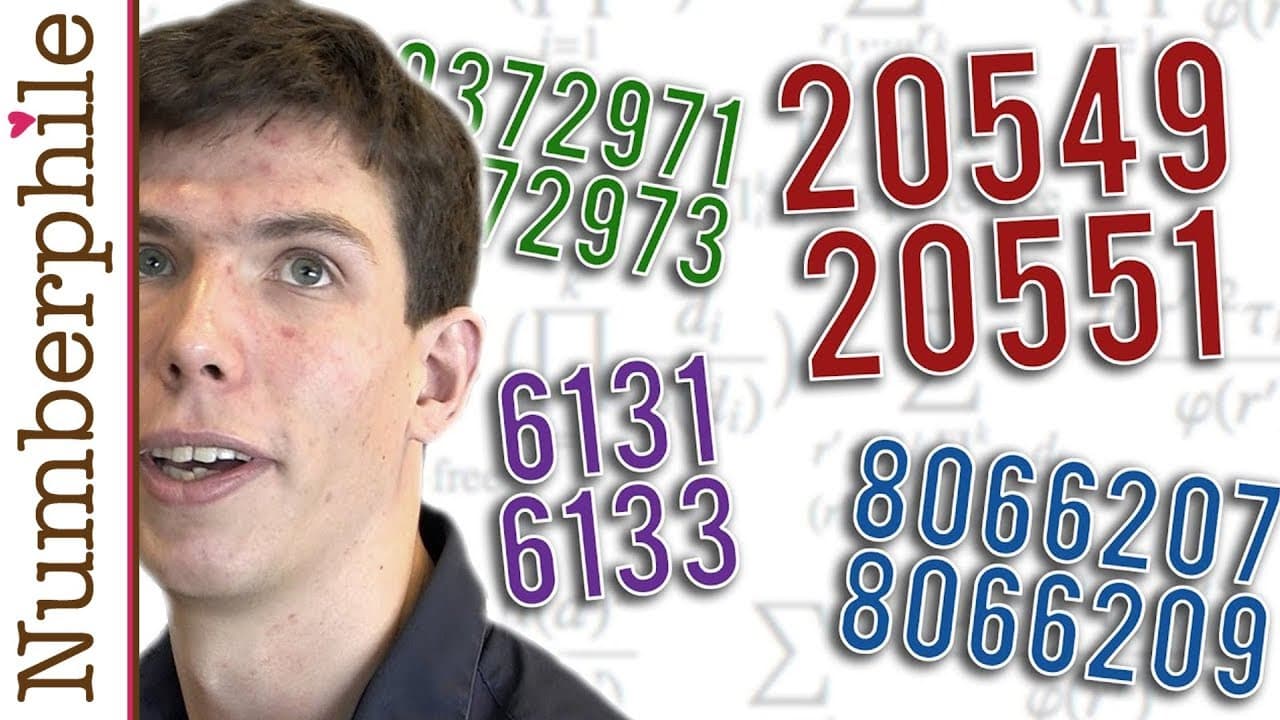
The Twin Prime Conjecture posits that there are infinitely many pairs of prime numbers that are exactly two apart.

Transcript

I'm interested in the twin prime conjecture so this is Asking about consecutive prime numbers p 1 as the first prime which be equal to [2] and there'll be the second time P 2 which would be equal to 3 And you can look at the gaps between the primes, so the gap between three and two... is one, this is the only time you can possibly have two prime nu... Read More

Key Insights

  • 🧘 The Twin Prime Conjecture posits infinite pairs of prime numbers with exactly a two-unit difference.
  • 👍 Yitang Zhang's 2013 breakthrough advanced understanding but did not fully prove the conjecture.
  • 💐 Recent developments have optimized methods, lowering the bound of prime pairs differing by less than 246.
  • ❓ Collaborative efforts and innovative approaches are at the forefront of refining techniques related to the Twin Prime Conjecture.
  • 👍 The quest to prove the conjecture stems from the inherent intrigue and complexity of prime numbers.
  • 👍 The Riemann hypothesis is a significant unsolved problem in number theory that, if proven, would revolutionize the field.
  • 💦 Mathematical progress, such as Zhang's work, often involves heuristic approaches and rigorous proofs.

Install to Summarize YouTube Videos and Get Transcripts

Explore YouTube Video Summarizer or Get YouTube Transcript Extractor

Questions & Answers

Q: What is the Twin Prime Conjecture?

The Twin Prime Conjecture suggests that there are infinite pairs of prime numbers separated by exactly two.

Q: How did Yitang Zhang contribute to understanding the Twin Prime Conjecture?

Zhang's 2013 breakthrough showed that prime pairs with gaps less than 70 million occur infinitely often but did not prove the conjecture entirely.

Q: What are some recent developments in optimizing methods related to the Twin Prime Conjecture?

Collaborative projects have refined techniques, lowering the bound of prime pairs differing by less than 246 using innovative approaches.

Q: What is the significance of finding pairs of twin primes?

Finding twin primes has theoretical implications and pushes the boundaries of number theory, contributing to a deeper understanding of prime numbers.

Summary & Key Takeaways

  • The Twin Prime Conjecture states that there are infinitely many pairs of prime numbers that differ by exactly two.

  • Yitang Zhang's breakthrough in 2013 partially proved the conjecture, showing gaps of up to 70 million.

  • Recent developments have further optimized methods, narrowing the bound of prime pairs differing by less than 246.


Read in Other Languages (beta)

English

Share This Summary 📚

Summarize YouTube Videos and Get Video Transcripts with 1-Click

Download browser extensions on:

Try YouTube Summary with ChatGPT & Claude or YouTube Transcript Generator

Explore More Summaries from Numberphile 📚

Statistics, Storks, and Babies - Numberphile thumbnail
Statistics, Storks, and Babies - Numberphile
Numberphile
Brown Numbers - Numberphile thumbnail
Brown Numbers - Numberphile
Numberphile
Cow-culus and Elegant Geometry - Numberphile thumbnail
Cow-culus and Elegant Geometry - Numberphile
Numberphile
The man with 1,000 Klein Bottles UNDER his house - Numberphile thumbnail
The man with 1,000 Klein Bottles UNDER his house - Numberphile
Numberphile
Professors React to 2048 - Numberphile thumbnail
Professors React to 2048 - Numberphile
Numberphile
29 and Leap Years - Numberphile thumbnail
29 and Leap Years - Numberphile
Numberphile

Summarize YouTube Videos and Get Video Transcripts with 1-Click

Download browser extensions on:

Try YouTube Summary with ChatGPT & Claude or YouTube Transcript Generator

Apps & Extensions

  • Chrome Extension
  • Safari Extension
  • Edge Add-ons
  • Firefox Add-ons
  • iOS App
  • Android App

Key Features

  • YouTube Video Summarizer
  • Web & PDF Summarizer
  • Web & PDF Highlighter
  • Chat with PDF
  • Ask AI Clone
  • Audio Transcriber
  • Glasp Reader
  • Kindle Highlight Export
  • Idea Hatch

Integrations

  • Obsidian Plugin
  • Notion Integration
  • Pocket Integration
  • Instapaper Integration
  • Medium Integration
  • Readwise Integration
  • Snipd Integration
  • Hypothesis Integration

More Features

  • APIs
  • MCP Connector
  • Blog & Post
  • Embed Links
  • Image Highlight
  • Personality Test
  • Quote Shots

Company

  • About us
  • Blog
  • Community
  • FAQs
  • Job Board
  • Newsletter
  • Pricing
Terms

•

Privacy

•

Guidelines

© 2026 Glasp Inc. All rights reserved.