Linear Queue using Array Part 3 Delete Operation | Data Structure Using C
TL;DR
This content explains how to delete a value from a linear queue implemented using an array and highlights the importance of the front and rear counters.
Transcript
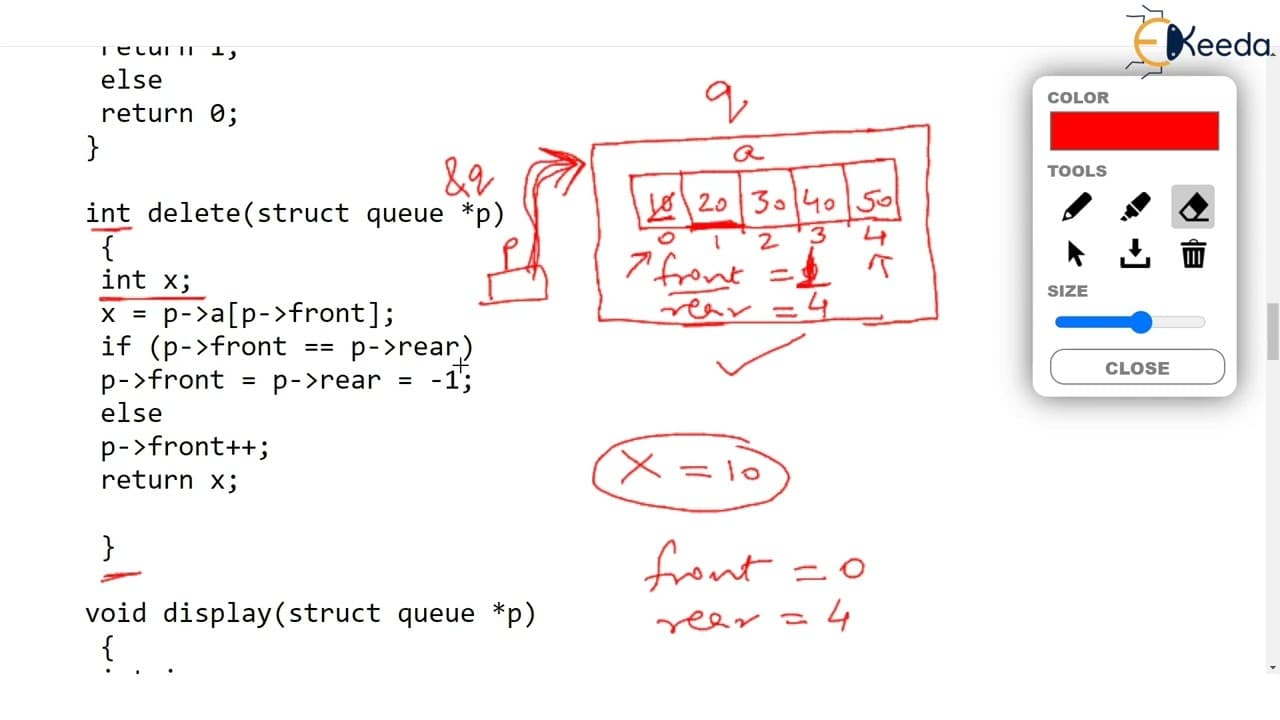
hello dear students let's continue our discussion on linear queue implemented by using array in the previous video we saw how to insert a new value in linear queue so we have seen how this insert function inserts values in the array every insertion always increases rear by one rear counter is increased by one during every insertion and if it is the... Read More
Key Insights
- ↩️ Deleting a value from a linear queue involves updating the front counter and returning the deleted value.
- 🤙 Checking if the queue is empty is essential before calling the delete function.
- 🫷 Pushing all the elements one place to the left after deletion can be time-consuming.
Install to Summarize YouTube Videos and Get Transcripts
Explore YouTube Video Summarizer or Get YouTube Transcript Extractor
Questions & Answers
Q: How does the delete function work in a linear queue?
The delete function checks if the queue is empty and, if not, it removes the front-most element and updates the front counter. It then returns the value that was deleted.
Q: Why is it important to check if the queue is empty before calling the delete function?
Checking if the queue is empty ensures that there is a value to delete. If the queue is empty, the program will display "q underflow" because there is nothing to delete.
Q: Why is the front counter increased by one when deleting a value in a linear queue?
Increasing the front counter by one ensures that the next element in the queue becomes the new front-most element. This simulates the behavior of a real-life queue where the next person in line becomes the front.
Q: Can the delete function push all the elements in the queue one place to the left after deleting a value?
While pushing the elements one place to the left is a possibility, it is time-consuming, especially for large queues. Instead, the front counter is increased by one to maintain efficiency.
Q: What happens when there is only one element left in the queue and it is deleted?
If the front and rear counters are equal, indicating that there was only one element in the queue, both counters are set to -1 to signify an empty queue.
Summary & Key Takeaways
-
The video discusses the process of deleting a value from a linear queue implemented using an array.
-
The delete function not only removes the value but also returns it.
-
The video emphasizes the importance of the front and rear counters in the queue.
Read in Other Languages (beta)
Share This Summary 📚
Summarize YouTube Videos and Get Video Transcripts with 1-Click
Try YouTube Summary with ChatGPT & Claude or YouTube Transcript Generator
Explore More Summaries from Ekeeda 📚



Summarize YouTube Videos and Get Video Transcripts with 1-Click
Try YouTube Summary with ChatGPT & Claude or YouTube Transcript Generator