The idea of division | Multiplication and division | Arithmetic | Khan Academy
TL;DR
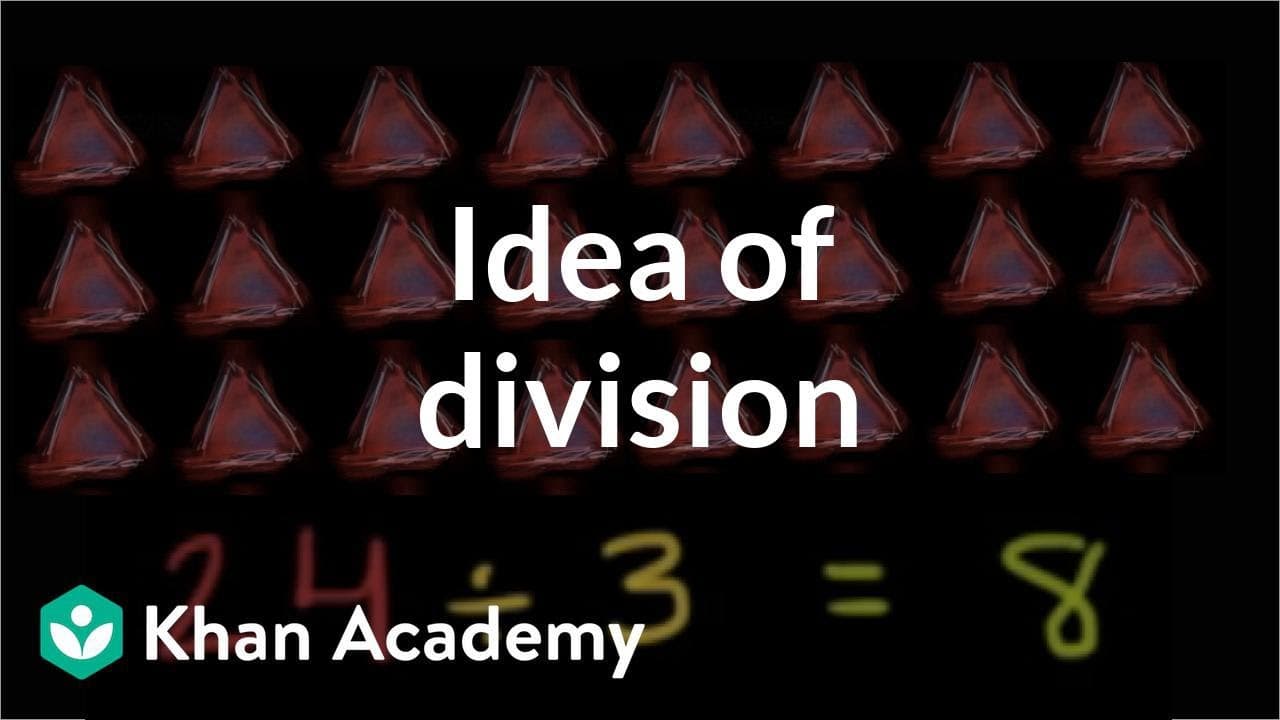
This video explains how to divide a set of 24 triangle objects into equal groups, highlighting the relationship between division and multiplication.
Transcript
We've got 24 triangle things right over here. And what I want to do in this video is to divide it into different numbers of groups. So the first thing I want to do is I want to divide this 24 triangle things into 3 groups and think about how many do I end up per group. So let's try that out. So I'm going to divide it into 3 equal groups. So that is... Read More
Key Insights
- 👥 Dividing a set of objects into equal groups can be achieved by dividing the total number by the desired number of groups.
- ✖️ The interchangeability of multiplication and division is evident in various arrangements of objects.
- 👥 Understanding how to divide objects into groups helps visualize and solve mathematical problems.
- 👥 Division can be approached from multiple perspectives, such as dividing into groups or dividing by a specific number of objects per group.
Install to Summarize YouTube Videos and Get Transcripts
Explore YouTube Video Summarizer or Get YouTube Transcript Extractor
Questions & Answers
Q: How many triangles are in each group when dividing 24 triangles into 3 equal groups?
When dividing 24 triangles into 3 equal groups, there are 8 triangles in each group. This can also be expressed as 24 divided by 3 equals 8.
Q: What is an alternative way to view 24 divided by 3?
Another way to view 24 divided by 3 is by dividing 24 into groups of 3. In this case, there are 8 groups of 3. This is equivalent to the previous division approach.
Q: What is the result of dividing 24 triangles into 12 equal groups?
Dividing 24 triangles into 12 equal groups results in 2 triangles per group. Thus, 24 divided by 12 equals 2.
Q: Can we divide 24 triangles into 12 groups instead of groups of 12?
Yes, dividing 24 triangles into 12 groups would yield 2 triangles in each group. Hence, 24 divided by 12 can be expressed as 24 divided into 12 equal groups, with 2 triangles per group.
Q: What happens when 24 triangles are divided into 6 equal groups?
Dividing 24 triangles into 6 equal groups would give 4 triangles per group. Therefore, the result of 24 divided by 6 is 4.
Q: How can we interpret 24 divided by 6 as groups of 6?
Viewing 24 divided by 6 as groups of 6 means that there are 4 groups of 6 triangles each. This is consistent with the previous approach.
Q: What is the outcome of dividing 24 triangles into 4 equal groups?
Dividing 24 triangles into 4 equal groups would result in 6 triangles in each group. Hence, 24 divided by 4 equals 6.
Q: How can we relate multiplication to the division of 24 triangles?
Multiplication can be related to the division of 24 triangles by considering that 4 times 6 equals 24, or 6 times 4 equals 24. This demonstrates the connection between multiplication and division.
Summary & Key Takeaways
-
The video demonstrates dividing 24 triangles into 3 equal groups, resulting in 8 triangles per group.
-
Additionally, it shows dividing 24 triangles into groups of 3, yielding 8 groups of 3.
-
The concept is extended to exploring division by 12, 6, and 4, emphasizing the relationship between multiplication and division.
Read in Other Languages (beta)
Share This Summary 📚
Summarize YouTube Videos and Get Video Transcripts with 1-Click
Try YouTube Summary with ChatGPT & Claude or YouTube Transcript Generator
Explore More Summaries from Khan Academy 📚



Summarize YouTube Videos and Get Video Transcripts with 1-Click
Try YouTube Summary with ChatGPT & Claude or YouTube Transcript Generator