Physics Fundamental Constants
TL;DR
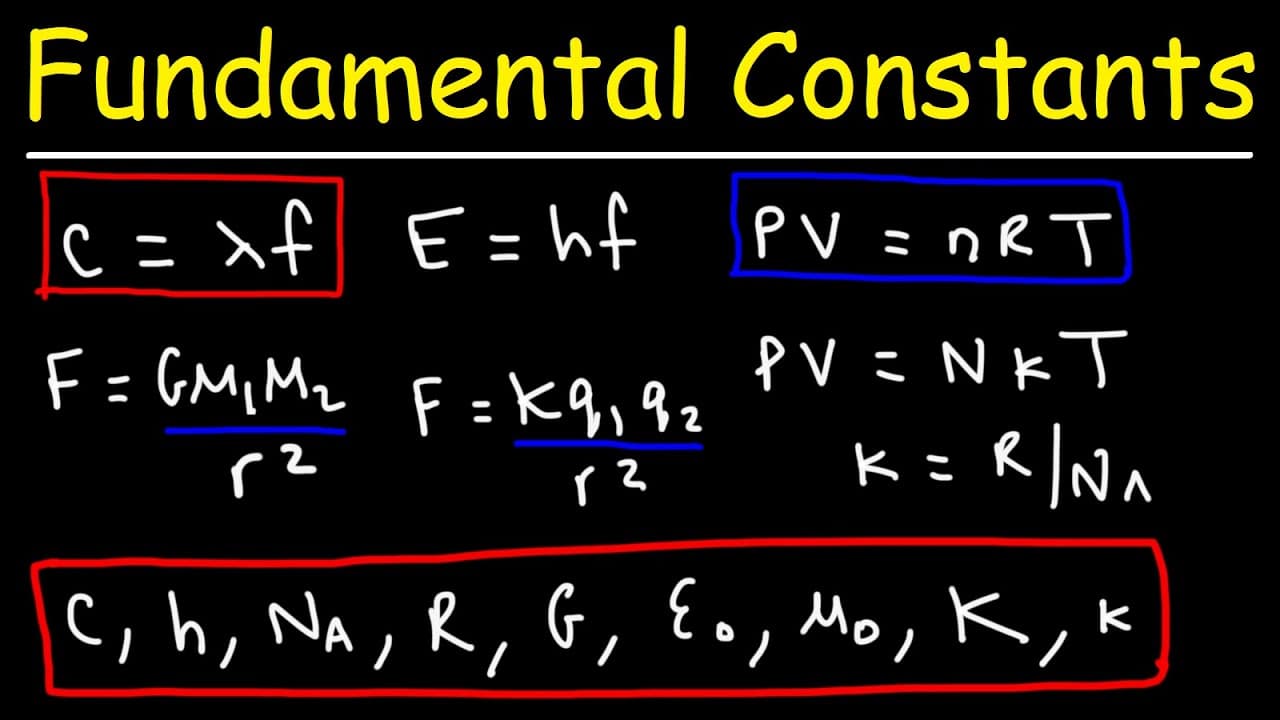
This video explains key fundamental constants in physics, including the speed of light, Planck's constant, universal gravitation constant, Coulomb's constant, Avogadro's constant, and Faraday's constant.
Transcript
today we're going to talk about fundamental constants in physics one of the most common fundamental constant that you're going to see is this letter C which represents the speed of light the speed of light in a vacuum is 3 times 10 to the 8 meters per second now the speed of light can change let's say if it's moving through water or through glass o... Read More
Key Insights
- 🙂 The speed of light is a fundamental constant and is used in calculating the properties of light and electromagnetic radiation.
- 🖐️ Planck's constant plays a vital role in quantum mechanics, helping determine the energy levels and transitions of particles.
- 👻 The universal gravitation constant allows us to quantify the force of gravity between different masses, particularly between celestial bodies.
- 🈂️ Coulomb's constant is essential in electrostatics, enabling the calculation of forces between charged particles.
- #️⃣ Avogadro's constant helps us understand the number of particles in one mole of a substance and is crucial in molar calculations.
- 🈂️ Faraday's constant represents the charge per mole of charge carriers, providing a measure of the amount of charge within a given substance or system.
- ❓ These fundamental constants are widely used in physics to calculate and explain different phenomena.
Install to Summarize YouTube Videos and Get Transcripts
Explore YouTube Video Summarizer or Get YouTube Transcript Extractor
Questions & Answers
Q: How is the speed of light used in physics calculations?
The speed of light is used in various physics equations involving light and electromagnetic radiation, such as determining wavelength and frequency.
Q: What is the significance of Planck's constant?
Planck's constant relates the energy of a photon to its frequency and is crucial in quantum mechanics, helping calculate energy levels and transitions.
Q: How is the universal gravitation constant used in physics?
The universal gravitation constant is used to quantify the force of gravity between two objects of different masses, like the Sun and Earth.
Q: How does Coulomb's constant come into play in electrostatics?
Coulomb's constant is used to calculate the force between two charges, whether they attract or repel. It helps explain the interaction of electric charges.
Q: What does Avogadro's constant represent?
Avogadro's constant represents the number of particles (atoms, molecules) in one mole of a substance, making it useful in calculations involving molar quantities.
Q: What is Faraday's constant used for?
Faraday's constant represents the charge per mole of charge carriers, whether they are electrons or other charged particles, and is significant in electrical calculations.
Summary & Key Takeaways
-
The speed of light in a vacuum is a fundamental constant represented by the letter C, which is 3 x 10^8 meters per second.
-
Planck's constant, represented by h, is used to calculate the energy of a photon and is equal to 6.626 x 10^-34 joules times seconds.
-
The universal gravitation constant, represented by G, is used to calculate the force of gravity between two objects, such as the Sun and Earth.
-
Coulomb's constant, represented by k, is used in electrostatics to calculate the force between two charges, whether they attract or repel.
-
Avogadro's constant, represented by NA, is the number of particles (atoms, molecules) in one mole of a substance.
-
Faraday's constant, represented by F, is the charge per mole of charge carriers in electricity.
Read in Other Languages (beta)
Share This Summary 📚
Summarize YouTube Videos and Get Video Transcripts with 1-Click
Try YouTube Summary with ChatGPT & Claude or YouTube Transcript Generator
Explore More Summaries from The Organic Chemistry Tutor 📚


Summarize YouTube Videos and Get Video Transcripts with 1-Click
Try YouTube Summary with ChatGPT & Claude or YouTube Transcript Generator