What Is Ridge Regression and How Does It Reduce Overfitting?
TL;DR
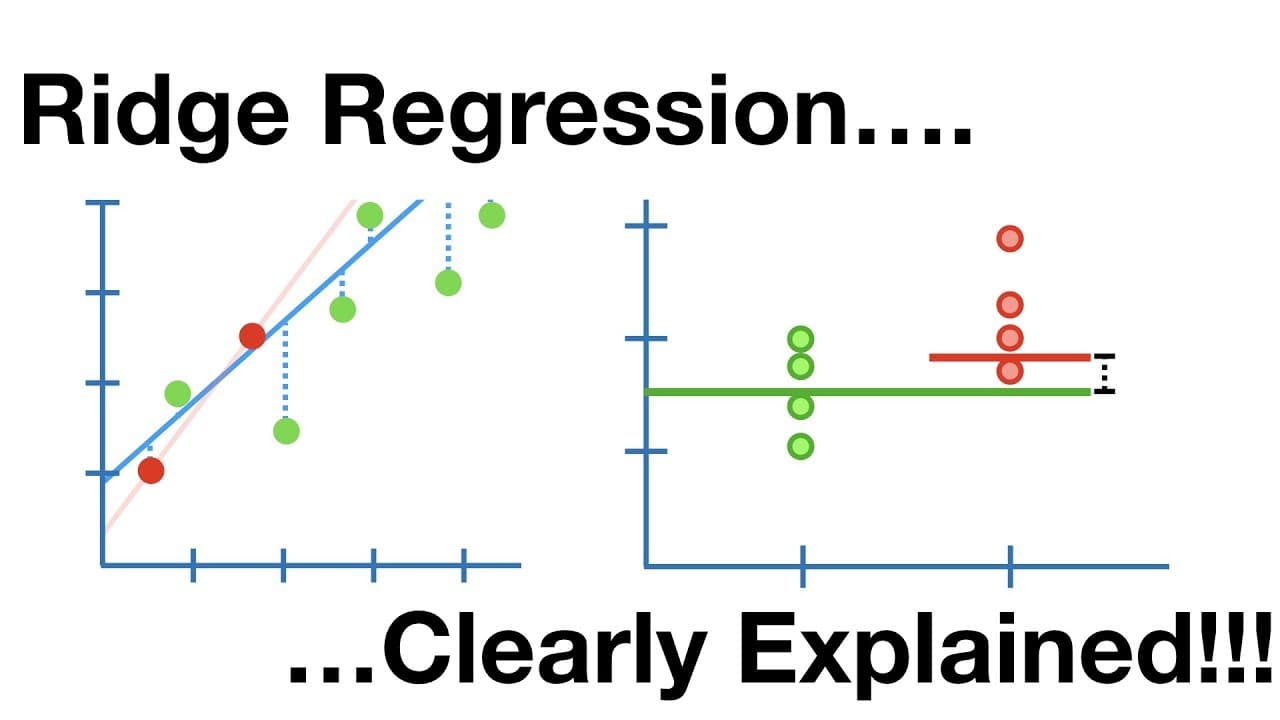
Ridge regression reduces overfitting by adding a penalty term to the least squares method, which shrinks the model parameters and lowers variance. This makes the predictions less sensitive to training data, thereby improving generalization, especially in small sample sizes. The strength of the penalty is controlled by the parameter lambda.
Transcript
regularization it's just another way to save desensitization let's check it out with a new regression stat quest hello I'm Josh stormer and welcome to stat quest today we're going to do part 1 of a series of video on regularization techniques in this video we're gonna cover Ridge regression and it's going to be clearly explained note this stat cues... Read More
Key Insights
- 🌉 Ridge regression reduces overfitting by introducing bias in the model's parameters.
- 🍉 The penalty term in Ridge regression helps strike a balance between bias and variance in the model.
- 🎮 Lambda controls the severity of the penalty, determining the trade-off between bias and variance.
- 🌉 Ridge regression can be applied to linear regression, logistic regression, and complex models with a large number of parameters.
Install to Summarize YouTube Videos and Get Transcripts
Explore YouTube Video Summarizer or Get YouTube Transcript Extractor
Questions & Answers
Q: How does Ridge regression help in reducing overfitting?
Ridge regression adds a penalty term to the least squares method, which shrinks the parameters of the model. This reduces the variance of the model and makes predictions less sensitive to the training data, reducing overfitting.
Q: What is the role of lambda in Ridge regression?
Lambda controls the severity of the penalty term in Ridge regression. A higher lambda value results in a stronger penalty, leading to greater shrinking of the parameters. It helps to determine the trade-off between bias and variance in the model.
Q: Can Ridge regression be applied to logistic regression?
Yes, Ridge regression can be applied to logistic regression models. In this case, instead of minimizing the sum of squared residuals, Ridge regression optimizes the sum of likelihoods. The penalty term helps reduce overfitting and makes the predictions less sensitive to the input variables.
Q: How does Ridge regression handle models with a large number of parameters and limited data?
When there is limited data to estimate a large number of parameters, Ridge regression can still find a solution by using cross-validation and the penalty term. By introducing the penalty, Ridge regression is able to find a solution even when there isn't enough data for traditional least squares estimation.
Key Insights:
- Ridge regression reduces overfitting by introducing bias in the model's parameters.
- The penalty term in Ridge regression helps strike a balance between bias and variance in the model.
- Lambda controls the severity of the penalty, determining the trade-off between bias and variance.
- Ridge regression can be applied to linear regression, logistic regression, and complex models with a large number of parameters.
- Limited data can still lead to accurate parameter estimates in Ridge regression through the use of cross-validation.
Summary & Key Takeaways
-
Ridge regression is a regularization technique that reduces overfitting in machine learning models by adding a penalty term to the least squares method.
-
The penalty term, controlled by the parameter lambda, shrinks the parameters of the model, making predictions less sensitive to the training data.
-
Ridge regression can be applied to linear regression, logistic regression, and complex models with a large number of parameters.
Read in Other Languages (beta)
Share This Summary 📚
Summarize YouTube Videos and Get Video Transcripts with 1-Click
Try YouTube Summary with ChatGPT & Claude or YouTube Transcript Generator
Explore More Summaries from StatQuest with Josh Starmer 📚




Summarize YouTube Videos and Get Video Transcripts with 1-Click
Try YouTube Summary with ChatGPT & Claude or YouTube Transcript Generator