Integrated Studies: Sustainability and Cross-Curricular Connections
TL;DR
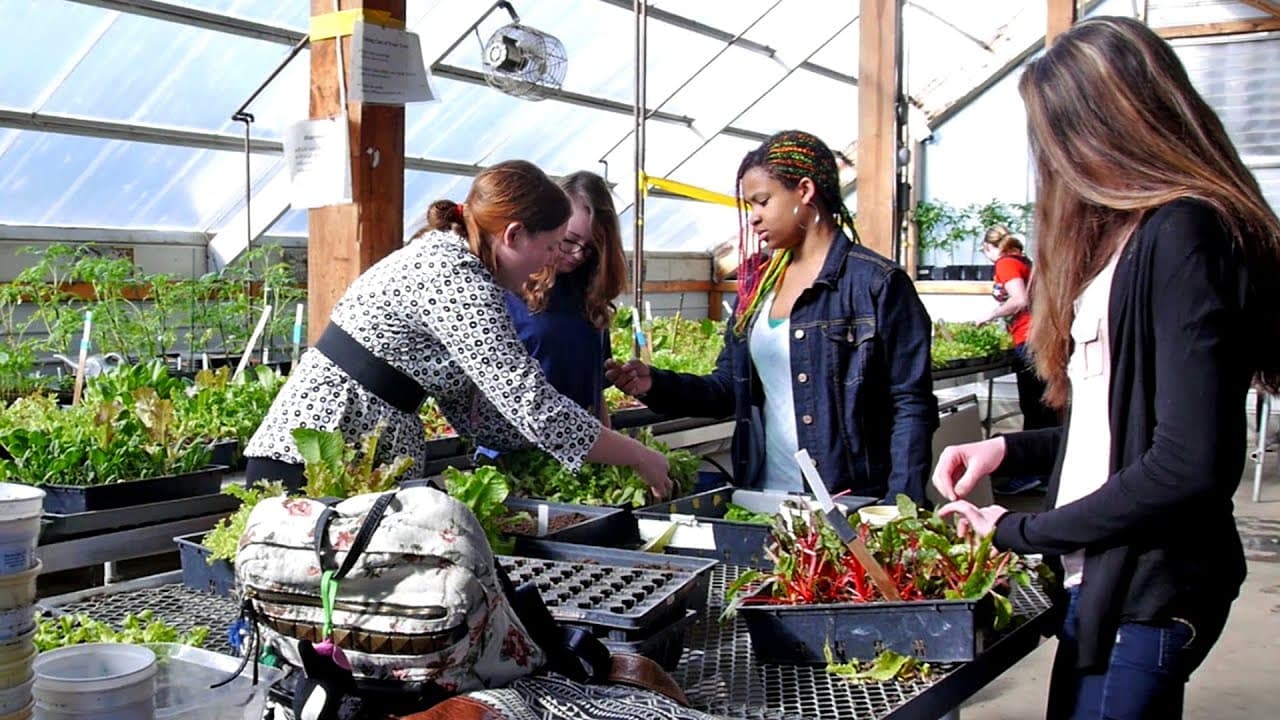
Educators collaborate to incorporate sustainability concepts into various subjects, using experiential lessons and a greenhouse as a learning tool.
Transcript
Tom: The social, economic, environmental needs of this generation, that in and of itself is important to teach. From an education perspective, we are experiencing increased engagements across a variety of disciplines. >>You can trim both of these right there. You still have, right, the leaf. This is the leaf, photochloroplast will be photosynthes... Read More
Key Insights
- 😵 Teaching sustainability requires collaboration and cross-disciplinary connections.
- 🤗 Experiential and hands-on lessons are effective in teaching sustainability concepts.
- ❓ Sustainability can be incorporated into various subjects, including biology, economics, and physics.
- 🧑🎓 Using real-world examples and resources, such as a greenhouse, enhances student understanding.
- 🧑🎓 Making connections between subjects helps students see the relevance and applicability of their learning.
- 🎓 Sustainability education encompasses social, economic, and environmental aspects.
- 🏦 Public banks can contribute to sustainability by reducing inequality and promoting economic growth.
Install to Summarize YouTube Videos and Get Transcripts
Explore YouTube Video Summarizer or Get YouTube Transcript Extractor
Questions & Answers
Q: How did teachers begin incorporating sustainability into their curriculum?
Teachers came together voluntarily to discuss using sustainability as a cross-disciplinary connection. This led to integrating sustainability concepts into various classes, such as biology and economics.
Q: How is the food production system used as a teaching tool?
The food production system serves as a vehicle for experiential lessons that are aligned with academic standards. It allows students to learn about ecological implications, economic aspects, and more.
Q: How did a physics teacher contribute to sustainability education?
The physics teacher collaborated with others to create a feasibility study for incorporating alternative energy into an irrigation system. The study led to the installation of solar panels.
Q: Why is it important to create connections between subjects?
Creating ties between different subjects allows students to see the practical applications of what they learn. It helps provide context and makes the learning experience more meaningful.
Summary & Key Takeaways
-
Educators come together to explore how sustainability can be integrated into different disciplines.
-
The concept of sustainability is used as an overarching theme to provide context for experiential lessons.
-
A greenhouse is utilized as a learning tool to teach about nutrient cycles, plant physiology, and energy transfer.
Read in Other Languages (beta)
Share This Summary 📚
Summarize YouTube Videos and Get Video Transcripts with 1-Click
Try YouTube Summary with ChatGPT & Claude or YouTube Transcript Generator
Explore More Summaries from Edutopia 📚



Summarize YouTube Videos and Get Video Transcripts with 1-Click
Try YouTube Summary with ChatGPT & Claude or YouTube Transcript Generator