Limiting and Excess Reactant - Stoichiometry Problems

TL;DR
This video explains how to calculate percent yield in a stoichiometry problem involving limiting and excess reactants.
Transcript
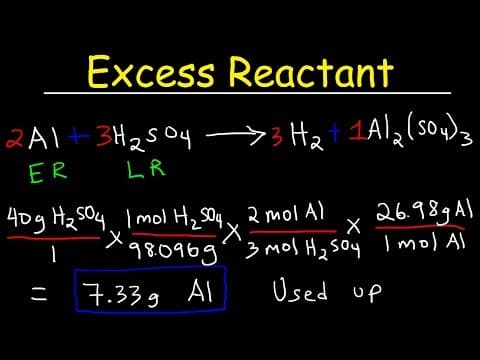
in this video we're going to work on stoichiometry problems associated with limiting and excess reactants so in this problem we have 5 moles of n2 reacting with 9 moles of h2 and we know that 85 grams of ammonia are produced how can we calculate the percent yield for this reaction now the first thing we need to do is write a balanced reaction so ni... Read More
Key Insights
- ⛔ Stoichiometry problems involving limiting and excess reactants require determining the limiting reactant to calculate the amount of product that can be produced.
- 😘 The limiting reactant is the reactant with the lowest mole per coefficient ratio.
- ❓ The theoretical yield is the maximum amount of product that can be obtained in a reaction, while the actual yield is the amount of product actually obtained.
- 🗂️ The percent yield is calculated by dividing the actual yield by the theoretical yield and multiplying by 100.
- ❓ The excess reactant is the reactant that is not completely consumed and remains after the reaction.
Install to Summarize YouTube Videos and Get Transcripts
Explore YouTube Video Summarizer or Get YouTube Transcript Extractor
Questions & Answers
Q: How do you determine the limiting reactant in a stoichiometry problem?
To determine the limiting reactant, compare the mole per coefficient ratio of each reactant. The reactant with the lowest ratio is the limiting reactant.
Q: How is the theoretical yield different from the actual yield?
The theoretical yield is the maximum amount of product that can be obtained in a reaction, while the actual yield is the amount of product actually obtained in a reaction.
Q: How do you calculate the percent yield in a stoichiometry problem?
The percent yield is calculated by dividing the actual yield by the theoretical yield and multiplying by 100.
Q: What is the excess reactant in a stoichiometry problem?
The excess reactant is the reactant that is not completely consumed and remains after the reaction.
Summary & Key Takeaways
-
In a stoichiometry problem involving limiting and excess reactants, it is important to determine the limiting reactant, which is the reactant that is completely consumed and determines the amount of product that can be produced.
-
To determine the limiting reactant, compare the mole per coefficient ratio of each reactant and identify the reactant with the lowest ratio. This reactant is the limiting reactant.
-
The theoretical yield is the maximum amount of product that can be obtained in a reaction. To calculate the percent yield, divide the actual yield by the theoretical yield and multiply by 100.
-
The excess reactant is the reactant that is not completely consumed and remains after the reaction. Its amount can be calculated by subtracting the moles of the limiting reactant that react from the original amount of the excess reactant.
Read in Other Languages (beta)
Share This Summary 📚
Summarize YouTube Videos and Get Video Transcripts with 1-Click
Try YouTube Summary with ChatGPT & Claude or YouTube Transcript Generator
Explore More Summaries from The Organic Chemistry Tutor 📚




Summarize YouTube Videos and Get Video Transcripts with 1-Click
Try YouTube Summary with ChatGPT & Claude or YouTube Transcript Generator