Nucleophile Strength
TL;DR
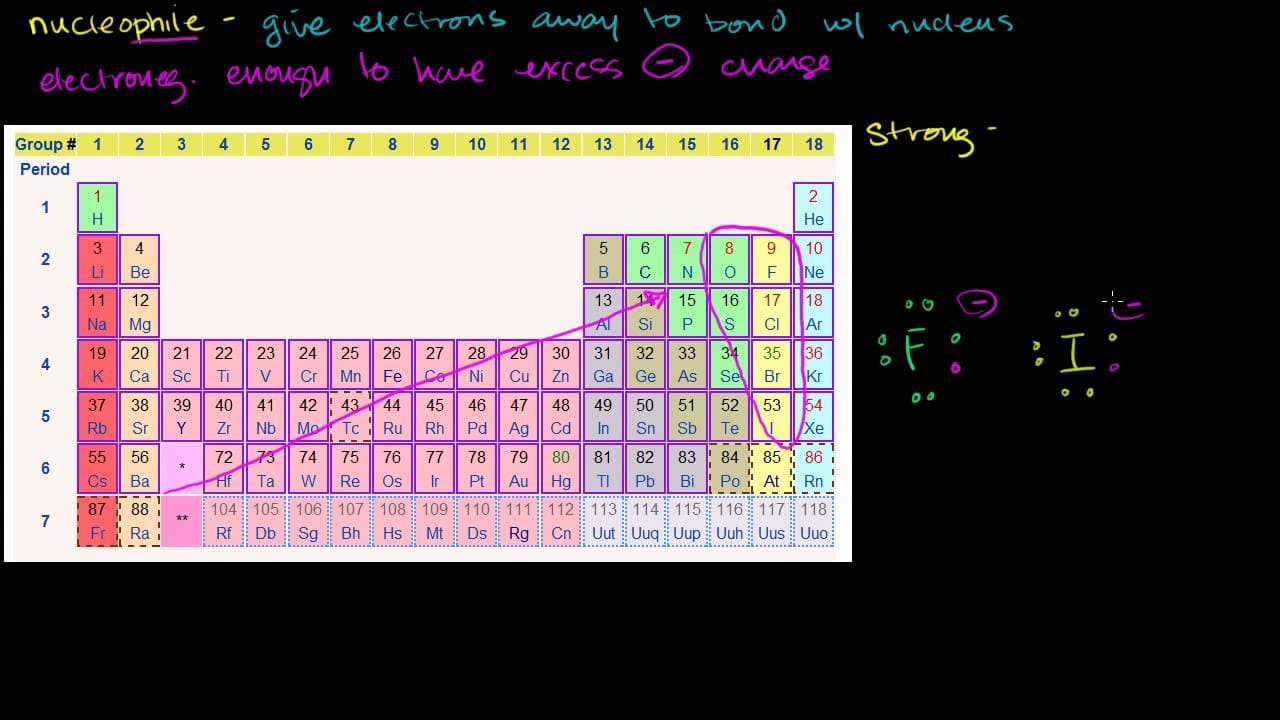
Nucleophiles are atoms, ions, or molecules that want to give away electrons to form bonds with other nuclei. The strength of a nucleophile is determined by its electronegativity, with stronger nucleophiles being less electronegative.
Transcript
in this video i want to talk a little bit about nucleophile strength nucleophile strength and just as a bit of review a nucleophile is an atom or an ion or a molecule that really wants to give away electrons and it really wants to give away electrons to i guess you could view it as another nucleus and form a bond with that nucleus and that's why it... Read More
Key Insights
- 💁 Nucleophiles are atoms, ions, or molecules that want to give away electrons to form bonds with other nuclei.
- ❎ Nucleophiles with excess negative charge are typically more electronegative.
- 💪 Strong nucleophiles have excess negative charge but are not too electronegative.
- ❎ Weak nucleophiles have only partial negative charge and are less likely to donate electrons.
- 🗯️ Electronegativity increases from the bottom left to the top right of the periodic table.
- 💪 Iodide is one of the strongest nucleophiles due to being less electronegative than fluoride.
- 🔉 Fluoride and hydroxide are examples of medium-strength nucleophiles.
Install to Summarize YouTube Videos and Get Transcripts
Explore YouTube Video Summarizer or Get YouTube Transcript Extractor
Questions & Answers
Q: What is a nucleophile?
A nucleophile is an atom, ion, or molecule that wants to donate electrons and form bonds with nuclei.
Q: How is nucleophile strength related to electronegativity?
Nucleophiles are usually more electronegative, as they have excess negative charge. Electronegativity increases from the bottom left to the top right of the periodic table.
Q: What distinguishes a strong nucleophile from a weak one?
Strong nucleophiles have excess negative charge but aren't too electronegative. Weak nucleophiles have only partial negative charge.
Q: Can weak nucleophiles still donate electrons?
Yes, weak nucleophiles can donate electrons to highly electron-deficient species, such as carbocations, despite having only a partial negative charge.
Summary & Key Takeaways
-
A nucleophile is an atom, ion, or molecule that wants to give away electrons to form bonds with nuclei.
-
Nucleophiles with excess negative charge or partial negative charge are usually more electronegative.
-
Strong nucleophiles have excess negative charge but are not too electronegative, while weak nucleophiles have only partial negative charge.
Read in Other Languages (beta)
Share This Summary 📚
Summarize YouTube Videos and Get Video Transcripts with 1-Click
Try YouTube Summary with ChatGPT & Claude or YouTube Transcript Generator
Explore More Summaries from Khan Academy 📚



Summarize YouTube Videos and Get Video Transcripts with 1-Click
Try YouTube Summary with ChatGPT & Claude or YouTube Transcript Generator