Area of rectangles and the distributive property | Measurement | Pre-Algebra | Khan Academy
TL;DR
Learn how to calculate the area of a rectangle by finding the product of its length and width, or by breaking it down into smaller rectangles and adding their areas together.
Transcript
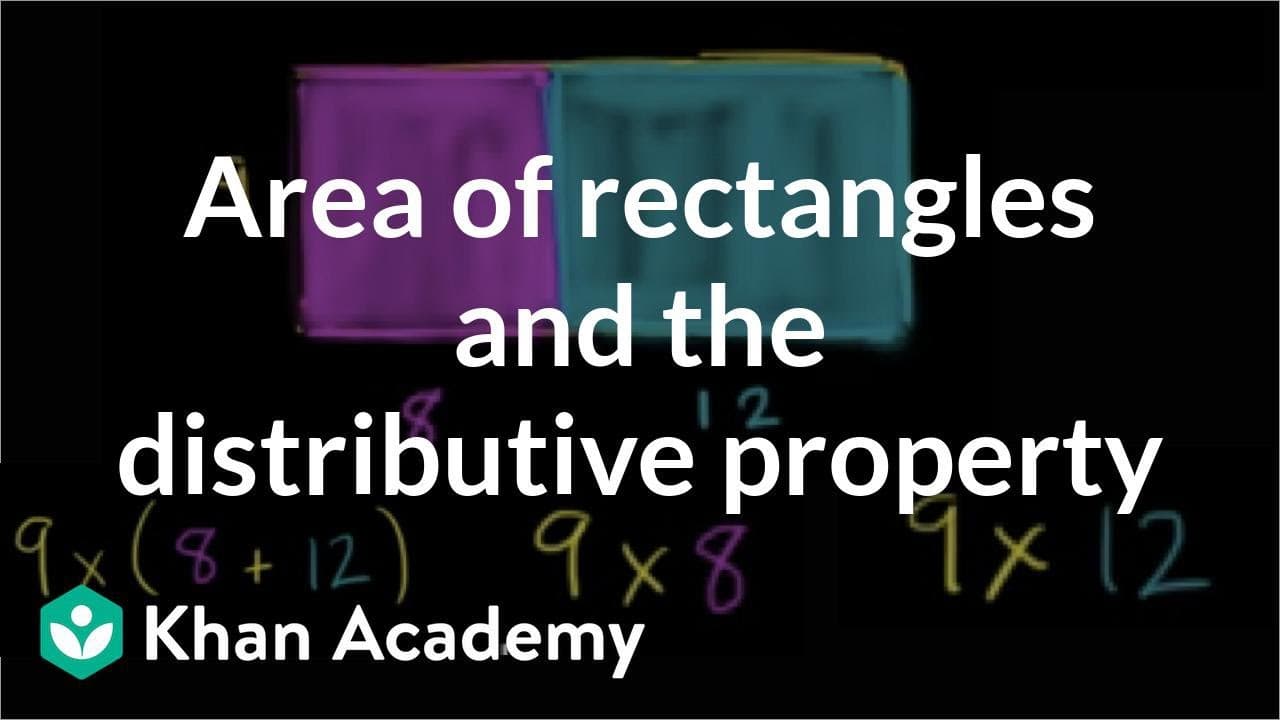
I have this rectangle here, and I want to figure out its area. I want to figure out how much space it is taking up on my screen right over here. And I encourage you to pause this video and try to figure out the area of this entire rectangle. And when you do it, think about the two different ways you could do it. You could either multiply the length... Read More
Key Insights
- 💨 There are two ways to calculate the area of a rectangle: multiplying the length by the width, or breaking it down into smaller rectangles and adding their areas.
- ❓ The distributive property applies to calculating the area of a rectangle using the second strategy.
- ❓ The two strategies are equivalent and will always yield the same result.
- 🛩️ The width of the larger rectangle is found by adding the individual widths of the smaller rectangles within it.
- 🛩️ The area of the entire rectangle can be calculated by adding the areas of the smaller rectangles together.
- 🤑 The distributive property works with any numbers, not just the ones used in the example.
- ❓ Calculating the area of a rectangle is a fundamental concept in geometry.
Install to Summarize YouTube Videos and Get Transcripts
Explore YouTube Video Summarizer or Get YouTube Transcript Extractor
Questions & Answers
Q: What are the two different strategies for calculating the area of a rectangle?
The first strategy is to multiply the length of the rectangle by its width. The second strategy is to separate the rectangle into smaller rectangles and calculate their individual areas, then add them together to get the total area.
Q: How can you find the width of the larger rectangle?
To find the width, you need to add the individual widths of the smaller rectangles within the larger rectangle.
Q: Why are the two strategies equivalent?
The two strategies are equivalent because they both calculate the same area. Whether you find the area of the entire rectangle or add the areas of smaller rectangles, the result is the same.
Q: What does the distributive property have to do with calculating the area of a rectangle?
The distributive property is demonstrated when you calculate the area of the rectangle using the second strategy. It states that multiplying a sum by a number is the same as multiplying each term within the sum by the number separately.
Summary & Key Takeaways
-
The video teaches two different strategies for calculating the area of a rectangle: multiplying the length and width, or finding the sum of the areas of smaller rectangles within the larger rectangle.
-
The length of the larger rectangle is 9 and the width is 8 plus 12.
-
You can calculate the area of the entire rectangle (9 times 20) or separately calculate the areas of the purple and blue rectangles (9 times 8 and 9 times 12, respectively) and add them together.
Read in Other Languages (beta)
Share This Summary 📚
Summarize YouTube Videos and Get Video Transcripts with 1-Click
Try YouTube Summary with ChatGPT & Claude or YouTube Transcript Generator
Explore More Summaries from Khan Academy 📚



Summarize YouTube Videos and Get Video Transcripts with 1-Click
Try YouTube Summary with ChatGPT & Claude or YouTube Transcript Generator