Problem 1 VSWR Measurement - Microwave Measurement - Microwave Engineering
TL;DR
In this video, the host discusses microwave measurements, specifically VSWR measurement in a rectangular waveguide, and provides a step-by-step calculation of VSWR.
Transcript
click the bell icon to get latest videos from akira hello friends i welcome you all to this video we are with the 13th chapter of microwave engineering the chapter is titled microwave measurements so far in this chapter we have first of all seen how exactly the low frequency measurements can be done next to that we have been introduced to the very ... Read More
Key Insights
- 😘 Microwave measurements involve various components and techniques, such as low-frequency measurements, slotted lines, and tunable detectors.
- 🫥 VSWR plays a critical role in microwave measurements as it indicates the efficiency of power transmission and the mismatch between the load and transmission line.
- 📳 Rectangular waveguides have specific dimensions and modes of propagation that affect VSWR calculations.
Install to Summarize YouTube Videos and Get Transcripts
Explore YouTube Video Summarizer or Get YouTube Transcript Extractor
Questions & Answers
Q: What is VSWR and why is it important in microwave measurements?
VSWR stands for Voltage Standing Wave Ratio. It is a measure of how efficiently power is transmitted through a transmission line. It is important in microwave measurements because it indicates the mismatch between the load and the transmission line, affecting signal quality.
Q: How is VSWR calculated in a rectangular waveguide?
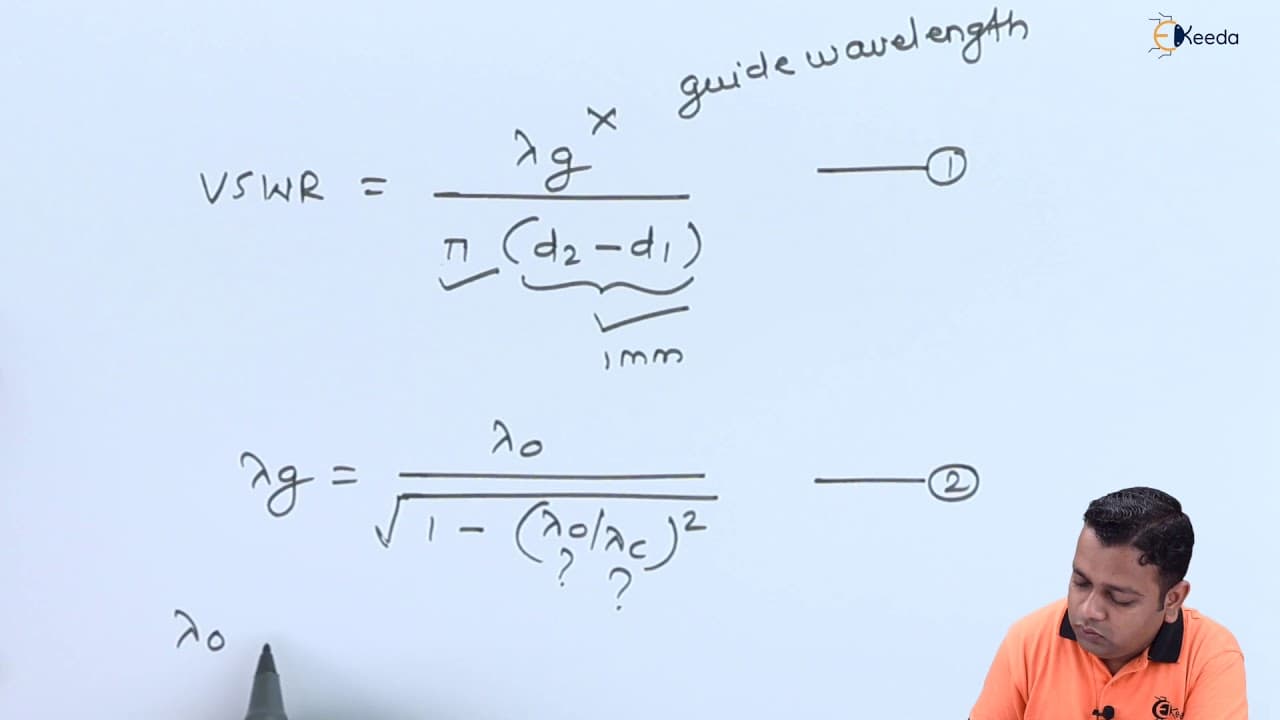
VSWR can be calculated using the formula VSWR = λg / (π * (d2 - d1)), where λg is the guided wavelength and d2 - d1 is the distance between twice minimum power points. The guided wavelength can be computed using the formula λg = λ0 / sqrt(1 - λ0/λc)^2, where λ0 is the wavelength in free space and λc is the cutoff wavelength.
Q: What is the TE 1 0 mode in wave propagation?
The TE 1 0 mode is the dominant mode in rectangular waveguide propagation. It offers the lowest possible cutoff frequency and the maximum possible wavelength. It is characterized by the electric field only in the transverse magnetic direction and no magnetic field in the transverse electric direction.
Q: How does the double minimum method work in VSWR measurement?
The double minimum method involves measuring the distance between two minimum power points on a slotted line. This distance is used to calculate the VSWR. By adjusting the position of the probe, the minimum and maximum power points can be identified, helping determine the VSWR value.
Summary & Key Takeaways
-
The video discusses the 13th chapter of microwave engineering, focusing on microwave measurements.
-
The host explains low-frequency measurements, the slotted line component, and the significance of the tunable detector.
-
The video demonstrates how to calculate the VSWR of a transmission system operating at 10 GHz using the dimensions and distance between minimum power points on a slotted line.
Read in Other Languages (beta)
Share This Summary 📚
Summarize YouTube Videos and Get Video Transcripts with 1-Click
Try YouTube Summary with ChatGPT & Claude or YouTube Transcript Generator
Explore More Summaries from Ekeeda 📚






Summarize YouTube Videos and Get Video Transcripts with 1-Click
Try YouTube Summary with ChatGPT & Claude or YouTube Transcript Generator