Numerical 3 - Bernoulli's Equation for Compressible Flow - Compressible Flow - Fluid Mechanics 2
TL;DR
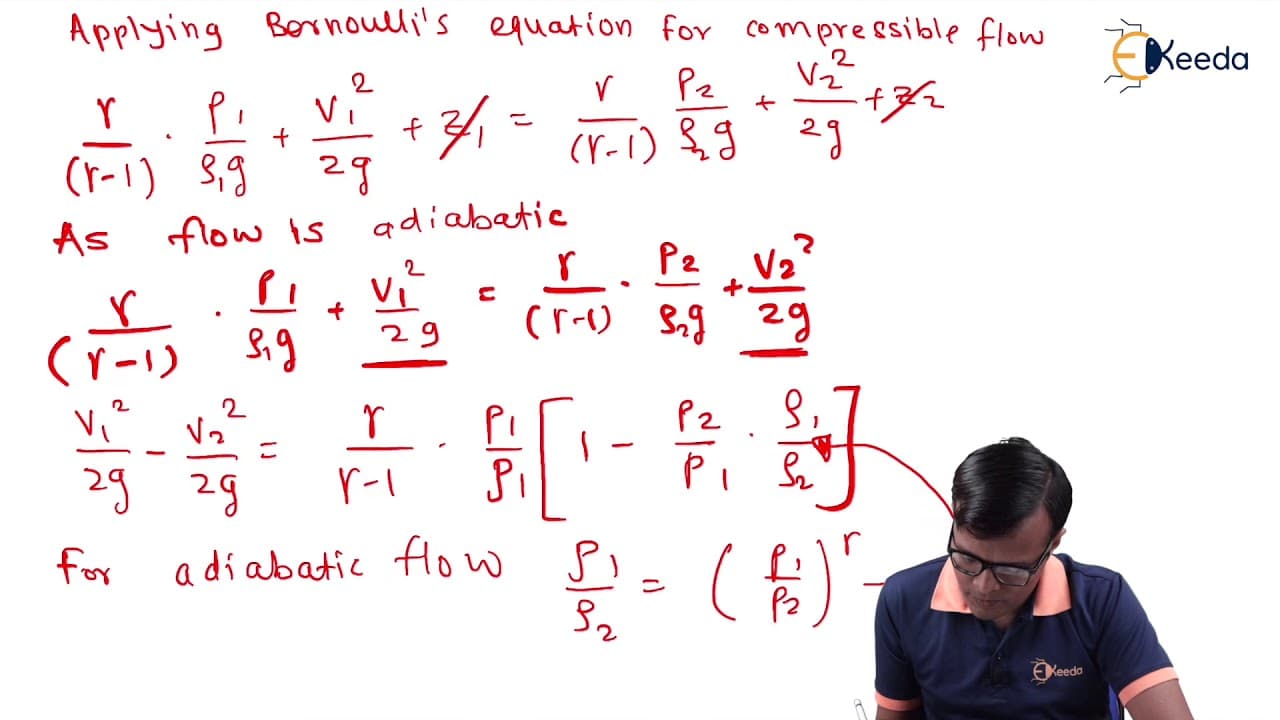
Solving a numerical problem using Bernoulli's equation in compressible flow to find the velocity of air in a horizontal pipe.
Transcript
hello friends in this video we are going to solve a numerical which is based on Bernoulli's equation in compressible flow so let us go to the video let's start with numerical certain mass of air passing through a horizontal main with a velocity of 380 meter per second there is a pipe we will call it as main pipe or only main and mass of air is pass... Read More
Key Insights
- 💐 Bernoulli's equation is a powerful tool for analyzing fluid flow and can be applied in both compressible and incompressible flow problems.
- 💐 Adiabatic flow refers to a flow process where there is neither heat transfer to the system nor from the system.
- 💱 The given problem involves a change in diameter of the pipe, resulting in a change in velocity and pressure.
- 🌸 Substituting known values and applying properties of adiabatic flow, the velocity at section 2 is calculated to be 29.84 m/s.
- 🫢 The density terms in the equation are omitted by using the known values of gas constant and temperature.
Install to Summarize YouTube Videos and Get Transcripts
Explore YouTube Video Summarizer or Get YouTube Transcript Extractor
Questions & Answers
Q: What is the purpose of using Bernoulli's equation in the given numerical problem?
Bernoulli's equation is used to analyze fluid flow and determine the relationship between pressure, velocity, and elevation along a streamline. In this problem, it is used to find the velocity of air in the horizontal pipe.
Q: How is the change in velocity of air achieved in the problem?
The change in velocity of air is achieved by reducing the diameter of the pipe at a specific section. This causes an increase in pressure and a corresponding decrease in velocity according to Bernoulli's equation.
Q: What are the given values in the problem?
The given values include the velocity of air at section 1 (380 m/s), the pressure at section 1 (80 kN/m²), the pressure at section 2 (128 kN/m²), and the temperature at section 1 (45°C).
Q: How is the equation simplified to solve for the velocity at section 2?
By using properties of adiabatic flow and substituting known values, the equation is simplified to express the ratio of velocities (V2/V1) and the pressure ratios (P2/P1). Solving the equation yields the velocity at section 2 as 29.84 m/s.
Summary & Key Takeaways
-
The video discusses a numerical problem that involves calculating the velocity of air in a horizontal pipe using Bernoulli's equation for compressible flow.
-
The problem involves given values for pressure, velocity, and temperature at different sections of the pipe.
-
By applying Bernoulli's equation and using the properties of adiabatic flow, the velocity of air at the second section of the pipe is determined to be 29.84 m/s.
Read in Other Languages (beta)
Share This Summary 📚
Summarize YouTube Videos and Get Video Transcripts with 1-Click
Try YouTube Summary with ChatGPT & Claude or YouTube Transcript Generator
Explore More Summaries from Ekeeda 📚





Summarize YouTube Videos and Get Video Transcripts with 1-Click
Try YouTube Summary with ChatGPT & Claude or YouTube Transcript Generator