Problem Microwave Bipolar Transistor Configurations - Microwave Transistors and Tunnel Diodes
TL;DR
This video discusses the chapter on microbial transistors and eternal diodes, covering their physical descriptions, configurations, and problem-solving related to them.
Transcript
click the bell icon to get latest videos from akira hello friends I welcome you all to this video we are dealing with the chapter microbial transistors and eternal diodes the basic bipolar Junction transistors working at the microbial applications for the microwave frequency range that we are discussing in this particular chapter so very first of a... Read More
Key Insights
- ⚾ Microbial transistors and eternal diodes operate at microwave frequencies and are based on bipolar junction transistor principles.
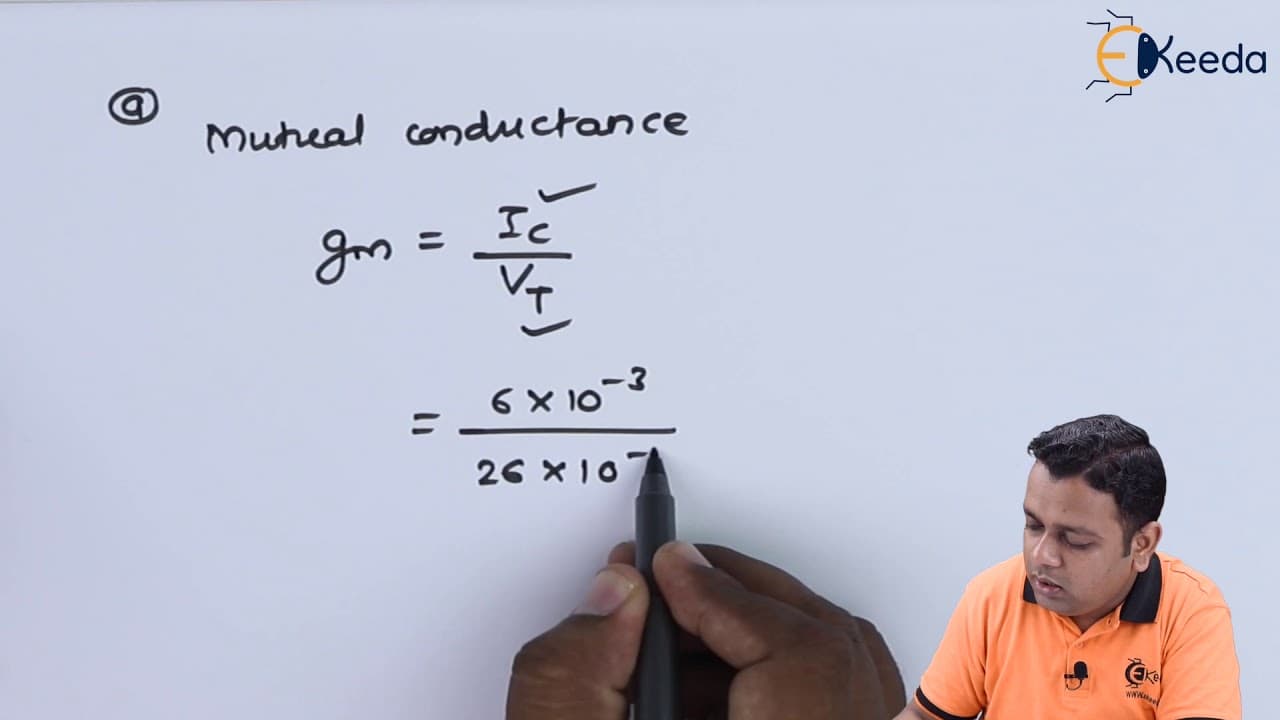
- 🤩 Mutual conductance (GM) is a key parameter that determines device performance.
- 🔠 Input conductance (GXB) and resistance (RI) are important characteristics for input signal analysis.
- 🈂️ The electron diffusion coefficient (Dn) affects charge carrier mobility in the device.
- ❓ The diffusion capacitance (CXB) is calculated using the values of GM, width (WB), and Dn.
- 🎨 Understanding these parameters is crucial for analyzing and designing microbial transistors and eternal diodes.
- 📔 Further topics, such as the operating principles of microbial bipolar transistors, will be covered in future lectures.
Install to Summarize YouTube Videos and Get Transcripts
Explore YouTube Video Summarizer or Get YouTube Transcript Extractor
Questions & Answers
Q: What are microbial transistors and eternal diodes?
Microbial transistors and eternal diodes are electronic devices that operate at the microwave frequency range and are based on the principles of bipolar junction transistors.
Q: How is mutual conductance computed?
Mutual conductance (GM) is calculated by dividing the collector current (IC) by the voltage (VT). In the problem given, GM is found to be 0.23 Mhos.
Q: What is the input conductance and resistance?
The input conductance (GXB) is the product of GM and the gain factor (hfe), resulting in a value of 1.92 mhos. The input resistance (RI) is a constant value of 521 ohms.
Q: How is the electron diffusion coefficient determined?
The electron diffusion coefficient (Dn) is computed by multiplying the mobility value (μn) with VT. In the problem, Dn is found to be 41.6 cm²/s.
Summary & Key Takeaways
-
The video introduces the topic of microbial transistors and eternal diodes, focusing on their physical descriptions and microwave bipolar junction configurations.
-
A practice problem is provided, involving the computation of mutual conductance, input conductance, input resistance, electron diffusion coefficient, and diffusion capacitance.
-
Detailed explanations are given for each parameter and how to compute them.
Read in Other Languages (beta)
Share This Summary 📚
Summarize YouTube Videos and Get Video Transcripts with 1-Click
Try YouTube Summary with ChatGPT & Claude or YouTube Transcript Generator
Explore More Summaries from Ekeeda 📚






Summarize YouTube Videos and Get Video Transcripts with 1-Click
Try YouTube Summary with ChatGPT & Claude or YouTube Transcript Generator