Curvature formula, part 2
TL;DR
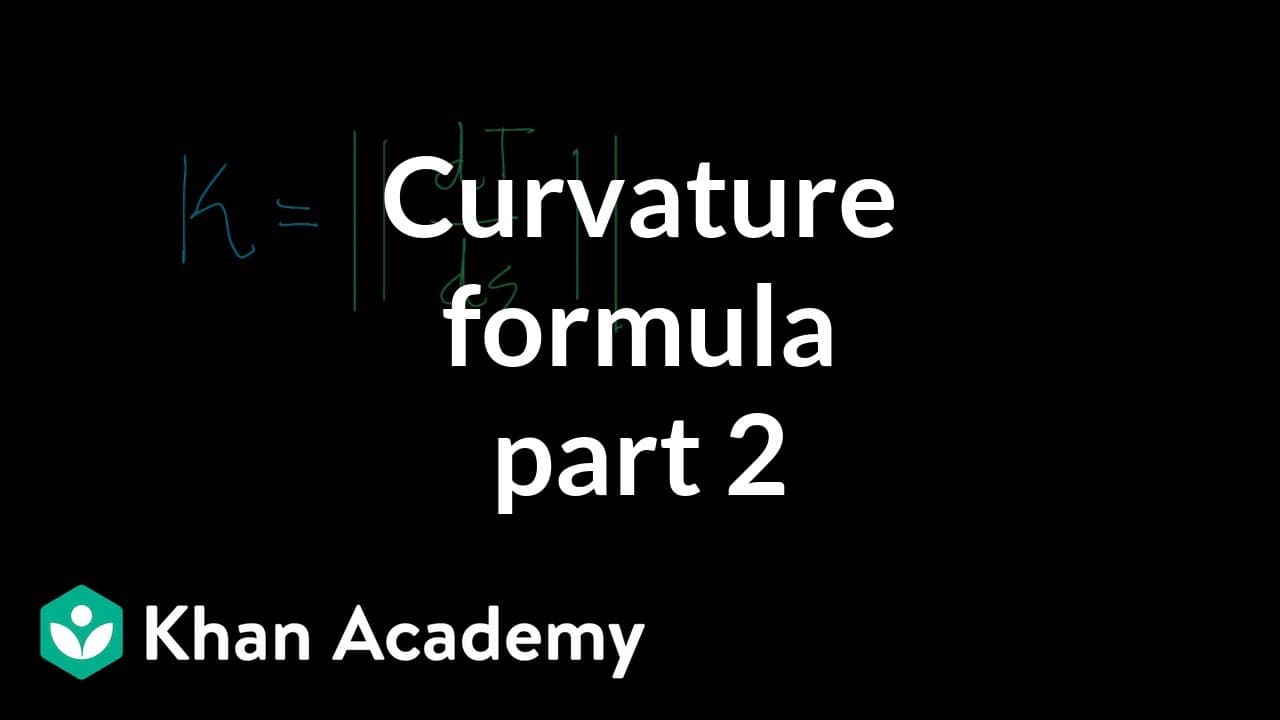
Curvature measures the rate of change of unit tangent vectors along a curve with respect to arc length.
Transcript
- [Voiceover] In the last video I started to talk about the formula for curvature. Just to remind everyone of where we are you imagine that you have some kind of curve in let's say two dimensional space just for the sake of being simple. Let's say this curve is parameterized by a function S of T. So every number T corresponds to some point on the c... Read More
Key Insights
- 🇦🇪 Curvature measures the rate of change of unit tangent vectors, providing information about the shape of a curve.
- 🗺️ Arc length represents the distance traveled along a curve, and the curvature accounts for the change in the unit tangent vector during this distance.
- 🇦🇪 The unit tangent vector function is obtained by normalizing the derivative of the vector-valued function.
- 🕴️ In the example of a cosine-sine pair, the unit tangent vector simplifies to negative sine of t and cosine of t, divided by the radius of the circle being drawn.
- 🫠 Generalizing the concept allows for more complex curves, where the unit tangent vector and arc length may vary.
- 🇦🇪 The magnitude of the unit tangent vector is always equal to 1, making it a unit vector.
- 🫠 The relationship between arc length and the unit tangent vector is crucial in understanding how curvature is calculated.
Install to Summarize YouTube Videos and Get Transcripts
Explore YouTube Video Summarizer or Get YouTube Transcript Extractor
Questions & Answers
Q: What does curvature measure?
Curvature measures the rate at which the unit tangent vector changes along a curve with respect to arc length.
Q: How is the unit tangent vector obtained?
The unit tangent vector is derived by dividing the derivative of the vector-valued function by its magnitude.
Q: What is the relationship between arc length and the unit tangent vector?
Arc length represents a small step along the curve, and the curvature measures the change in the unit tangent vector during that step.
Q: How is the unit tangent vector function expressed in the example?
In the provided example of a cosine-sine pair, the unit tangent vector function simplifies to negative sine of t and cosine of t.
Summary & Key Takeaways
-
Curvature is determined by the rate of change of unit tangent vectors, which indicate the direction of the curve at each point.
-
Arc length represents a small step along the curve, and the curvature measures how much the unit tangent vector changes in that step.
-
The unit tangent vector is obtained by dividing the derivative of the vector-valued function by its magnitude.
Read in Other Languages (beta)
Share This Summary 📚
Summarize YouTube Videos and Get Video Transcripts with 1-Click
Try YouTube Summary with ChatGPT & Claude or YouTube Transcript Generator
Explore More Summaries from Khan Academy 📚



Summarize YouTube Videos and Get Video Transcripts with 1-Click
Try YouTube Summary with ChatGPT & Claude or YouTube Transcript Generator