Adolescence: Crash Course Psychology #20
TL;DR
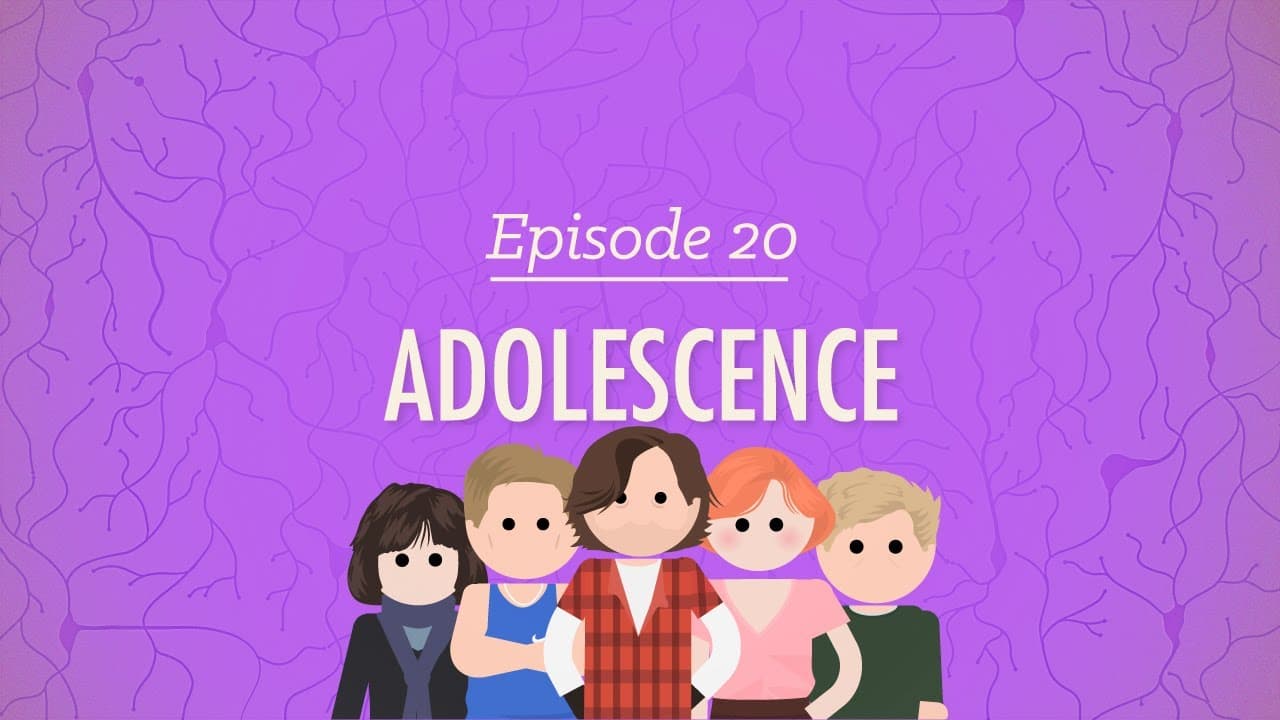
Explores Erikson's stages of development using The Breakfast Club.
Transcript
So far in our exploration of how the mind grows, we've talked about a lot of different philosophies and models and ways of looking at things. But here's a surprisingly useful tool for understanding developmental psychology: The Breakfast Club. This video, by the way, will contain Breakfast Club spoilers. That classic 80s movie about a band of teena... Read More
Key Insights
- The Breakfast Club serves as a metaphor for adolescent struggles, highlighting the conflict between individuality and group belonging.
- Erik Erikson's eight-stage model outlines psychosocial development from infancy to late adulthood, each stage defined by a specific crisis.
- Adolescence, according to Erikson, is marked by identity vs. role confusion, where teens explore different roles to establish their identities.
- Young adulthood involves the crisis of intimacy vs. isolation, focusing on forming intimate relationships to avoid loneliness.
- Middle adulthood is characterized by generativity vs. stagnation, where individuals seek purpose through work and community involvement.
- Late adulthood deals with integrity vs. despair, reflecting on one's life satisfaction and accomplishments.
- Fluid intelligence, which involves problem-solving skills, peaks in adolescence, while crystallized intelligence, based on accumulated knowledge, improves with age.
- Dementia, including Alzheimer's, affects cognitive functions in older age, though not all memory decline is indicative of these conditions.
Install to Summarize YouTube Videos and Get Transcripts
Explore YouTube Video Summarizer or Get YouTube Transcript Extractor
Questions & Answers
Q: How does The Breakfast Club illustrate adolescent struggles?
The Breakfast Club illustrates adolescent struggles by showing how teenagers grapple with the need to belong to a group while also striving for individuality. This reflects Erik Erikson's concept of identity vs. role confusion, where adolescents explore different roles to establish a sense of self amidst peer pressure and societal expectations.
Q: What is Erikson's model of psychosocial development?
Erikson's model of psychosocial development outlines eight stages from infancy to late adulthood, each defined by a specific crisis or issue. These stages include trust vs. mistrust in infancy, identity vs. role confusion in adolescence, and integrity vs. despair in late adulthood, highlighting the lifelong nature of psychological growth and development.
Q: What characterizes the adolescent stage in Erikson's model?
In Erikson's model, the adolescent stage is characterized by the crisis of identity vs. role confusion. During this period, teenagers experience physical, emotional, and social changes, leading them to explore different roles and identities. This stage is crucial for developing a coherent sense of self, balancing the need for individuality with societal and peer expectations.
Q: How does Erikson define young adulthood's main crisis?
Erikson defines young adulthood's main crisis as intimacy vs. isolation. In this stage, individuals seek to form deep, meaningful relationships, whether romantic or platonic. Successfully navigating this stage leads to feelings of connection and commitment, while failure can result in loneliness and isolation, highlighting the importance of intimacy in adult life.
Q: What are the key challenges of middle adulthood in Erikson's theory?
Middle adulthood in Erikson's theory involves the challenge of generativity vs. stagnation. Individuals focus on contributing to society through work, community involvement, and raising families. Success in this stage leads to a sense of purpose and productivity, while failure can result in feelings of stagnation and lack of fulfillment, often manifesting as a mid-life crisis.
Q: What are the differences between fluid and crystallized intelligence?
Fluid intelligence refers to the ability to solve new problems and think abstractly, peaking in adolescence and declining with age. In contrast, crystallized intelligence is based on accumulated knowledge and experience, improving with age. Both types of intelligence are crucial for daily functioning, with fluid intelligence aiding in quick thinking and crystallized intelligence supporting knowledge-based tasks.
Q: How does dementia affect cognitive functions in older adults?
Dementia affects cognitive functions by impairing thinking, memory, and personality, interfering with daily functioning. Alzheimer's disease is a common form of progressive dementia, characterized by declining memory and reasoning. While dementia risk increases with age, it is not a normal part of aging, and many older adults remain cognitively sharp despite some memory changes.
Q: What is the significance of Erikson's model in understanding psychological development?
Erikson's model is significant for understanding psychological development as it provides a comprehensive framework for examining the lifelong nature of personal growth. By identifying specific crises at each stage, it highlights how individuals navigate challenges and develop their identities, relationships, and sense of purpose, contributing to the broader understanding of human psychology.
Summary & Key Takeaways
-
The video uses The Breakfast Club as a lens to explore Erikson's stages of psychosocial development, particularly focusing on adolescence's identity crisis.
-
Erikson's model outlines eight stages of development, each defined by a specific crisis, from infancy's trust vs. mistrust to late adulthood's integrity vs. despair.
-
Adolescents face identity vs. role confusion, while adults navigate intimacy, generativity, and integrity issues, with intelligence and cognitive changes occurring throughout life.
Read in Other Languages (beta)
Share This Summary 📚
Summarize YouTube Videos and Get Video Transcripts with 1-Click
Try YouTube Summary with ChatGPT & Claude or YouTube Transcript Generator
Explore More Summaries from CrashCourse 📚



Summarize YouTube Videos and Get Video Transcripts with 1-Click
Try YouTube Summary with ChatGPT & Claude or YouTube Transcript Generator