Stanford XCS224U: Natural Language Understanding I Homework 1 I Overview: Bake Off
TL;DR
This screencast provides an overview of Assignment 1 and the associated Bake Off, focusing on multi-domain sentiment analysis using various resources and tools.
Transcript
welcome everyone this screencast is an overview of assignment one and the associated Bake Off the goal here is to give you a sense for the nature of the work that is the nature of the questions that you'll be answering as well as the thinking behind them and I think that will help you both with the current work and also with subsequent assignments ... Read More
Key Insights
- 🧑🎓 The assignment and Bake Off aim to familiarize students with various aspects of sentiment analysis and encourage original and creative approaches to the task.
- 🦻 Multiple resources, including datasets and tutorials, are provided to aid in training and development.
- 😑 The assignment covers tasks such as developing linear classifiers, fine-tuning pre-trained models, and building an original sentiment classifier.
- 🏆 Attention to proper coding techniques, use of unit tests, and adherence to ethical guidelines regarding test set usage is emphasized.
Install to Summarize YouTube Videos and Get Transcripts
Explore YouTube Video Summarizer or Get YouTube Transcript Extractor
Questions & Answers
Q: What is the goal of Assignment 1 and the Bake Off?
The goal is to provide students with an understanding of the work and questions involved in the assignment and to encourage creative exploration and development of sentiment analysis models.
Q: What resources are available for training and development?
Resources include DynaSent Round 1, DynaSent Round 2, and Stanford Sentiment Treebank datasets, which are labeled with ternary sentiment. These datasets can be used to train and develop sentiment analysis models.
Q: What is the task in Question 1?
In Question 1, students are tasked with developing lightweight models using linear classifiers. They need to write feature functions, train linear models, and assess their performance using provided functions.
Q: What is the focus of Question 2?
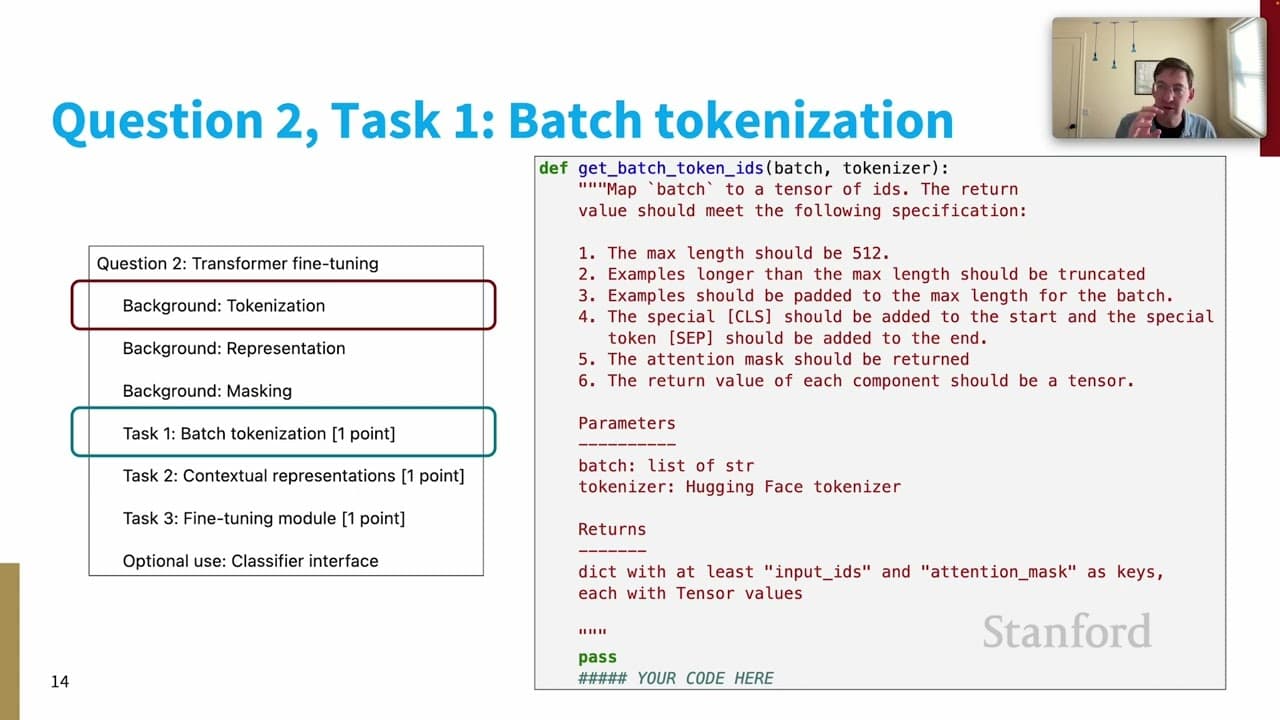
Question 2 focuses on fine-tuning pre-trained models, specifically a BERT Mini model. Students need to complete tasks related to tokenization, representation, and writing a fine-tuning module.
Q: What is the main objective of Question 3?
In Question 3, students are required to develop an original ternary sentiment classifier model. They can explore various techniques and approaches, but they cannot use the test sets for DynaSent Round 1, DynaSent Round 2, or the Stanford Sentiment Treebank.
Q: How does the Bake Off work?
After developing the original system in Question 3, students need to run their models on unlabeled examples provided, add predictions, save the results as a file, and submit it to GradeScope. A leaderboard will be created to show the performance of different systems.
Q: What is the significance of the teaching team's report?
The teaching team will provide a report reflecting on the results and strategies employed by students. This analysis helps everyone learn from each other's successes and failures, contributing to a deeper understanding of sentiment analysis.
Summary & Key Takeaways
-
The screencast introduces Assignment 1 and the Bake Off, explaining the nature of the questions and the thinking behind them.
-
It highlights the resources available for training and development, including datasets like DynaSent and Stanford Sentiment Treebank.
-
The assignment involves tasks such as developing linear classifiers, fine-tuning pre-trained models, and building an original ternary sentiment classifier.
Read in Other Languages (beta)
Share This Summary 📚
Summarize YouTube Videos and Get Video Transcripts with 1-Click
Try YouTube Summary with ChatGPT & Claude or YouTube Transcript Generator
Explore More Summaries from Stanford Online 📚
Summarize YouTube Videos and Get Video Transcripts with 1-Click
Try YouTube Summary with ChatGPT & Claude or YouTube Transcript Generator