Justification using second derivative: maximum point | AP Calculus AB | Khan Academy
TL;DR
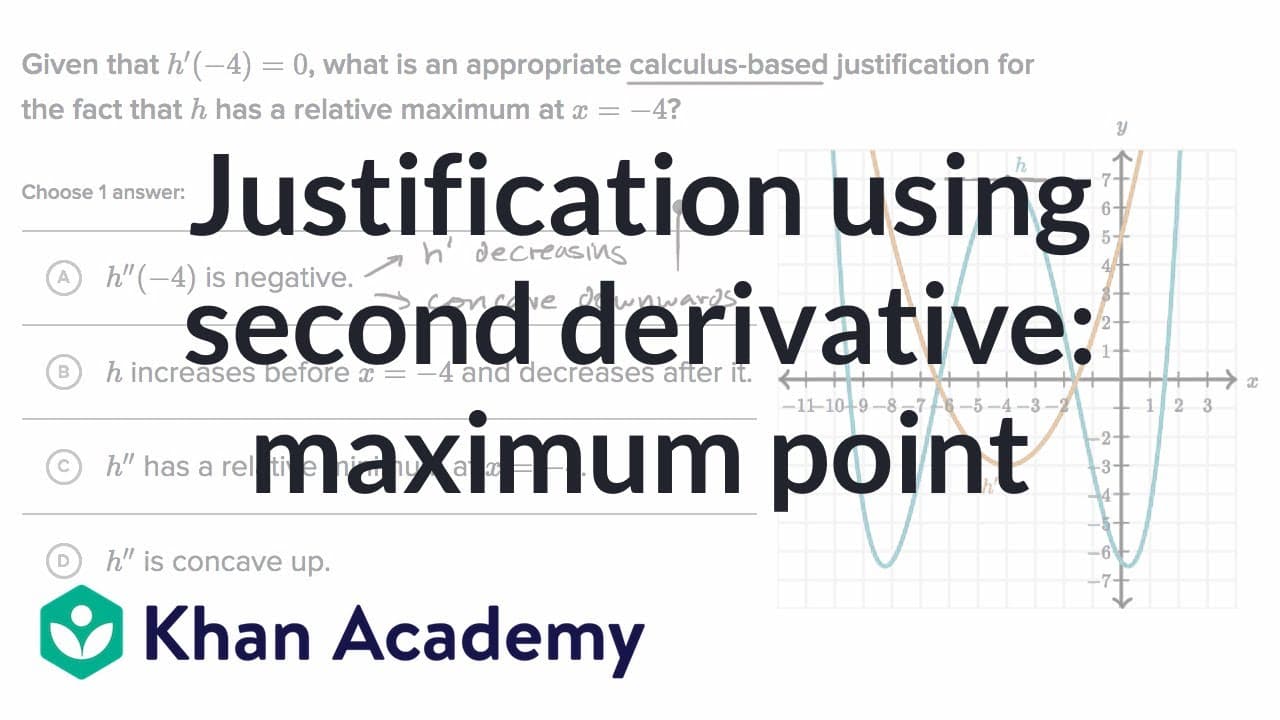
Given that h'(-4) = 0, the calculus-based justification for the relative maximum at x = -4 is that the second derivative at x = -4 is negative, indicating a concave downwards shape.
Transcript
- [Instructor] We're told that given that h prime of negative four is equal to zero, what is an appropriate calculus-based justification for the fact that h has a relative maximum at x is equal to negative four? So right over here, we actually have the graph of our function h. This is the graph y is equal to h of x. And we don't have graphed the fi... Read More
Key Insights
- ☺️ The second derivative being negative at x = -4 justifies the relative maximum.
- 👈 Increase before x = -4 and decrease after x = -4 support the presence of a maximum point.
- ❓ A relative minimum in the second derivative does not provide a justification for a relative maximum in the original function.
Install to Summarize YouTube Videos and Get Transcripts
Explore YouTube Video Summarizer or Get YouTube Transcript Extractor
Questions & Answers
Q: How can we justify that h has a relative maximum at x = -4 based on h'(-4) = 0?
The second derivative at x = -4 being negative suggests that h is concave downwards around x = -4, which is the shape of a relative maximum. The zero slope at x = -4 confirms this characteristic.
Q: Why can't we use the fact that h decreases after x = -4 as a calculus-based justification for the relative maximum?
Although h does decrease after x = -4, this justification is not calculus-based. It merely observes the behavior of the function without considering the derivatives.
Q: Can a relative minimum in the second derivative justify a relative maximum in the original function?
No, a relative minimum in the second derivative does not guarantee a relative maximum in the original function. The sign of the second derivative must be negative to ensure a concave downwards shape.
Q: How do we know that h'(-4) being concave upwards is not enough to justify a relative maximum?
The second derivative being concave upwards does not necessarily imply the original function is concave upwards. The positive second derivative could result in a monotonically increasing first derivative and a concave upwards shape for the function.
Summary & Key Takeaways
-
The graph represents the function h(x), with the second derivative graphed in orange.
-
Given that h'(-4) = 0, we are looking for a calculus-based justification for the relative maximum at x = -4.
-
The justification lies in the fact that the second derivative at x = -4 is negative, indicating a concave downwards shape and confirming the relative maximum.
Read in Other Languages (beta)
Share This Summary 📚
Summarize YouTube Videos and Get Video Transcripts with 1-Click
Try YouTube Summary with ChatGPT & Claude or YouTube Transcript Generator
Explore More Summaries from Khan Academy 📚



Summarize YouTube Videos and Get Video Transcripts with 1-Click
Try YouTube Summary with ChatGPT & Claude or YouTube Transcript Generator