Matrices as transformations of the plane | Matrices | Precalculus | Khan Academy
TL;DR
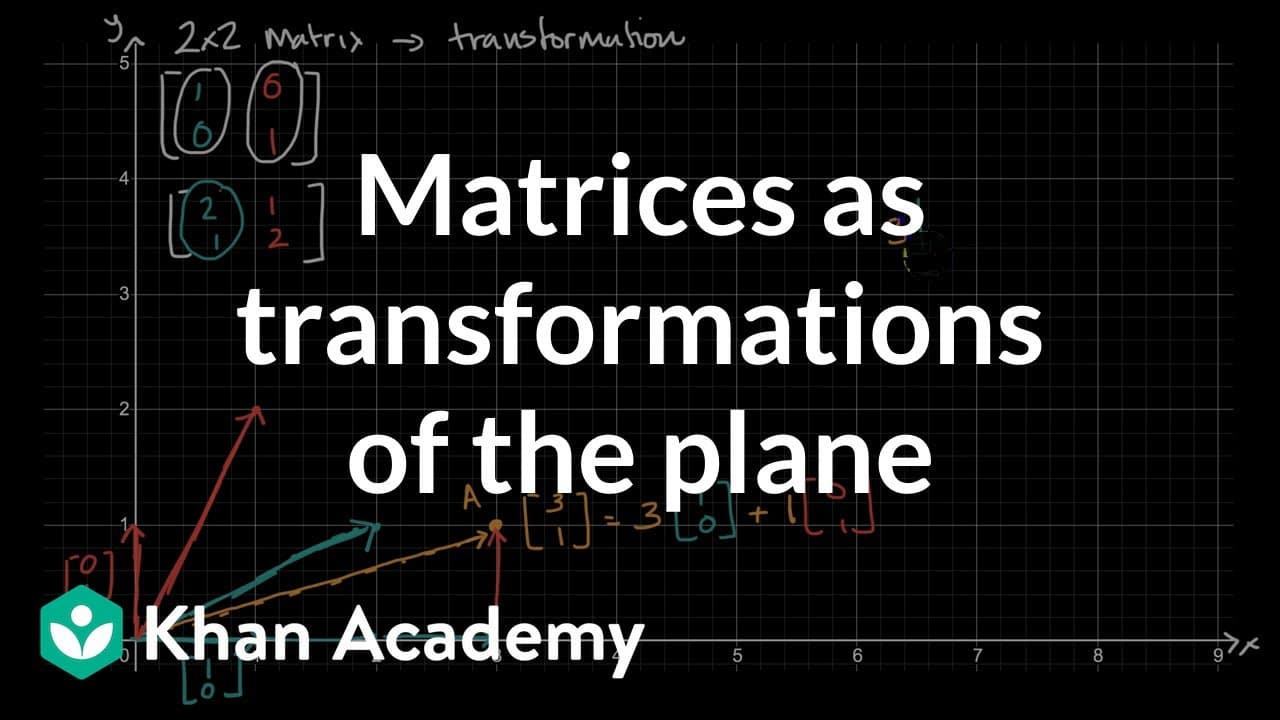
A 2x2 matrix can represent a linear transformation on a coordinate plane, allowing points to be mapped to new positions and preserving linearity.
Transcript
- [Instructor] In this video, we're going to explore how a two by two matrix can be interpreted as representing a transformation on the coordinate plane. So let's just start with some examples or some conceptual ideas. So the first conceptual idea is that any point on our coordinate plane here and this of course is our X axis and this is our Y axis... Read More
Key Insights
- 😥 Any point on a coordinate plane can be represented as a combination of the standard basis vectors: (1,0) and (0,1).
- 👶 A 2x2 matrix can represent linear transformations by mapping the standard basis vectors to new positions.
- 😥 The identity transformation matrix maps any point on the coordinate plane back to itself.
- 🫥 Linear transformations preserve linearity and map lines to new lines without introducing curves or zigzags.
- ❓ 2x2 matrices can be used to represent various linear transformations, including rotations, reflections, and dilations.
- 👻 Keeping the origin fixed allows for a wider range of linear transformations using 2x2 matrices.
- ✈️ Linear transformations can be used to transform geometric objects on a coordinate plane systematically.
Install to Summarize YouTube Videos and Get Transcripts
Explore YouTube Video Summarizer or Get YouTube Transcript Extractor
Questions & Answers
Q: How can any point on a coordinate plane be represented using two vectors?
Any point on a coordinate plane can be represented as a combination of two vectors: (1,0) that moves one unit in the X direction, and (0,1) that moves one unit in the Y direction.
Q: How does a 2x2 matrix represent a linear transformation?
In a 2x2 matrix, the first column represents the transformation of the (1,0) vector, and the second column represents the transformation of the (0,1) vector. The matrix maps these vectors to new positions.
Q: What is the purpose of the identity transformation matrix?
The identity transformation matrix (1,0;0,1) preserves the original positions of points on the coordinate plane. It maps any point back to itself without any change.
Q: Can linear transformations change lines into curves?
No, linear transformations preserve linearity. They map lines to new lines and do not introduce curves or zigzags. Linear transformations maintain the same properties of lines in the transformed space.
Summary & Key Takeaways
-
Any point on a coordinate plane can be represented as a combination of the standard basis vectors: (1,0) and (0,1).
-
A 2x2 matrix can be used to represent a linear transformation on the coordinate plane, with the first column indicating the transformation of the standard basis vectors.
-
Linear transformations preserve linearity and map points and lines to new positions while maintaining their properties.
Read in Other Languages (beta)
Share This Summary 📚
Summarize YouTube Videos and Get Video Transcripts with 1-Click
Try YouTube Summary with ChatGPT & Claude or YouTube Transcript Generator
Explore More Summaries from Khan Academy 📚



Summarize YouTube Videos and Get Video Transcripts with 1-Click
Try YouTube Summary with ChatGPT & Claude or YouTube Transcript Generator