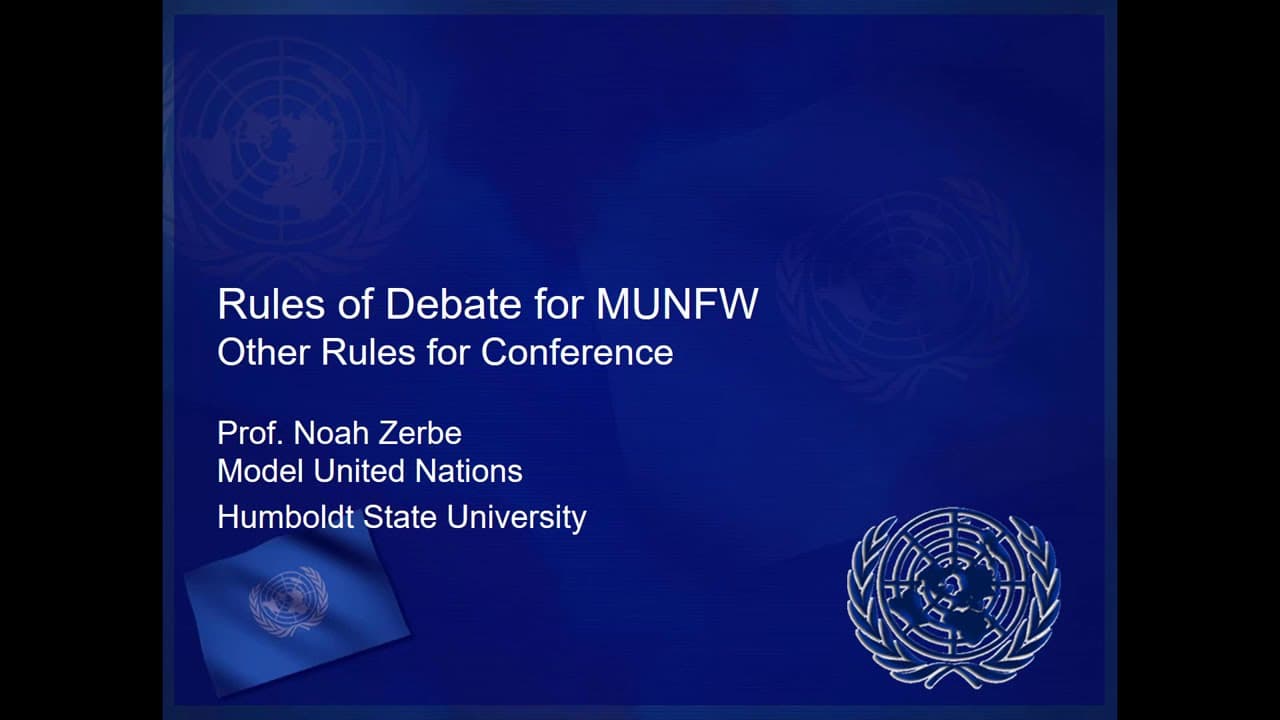
Model United Nations: Other Rules of Parliamentary Procedure for Conference
TL;DR
This video provides an overview of miscellaneous rules used in Model United Nations conferences, covering topics such as competence, right of reply, credentials, and security council priority.
Transcript
Hi. This is Noah Zerbe. Welcome back to my Model United Nations video series. This video series focuses on preparing students to be familiar with the rules of debate used at Model United Nations of the Far West, held every April in San Francisco. While the video focuses on the rules for MUNFW, the basic concepts of parliamentary procedur... Read More
Key Insights
- 🇺🇳 Understanding the miscellaneous rules in Model United Nations conferences is important, although they may not commonly be used.
- 👻 Competence allows the body to decide if a resolution or motion is within its jurisdiction.
- 🗯️ Right of reply grants the opportunity to respond to extraordinary attacks on personal or national dignity.
- ❓ Credentials can be challenged if there is a major discrepancy between a delegation's vote and policy.
- 👻 Provisional admission allows a delegation to retain rights while their credentials are being reviewed.
- ❓ Security Council priority prevents voting on items under consideration by the Security Council in other committees.
- 👻 Uniting for Peace resolution allows the Security Council to refer an item to the General Assembly if vetoed by permanent members.
- 🧘 Invitation to silent prayer or meditation is limited to specific moments during the opening and closing of General Assembly sessions.
Install to Summarize YouTube Videos and Get Transcripts
Explore YouTube Video Summarizer or Get YouTube Transcript Extractor
Questions & Answers
Q: What is P-13?
P-13, Competence, allows the body to decide through a two-thirds majority vote whether a particular resolution or motion falls under its jurisdiction. It does not apply to agenda items.
Q: When is a right of reply granted?
A right of reply may be granted by the chair if a delegate is egregiously and personally attacked by another delegate, but it should be reserved for exceptional attacks and not normal diplomatic exchanges. It is exclusively granted by the chair and not requested by the delegate.
Q: What is the purpose of P-31, Credentials?
P-31 allows a delegation to challenge the credentials of another delegation if there is a major discrepancy between their vote on a proposal and their actual policy. The challenge is reviewed by the Credentials Committee, and the General Assembly makes the final decision on credentialing.
Q: How does P-38, Invitation to Participate, work?
P-38 is used to invite observers, which can be organizations or non-member states, to participate in committee work. It requires a simple majority vote and limits the observers' participation to specific rules.
Summary & Key Takeaways
-
The video covers miscellaneous rules used in Model United Nations conferences, which may not be commonly used but are important to understand.
-
Rules discussed include competence, right of reply, credentials, provisional admission, security council priority, and invitation to silent prayer or meditation.
-
The video emphasizes the importance of understanding these rules but also notes that some rules, such as calling credentials, should be avoided to prevent unnecessary drama.
Read in Other Languages (beta)
Share This Summary 📚
Summarize YouTube Videos and Get Video Transcripts with 1-Click
Try YouTube Summary with ChatGPT & Claude or YouTube Transcript Generator
Explore More Summaries from Noah Zerbe 📚
Summarize YouTube Videos and Get Video Transcripts with 1-Click
Try YouTube Summary with ChatGPT & Claude or YouTube Transcript Generator