What Is Brewster's Angle and How Is It Calculated?
TL;DR
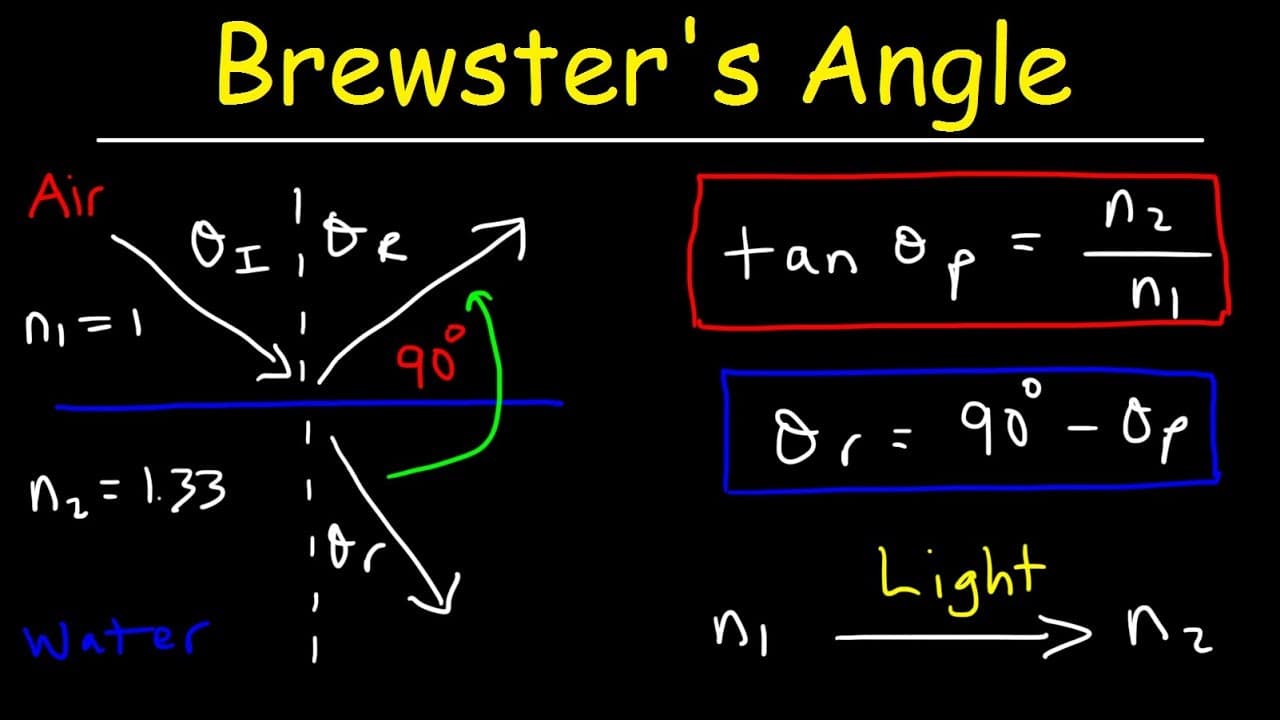
Brewster's angle is the specific incident angle where light reflected from a surface is completely polarized. It can be calculated using Brewster's law, which states that the tangent of the polarizing angle is equal to the ratio of the indices of refraction of the two mediums involved. The angle of refraction can also be determined, as it is complementary to Brewster's angle.
Transcript
in this video we're going to talk about how to calculate the brewster's angle and also the polarizing angle but first let's go over this problem light travels from air to water at what incident angle is the reflected light completely polarized well let's find out so let's say we have air on top and water beneath and so here we have the normal line ... Read More
Key Insights
- 🔺 The angle of incidence is equal to the angle of reflection according to the law of reflection.
- 🔺 At the polarizing angle, the reflected and refracted rays are at right angles to each other.
- 🫰 The polarizing angle can be calculated using Brewster's law, which relates it to the indices of refraction of the two media.
- 🔺 The angle of refraction can be calculated using Snell's law, which relates it to the angles of incidence and the indices of refraction.
- 🔺 The refracted angle and the polarizing angle are complementary, adding up to 90 degrees.
- 🔺 The polarizing angle and Brewster's angle are equivalent when air is involved.
- ✈️ Brewster's law can also be used to calculate the polarizing angle for light traveling from air to another medium.
Install to Summarize YouTube Videos and Get Transcripts
Explore YouTube Video Summarizer or Get YouTube Transcript Extractor
Questions & Answers
Q: What is the polarizing angle?
The polarizing angle is the incident angle at which the reflected light becomes completely polarized. It can be calculated using Brewster's law.
Q: How do you calculate the polarizing angle using Brewster's law?
The polarizing angle can be calculated using the formula tangent(theta_p) = n2/n1, where n2 and n1 are the indices of refraction of the two media involved.
Q: What is Brewster's law?
Brewster's law states that the tangent of the polarizing angle is equal to the ratio of the indices of refraction of the two media involved.
Q: How do you calculate the angle of refraction?
The angle of refraction can be calculated using Snell's law, which states that the ratio of the sines of the angles of incidence and refraction is equal to the ratio of the indices of refraction of the two media involved.
Summary & Key Takeaways
-
The polarizing angle is the incident angle at which the reflected light becomes completely polarized.
-
Brewster's law relates the polarizing angle to the indices of refraction of the two media involved.
-
Snell's law can be used to calculate the angle of refraction when light travels from one medium to another.
Read in Other Languages (beta)
Share This Summary 📚
Summarize YouTube Videos and Get Video Transcripts with 1-Click
Try YouTube Summary with ChatGPT & Claude or YouTube Transcript Generator
Explore More Summaries from The Organic Chemistry Tutor 📚



Summarize YouTube Videos and Get Video Transcripts with 1-Click
Try YouTube Summary with ChatGPT & Claude or YouTube Transcript Generator