How to Derive the Sum Formula for a Geometric Series
TL;DR
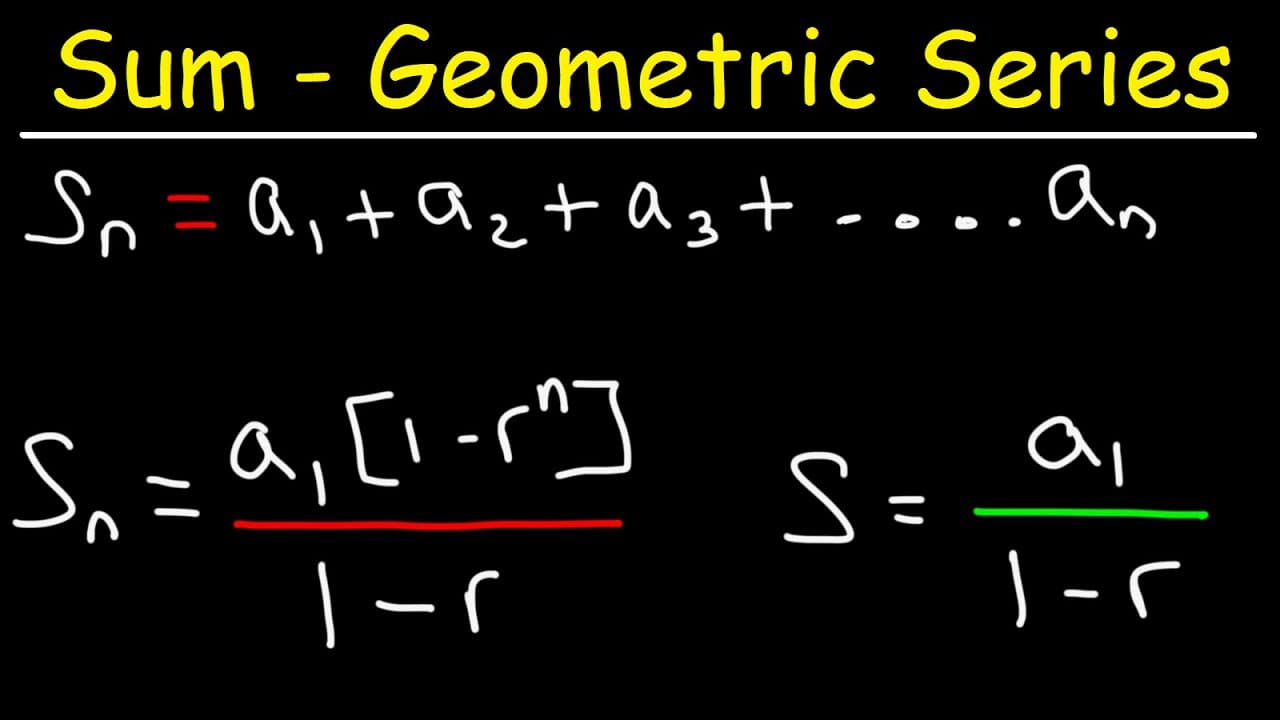
To derive the sum formula for a geometric series, use the formula for the sum of a finite series: S_n = a_1 * (1 - r^n) / (1 - r), where a_1 is the first term, r is the common ratio, and n is the number of terms. For an infinite geometric series with |r| < 1, the sum is S_infinity = a_1 / (1 - r).
Transcript
in this video we're going to talk about how to prove the formula that will help us to calculate the sum of a geometric series and there's two of them there's the finite geometric series and the infinite geometric series we're going to talk about how to prove the formula to calculate the sum of both of those so let's start with a geometric sequence ... Read More
Key Insights
- 🍉 Geometric sequences have a common ratio between terms, which can be used to calculate the terms of the sequence.
- 🍉 Adding the terms of a geometric sequence gives a geometric series.
- 🍹 The sum of a finite geometric series can be calculated using the formula A sub 1 multiplied by (1 - r^n) / (1 - r).
- 🥳 An infinite geometric series has a finite sum if the absolute value of the common ratio is less than one.
- 🍹 The sum of an infinite geometric series can be calculated using the formula A sub 1 / (1 - r).
- 🍉 The formula for the sum of a finite geometric series can be derived by multiplying and subtracting terms in the equation.
Install to Summarize YouTube Videos and Get Transcripts
Explore YouTube Video Summarizer or Get YouTube Transcript Extractor
Questions & Answers
Q: How can we calculate the sum of a geometric series?
To calculate the sum of a finite geometric series, you can use the formula A sub 1 multiplied by (1 - r^n) / (1 - r), where A sub 1 is the first term, r is the common ratio, and n is the number of terms.
Q: What is the condition for an infinite geometric series to have a finite sum?
An infinite geometric series has a finite sum when the absolute value of the common ratio is less than one. If the absolute value of the common ratio is greater than one, the series diverges and the sum is infinite.
Q: How can we derive the formula for the sum of a finite geometric series?
By manipulating the equation for the sum of a geometric series, we can multiply it by the common ratio and subtract it from the original equation, resulting in the formula A sub 1 multiplied by (1 - r^n) / (1 - r).
Q: What happens to the sum of an infinite geometric series as the number of terms approaches infinity?
As the number of terms in an infinite geometric series increases, the sum of the series approaches a constant value given by A sub 1 / (1 - r), where A sub 1 is the first term and r is the common ratio.
Summary & Key Takeaways
-
Geometric sequences have a common ratio between terms, and geometric series are obtained by adding these terms.
-
The formula to calculate the sum of a finite geometric series is A sub 1 multiplied by (1 - r^n) / (1 - r), where A sub 1 is the first term, r is the common ratio, and n is the number of terms.
-
For an infinite geometric series with an absolute value of the common ratio less than one, the sum is given by A sub 1 / (1 - r).
Read in Other Languages (beta)
Share This Summary 📚
Summarize YouTube Videos and Get Video Transcripts with 1-Click
Try YouTube Summary with ChatGPT & Claude or YouTube Transcript Generator
Explore More Summaries from The Organic Chemistry Tutor 📚

Summarize YouTube Videos and Get Video Transcripts with 1-Click
Try YouTube Summary with ChatGPT & Claude or YouTube Transcript Generator