Conditions for MVT: graph | Existence theorems | AP Calculus AB | Khan Academy
TL;DR
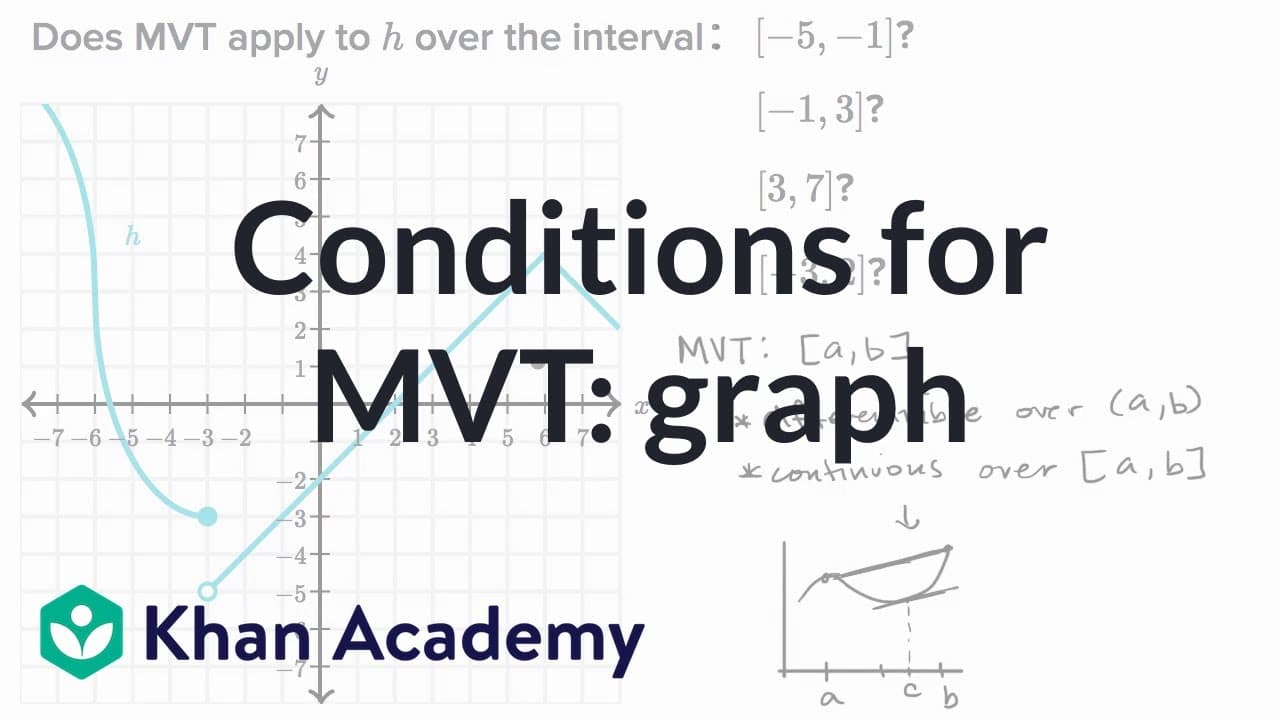
The Mean Value Theorem applies to certain intervals if the function is differentiable and continuous over the specified range.
Transcript
- [Instructor] So we're asked, does the mean value theorem apply to h over the interval? And they actually give us four different intervals here. So we should separately consider them. And this is the graph of y is equal to h of x. So pause this video and see, does the mean value theorem apply to h over any or all or some of these intervals? All ri... Read More
Key Insights
- ❓ The Mean Value Theorem applies when the function is differentiable and continuous over the specified interval.
- 🦔 Discontinuities and sharp edges in the function can prevent the application of the Mean Value Theorem.
- 😥 Linear functions satisfy the Mean Value Theorem for all points within the interval.
Install to Summarize YouTube Videos and Get Transcripts
Explore YouTube Video Summarizer or Get YouTube Transcript Extractor
Questions & Answers
Q: What are the conditions that need to be met to apply the Mean Value Theorem?
The function must be differentiable over the open interval and continuous over the closed interval. This ensures that there is a point where the derivative is equal to the average rate of change.
Q: How can we determine if the Mean Value Theorem applies to a specific interval?
We need to check if the function is differentiable and continuous over the interval. If there are discontinuities or sharp edges, the theorem does not apply.
Q: Can the Mean Value Theorem apply to intervals with a linear function?
Yes, if the function is linear over the interval, every point within the interval satisfies the condition of having the derivative equal to the average rate of change.
Q: What does it mean if the Mean Value Theorem does not apply to an interval?
If the theorem does not apply, it means that there is no point within the interval where the derivative is equal to the average rate of change. This could be due to discontinuities or lack of differentiability.
Summary & Key Takeaways
-
The Mean Value Theorem states that there exists a value within an interval where the derivative of the function is equal to the average rate of change.
-
To apply the Mean Value Theorem, the function must be differentiable over the open interval and continuous over the closed interval.
-
The theorem does not apply to intervals where there are discontinuities or sharp edges in the function.
Read in Other Languages (beta)
Share This Summary 📚
Summarize YouTube Videos and Get Video Transcripts with 1-Click
Try YouTube Summary with ChatGPT & Claude or YouTube Transcript Generator
Explore More Summaries from Khan Academy 📚



Summarize YouTube Videos and Get Video Transcripts with 1-Click
Try YouTube Summary with ChatGPT & Claude or YouTube Transcript Generator