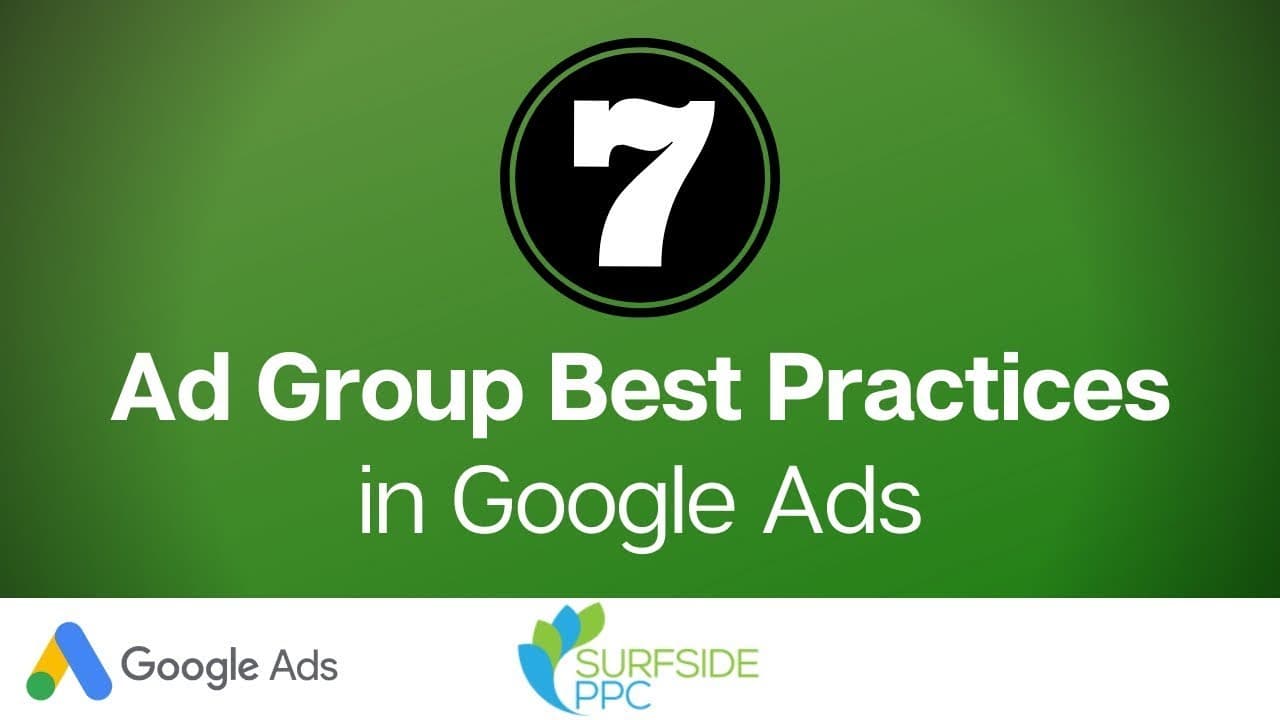
What Are the Best Practices for Google Ads Ad Groups?
TL;DR
The best practices for Google Ads ad groups include creating separate ad groups for each landing page to ensure targeted traffic, using fewer keywords per ad group to maintain organization, and avoiding crossover with negative keywords. Additionally, include multiple ads in each ad group for optimization, test different landing pages to determine effectiveness, utilize ad group level ad extensions for relevancy, and consolidate campaigns with more ad groups for streamlined management.
Transcript
what's up everyone welcome to the Surfside PPC youtube channel today I'm gonna be going over 7 ad group best practices for Google Ads so as you're setting up your ad groups some of the different things to keep in mind to make sure that you're getting the most out of your campaign so I'm gonna get right into it the two examples I'm gonna be using to... Read More
Key Insights
- 🫠 Ad groups should be organized around landing pages to ensure targeted traffic and better ad relevance.
- 🫠 Using fewer keywords per ad group helps maintain campaign organization and relevance.
- 🫠 Bids and negative keywords can be used to avoid crossover and ensure ad placement on the most relevant landing pages.
- 🥺 Multiple ads in each ad group allow for testing and optimization, leading to improved campaign performance.
- 📟 Testing different landing pages helps identify the most effective pages for conversions.
- 🫠 Ad group level ad extensions increase ad relevance and quality score.
- 🫠 Consolidating ad groups in fewer campaigns streamlines management and optimization.
Install to Summarize YouTube Videos and Get Transcripts
Explore YouTube Video Summarizer or Get YouTube Transcript Extractor
Questions & Answers
Q: Why is it important to create separate ad groups for each landing page?
Creating separate ad groups for each landing page helps to ensure that targeted traffic is sent to the most relevant landing page, improving the chances of conversions. It allows for more specific ad messaging and better alignment between keywords and landing page content.
Q: How many keywords should be used per ad group?
It is recommended to use fewer keywords per ad group to keep campaigns organized and relevant. This allows for better control over ad messaging and landing page matching. Ideally, each ad group should target one specific keyword or a closely related group of keywords.
Q: How can bids and negative keywords help avoid crossover in ad groups?
By setting slightly lower bids on broader keywords within an ad group and using negative keywords, you can avoid showing the same ads for similar but different search terms. For example, if a keyword is broad enough to match multiple variations, negative keywords can be used to exclude specific variations from being triggered.
Q: Why is it important to create multiple ads in each ad group?
Creating multiple ads in each ad group allows for A/B testing and optimization. Google Ads can prioritize and serve the ads that perform better over time, leading to improved campaign performance. It also allows for more targeted ad messaging by tailoring ads to specific keywords or query intent.
Q: How can different landing pages be tested in Google Ads?
By creating duplicate ads and directing traffic to different landing pages, you can test which landing page performs better in terms of conversions. This can help identify the most effective landing pages for specific offers or target audiences.
Q: What are ad group level ad extensions?
Ad group level ad extensions are extensions that are specific to an ad group, providing additional information or links in the ad. By using ad extensions relevant to the keywords in the ad group, ad relevance can be increased, leading to a higher quality score and potentially better ad performance.
Q: Is it better to create fewer campaigns with more ad groups?
Generally, creating fewer campaigns with more ad groups is recommended unless there are specific reasons for splitting campaigns, such as location targeting or budgeting. Consolidating ad groups within campaigns allows for better optimization and management of campaigns, as well as easier reporting and tracking.
Summary & Key Takeaways
-
Ad groups should be focused on landing pages, with a separate ad group for each landing page to ensure targeted traffic.
-
Use fewer keywords per ad group to keep campaigns organized and relevant.
-
Use bids and negative keywords to avoid crossover in ad groups and ensure ads are shown on the most relevant landing pages.
-
Create multiple ads in each ad group, including a combination of expanded text ads and responsive search ads, to optimize campaign performance.
-
Test different landing pages to determine which ones perform best in terms of conversions.
-
Utilize ad group level ad extensions to increase ad relevance and improve quality score.
-
Create fewer campaigns but with more ad groups, unless location targeting or budgeting necessitates separate campaigns.
Read in Other Languages (beta)
Share This Summary 📚
Summarize YouTube Videos and Get Video Transcripts with 1-Click
Try YouTube Summary with ChatGPT & Claude or YouTube Transcript Generator
Explore More Summaries from Surfside PPC 📚




Summarize YouTube Videos and Get Video Transcripts with 1-Click
Try YouTube Summary with ChatGPT & Claude or YouTube Transcript Generator